
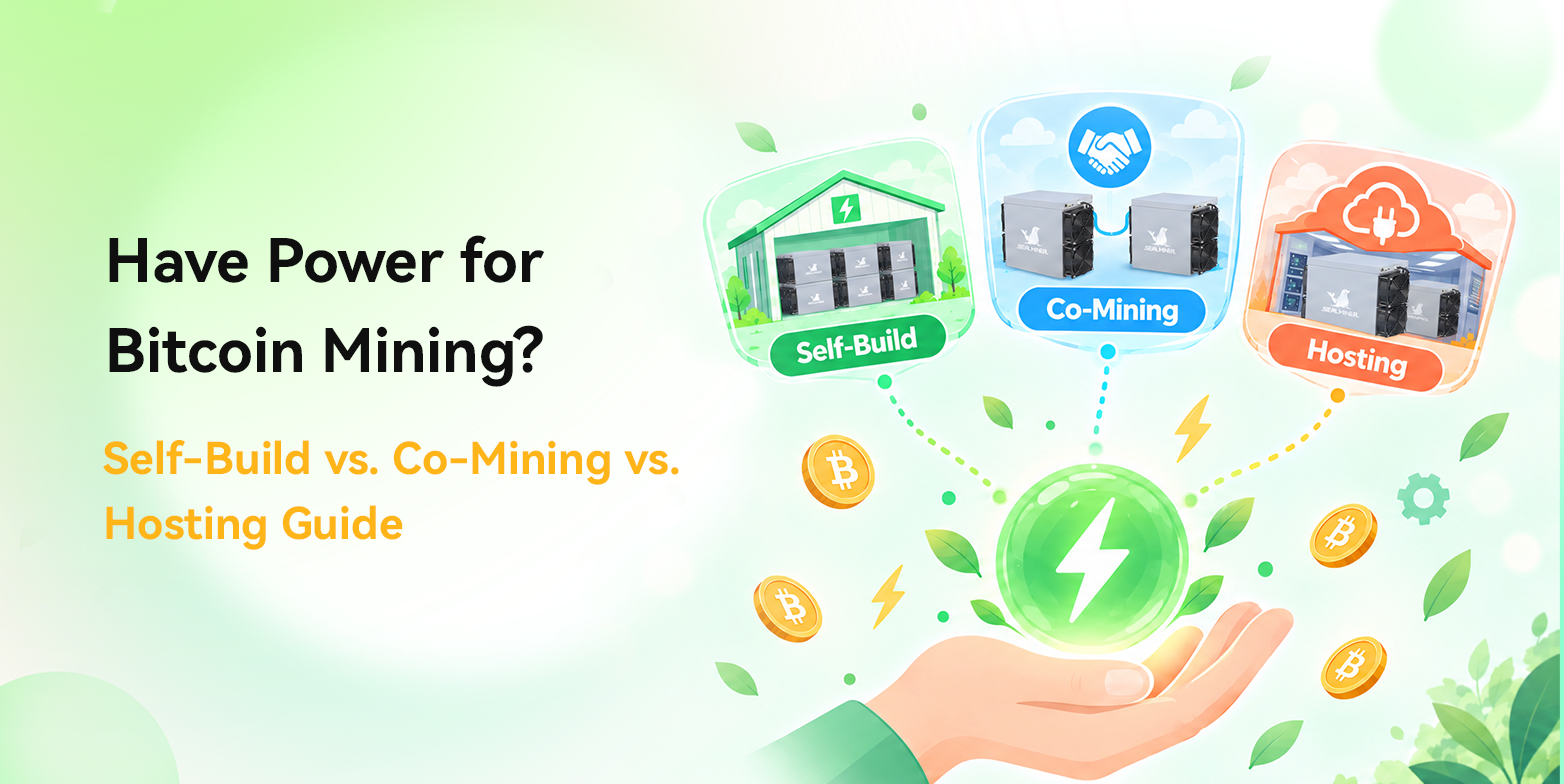
Have Power for Bitcoin Mining? Self-Build vs. Co-Mining vs. Hosting Guide
2026.10.08
Have cheap power or site resources for Bitcoin mining? Compare Self-Build, Co-Mining, and Hosting using a 10 MW case study. Analyze CAPEX, cash flow, and ROI to find the better mining model.
Having low-cost power, substation equipment, or an industrial site is a good starting point for bitcoin mining. But power on its own doesn't automatically turn into revenue. Resource owners generally have three paths: build and fund their own mine, partner with a mining company through co-mining, or offer their power and site to a mining company on a hosting basis.
The three models differ mainly in who pays for miner purchases, infrastructure, and day-to-day operations, and in who collects the mining revenue and bears the market risk. Using a 10 MW site as an example, this article compares the investment, cash flow, and payback period of each model to help resource owners decide based on their own situation.
Four Things to Check Before You Choose a Mining Model
Whichever model you pick, these four items determine whether the project can be done and whether it's worth doing.
| Requirement | What to Confirm | Why It Matters |
| Available capacity | Approved capacity that can be energized at any time, not planned capacity | Determines how many miners you can deploy. Without an approval for planned capacity, the project can't get off the ground |
| All-in power cost | Energy price + transmission and distribution fees + demand charges + taxes | Power cost determines whether miners can stay on during a market downturn |
| Supply stability | Number of outages per year, voltage fluctuations, participation in demand response | Downtime directly costs revenue, and frequent outages also raise failure rates for power supplies and hash boards |
| Interconnection and delivery timeline | Transformer and switchgear lead times; interconnection approval progress | Large transformer lead times typically run 128 weeks and small ones 3–6 months, so plan early |
Self-Build vs. Co-Mining vs. Hosting: Who Pays for What?
Co-mining is a partnership model in which the power resource owner provides the power, site, and infrastructure, the mining company provides miners and operations, and both sides account for project revenue together under a contract. It is not the same thing as the merged mining used by LTC and DOGE.
The table below shows how responsibilities, income, and risk are divided under each model.
| Comparison | Self-Build | Co-Mining | Hosting |
| Resource owner's contribution | Infrastructure + all miners | Mainly infrastructure; exact split set by agreement | Infrastructure |
| Who supplies the miners | Resource owner buys them | Partner supplies them, or both sides co-invest | Hosting customer |
| Who handles operations | Resource owner's own team | Partner handles miner and hashrate operations; resource owner handles power and site | Resource owner handles site and power; customer handles miners |
| Resource owner's income | All net mining revenue | Project net profit split by ratio | Hosting fees based on the customer's actual miner power use; income depends on customer renewals, on-time payment, and hosting capacity utilization |
| Bitcoin price and halving exposure | Borne entirely by the resource owner | Shared per the split ratio; fixed costs not in the project ledger fall on the resource owner | In a downturn, customers may pull out, default, or demand lower prices, and that risk passes indirectly to the resource owner |
| Operational control | Full autonomy | Joint control per contract; major decisions follow what's agreed | Resource owner controls the site, not the miners |
10 MW Case Study: Upfront Costs, Cash Flow, and Payback
Modeling Assumptions
- Site: 10 MW of usable capacity, with about 10% reserved for cooling, distribution losses, and networking equipment, leaving a miner load of about 9 MW
- Miners: 1,090 SEALMINER A3 Pro Hydro units (660 TH/s, 8,250 W, 12.5 J/TH), for total hashrate of about 719 PH/s and a miner load of about 8.99 MW. Miner price is $15/TH ($9,900 per unit)
- All-in power cost: $0.045/kWh; auxiliary load is assumed to be 5% of miner load
- Uptime: 95%. Pool fee: 2%. Other O&M costs: $0.005/kWh (staff, repairs and spare parts, networking, routine maintenance, etc.)
- Hashprice: $35.89/PH/day (as of Oct. 31, 2026; source: Hashrate Index)
- Power consumption: Metered miner electricity consumption is about 205 MWh/day (8.99 MW × 24 hours × 95%). Total site usage, including auxiliary load, is about 215 MWh/day
In real projects, some costs may be fixed expenses that must be paid even when miners are offline. Hashprice is assumed to stay constant before the halving. Taxes, financing costs, and equipment residual value are not included.
Initial Investment
| Item | Contents | Amount ($M) |
| Transformers and power distribution | Main transformer, step-down transformers, switchgear, circuit breakers, busbars, and cables | 1.5–2.0 |
| Cooling system | Water-cooled containers, closed-circuit cooling towers, pumps | 0.5–0.8 |
| Networking, security, civil works, and interconnection | Dual fiber lines, switches, monitoring, site civil works, and interconnection work | 0.3–0.6 |
| Total infrastructure | About $230–340K per MW | 2.3–3.4 |
| Miners | 1,090 units × $9,900 | 10.79 |
| Total self-build | Infrastructure + miners | 13.09–14.19 |
Infrastructure costs vary widely depending on whether you use air or liquid cooling and whether you build new or retrofit an old plant. A real project needs its own estimate based on interconnection conditions, existing facilities, cooling approach, and construction scope.
Annual Cash Flow
| Item | Calculation | Per Day ($) | Per Year ($M) |
| Mining revenue | 719.4 PH × $35.89 × 95% uptime × 98% (after pool fee) | About 24,040 | About 8.77 |
| Power cost | 215 MWh (incl. auxiliary load) × $0.045/kWh | About 9,690 | About 3.54 |
| Other O&M | 215 MWh × $0.005/kWh | About 1,080 | About 0.39 |
| Net cash flow | Revenue − power cost − O&M | About 13,270 | About 4.85 |
Resource Owner Payback Periods by Model
The biggest factor affecting payback is the extent to which hashprice recovers after the 2028 halving. After the halving, some higher-cost miners may shut down if mining revenue no longer covers their operating costs, potentially reducing network hashrate. Bitcoin's price and transaction fees will also shift. So instead of giving a single answer, this article assumes the project runs for 15 months before the halving, then models post-halving cash flow under three scenarios:
| Scenario | Post-Halving Hashprice ($/PH/day) | vs. Pre-Halving | Hosting Capacity Utilization | Annual Net Cash Flow After Halving ($M) |
| Conservative: bitcoin price and network hashrate unchanged | About 17.9 | About 50% | 70% | About 0.46 |
| Moderate: hashprice partially recovers | About 25 | About 70% | 90% | About 2.18 |
| Optimistic: hashprice recovers more | About 28 | About 78% | 100% | About 2.92 |
The moderate and optimistic scenarios show how sensitive payback is to hashprice. They are not forecasts of bitcoin's price or of hashprice.
Resource owner income under each model is calculated as follows:
- Self-build: All of the project's net cash flow.
- Co-mining: Project net cash flow × the resource owner's share. Power and O&M costs are charged to the project ledger at cost, so the resource owner earns no markup on power. The partner does not get priority recovery of miner costs.
- Hosting: Customer miner power use × hosting rate − (total site power use × power cost + O&M costs). The customer pays only by the miner meter, so auxiliary load power and O&M costs fall on the resource owner. Half of O&M costs are treated as fixed and must be paid even when slots sit empty.
The resulting payback times are shown below:
| Model | Resource Owner's Investment ($M) | Annual Pre-Halving Net Cash Flow ($M) | Conservative Payback | Moderate Payback | Optimistic Payback |
| Self-build | 13.09–14.19 | About 4.85 | Over 10 years | About 4.5–5.0 years | About 3.7–4.0 years |
| Co-mining: 30% share | 2.3–3.4 | About 1.45 | About 4.8 to over 10 years | About 2.0–3.7 years | About 1.8–3.1 years |
| Co-mining: 40% share | 2.3–3.4 | About 1.94 | About 1.2–6.6 years | About 1.2–2.4 years | About 1.2–2.1 years |
| Hosting: $0.06/kWh | 2.3–3.4 | About 0.56 | About 6.0–9.3 years | About 4.5–6.8 years | About 4.1–6.1 years |
| Hosting: $0.065/kWh | 2.3–3.4 | About 0.94 | About 3.1–5.0 years | About 2.6–4.0 years | About 2.5–3.6 years |
The table shows that how fast a self-built mine pays back depends on how much hashprice recovers after the halving.In the moderate scenario, the estimated payback period is approximately 4.5–5 years. In the conservative scenario, it takes more than 10 years. So don't stop at the moderate case. Also check whether the project can stay cash-flow positive in the conservative scenario and whether your funding can last until hashprice recovers. If the miners still have resale value at the end of the project, payback time shortens accordingly.
With co-mining, the resource owner invests less and gets paid back faster, but the outcome is very sensitive to contract terms. At a 40% owner share, payback is about 1.2–2.4 years in the moderate and optimistic scenarios. At a 30% share, it can exceed 10 years in the conservative scenario. The split ratio can't be set by investment amount alone. It also depends on the value of the power resource, operating responsibilities, contract term, and risk sharing. Which costs can be deducted first, and whether the partner gets priority recovery of miner costs, will also change the result directly.
Hosting doesn't expose the resource owner directly to mining revenue swings, but its income is still affected by the halving. Before the halving, the A3 Pro Hydro earns about $0.117 of mining revenue per kWh. In the conservative scenario that drops to about $0.059, below the $0.06–0.065/kWh hosting fee, so customers running miners of similar efficiency would lose money and may ask for lower rates, pull out, or fall behind on payments. In the moderate scenario, revenue is about $0.082 per kWh, and customers still have room to profit.
How the 2028 Bitcoin Halving Could Affect Project Economics
The 2028 halving will cut the bitcoin block subsidy from 3.125 BTC to 1.5625 BTC. Because transaction fees are also part of miners' income, the actual drop in hashprice won't necessarily be exactly 50%. Whether a project can get through the halving comes down to whether hashprice stays above the break-even point:
Break-Even Hashprice = (Daily Power Cost + Daily O&M Cost) ÷ (Total Hashrate × Uptime × (1 − Pool Fee)) = (9,690 + 1,080) ÷ (719.4 × 95% × 98%) ≈ $16.1/Ph/Day
In other words, even in the conservative scenario (about $17.9/PH/day), the project still generates positive cash flow of roughly $1,260 per day. The more hashprice recovers, the faster the payback.
Higher efficiency means better halving resilience. At the same 9 MW load, switching to the 9.45 J/TH SEALMINER A4 Ultra Hydro delivers about 32% more hashrate and can lower break-even hashprice to about $12/PH/day. (This is based on theoretical hashrate only. Real-world economics also depend on the price, delivery, and deployment costs of the new equipment.)
Co-mining and hosting can reduce some of the resource owner's risk, but they can't eliminate it. Co-mining lowers the capital the resource owner needs to buy miners, and hosting reduces dependence on mining revenue. But under either model, the resource owner may still owe fixed costs such as demand charges, minimum power purchase obligations, financing interest, site maintenance, security, and insurance. And once the project ends or a customer leaves, whether the substation equipment and site can be put to another use depends on equipment compatibility, permit conditions, and new power demand. These assets may not continue generating revenue once the mining project ends.
7 Things to Check Before Signing a Co-Mining Contract
- How is the power price set? Is it a fixed all-in price or does it float with the market? Who pays the demand charges and transmission and distribution fees?
- Which costs can be deducted first? List power, O&M, spare parts, and insurance item by item and agree on caps, so that unclear cost definitions don't squeeze your share.
- Does the partner recover hardware costs first? Does the partner recoup miner costs before profit sharing starts? This directly lengthens the resource owner's payback time.
- Performance metrics and responsibilities: Define power availability, miner uptime, and similar metrics clearly, including how they're measured and who is responsible. Agree on how downtime from different causes is handled and which compensation terms apply.
- Reconciliation and audit rights: Can the resource owner view the mining pool dashboard, power meter data, and the project ledger? Is settlement monthly or weekly?
- Shutdown mechanism: Who decides to stop mining when revenue falls below the shutdown power price? How are power costs and fixed fees shared during downtime?
- Expiration and exit: Who owns the miners, transformers, and other assets when the contract expires or ends early? Is there a buyback or renewal option?
Which Mining Model Fits Your Resources?
| If You… | Consider First |
| Have ample capital of your own (not reliant on high leverage), a high-voltage electrical and miner repair team, and the ability to withstand revenue swings around the halving | Self-build |
| Have low-cost power and a site but don't want to spend tens of millions of dollars on miners up front, have no in-house operations team, and want to go live quickly, using a partner's miner supply and deployment experience to shorten the build | Co-mining |
| Want less direct dependence on mining revenue, and can screen customers, manage contract performance, and handle empty slots | Hosting |
| Face high power costs (for example, above $0.06/kWh) | Run a post-halving stress test in the calculator first, then decide whether to proceed |
Calculate Returns Using Your Own Site Data
The calculations above are just one set of demonstration assumptions. Plug your actual capacity, all-in power cost, and miner model into Bitdeer's mining calculator to work out cash flow before and after the halving. Then check any co-mining proposal against the contract terms one by one. That will give you a much more reliable basis for your decision.
Note: The calculations in this article are based on demonstration assumptions and are intended only to illustrate the method. They do not represent industry-average costs or Bitdeer's actual pricing, and they are not a commitment of returns or investment advice. Scenarios with longer payback periods do not account for miner replacement, equipment lifespan, or contract expiration. Actual returns depend on bitcoin price, network difficulty, equipment delivery and performance, power costs, uptime, and contract terms. Equipment prices and specifications are subject to order confirmation.
*Information provided in this article is for general information and reference only and does not constitute nor is intended to be construed as any advertisement, professional advice, offer, solicitation, or recommendation to deal in any product. No guarantee, representation, warranty or undertaking, express or implied, is made as to the fairness, accuracy, timeliness, completeness or correctness of any information, or the future returns, performance or outcome of any product. Bitdeer expressly excludes any and all liability (to the extent permitted by applicable law) in respect of the information provided in this article, and in no event shall Bitdeer be liable to any person for any losses incurred or damages suffered as a result of any reliance on any information in this article.


