

Litecoin and Dogecoin Merged Mining: Earnings, Pool Payouts, and Performance
2026.10.15
Learn how Litecoin and Dogecoin merged mining works, how PPS, FPPS, and PPLNS payouts differ, and how to evaluate earnings and reconcile pool data.
Litecoin (LTC) and Dogecoin (DOGE) both use Scrypt proof of work. With merged mining, a compatible pool can use the same Scrypt work to mine on both networks. Miners do not need separate computing resources for each coin, but the chains retain independent block rewards, difficulty levels, and pool settlement rules. Operators need to know how the pool accepts shares, allocates rewards, settles balances, and pays them out, as well as what a changing DOGE share means for combined revenue.
To get a clearer picture of mining performance, compare pool settlement reports with on-site hashrate, electricity consumption, and wallet records. Together, these records help you distinguish changes in the revenue mix from changes in equipment performance or payout timing.
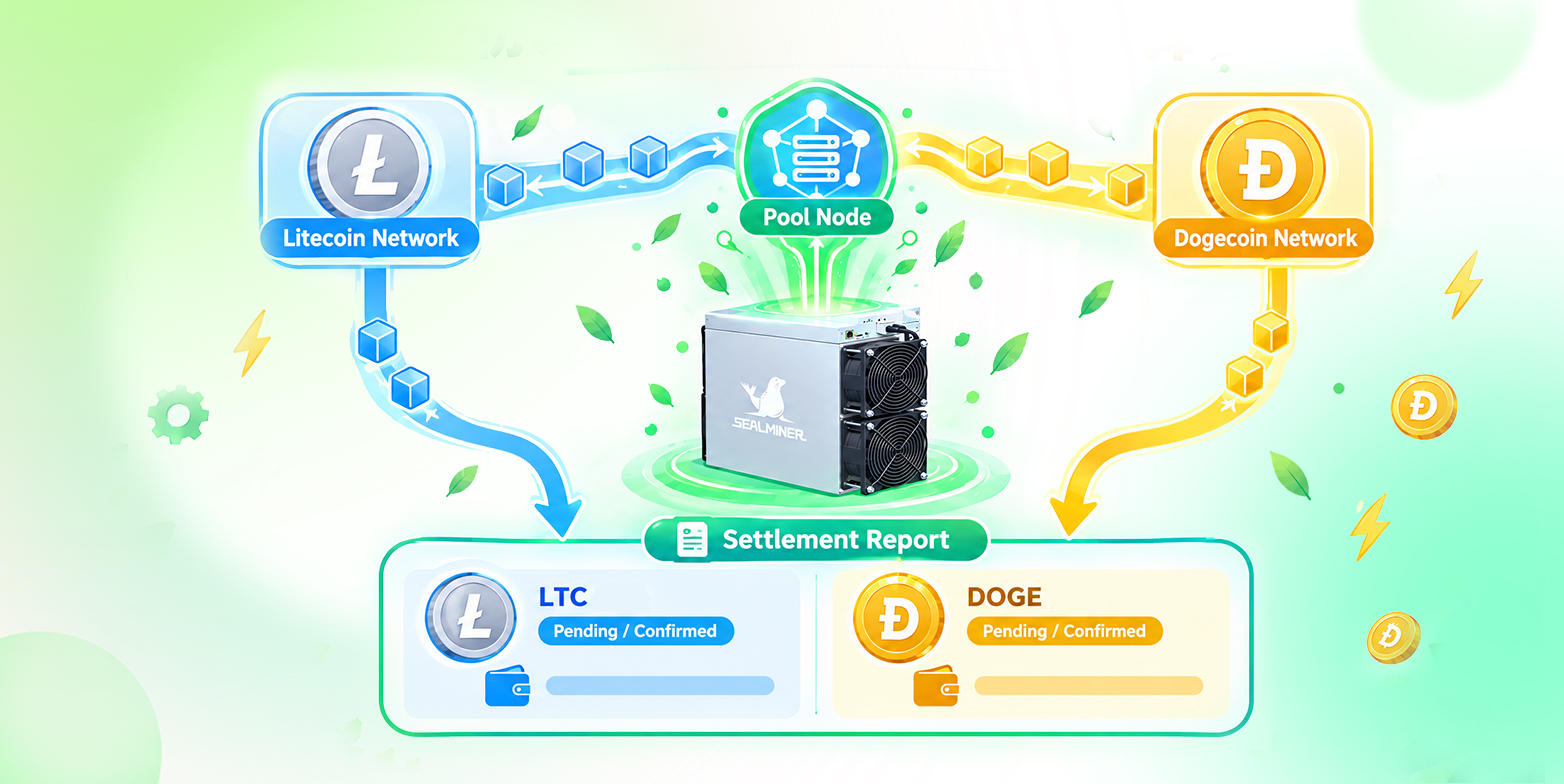
How Merged Mining Revenue Is Generated
Merged mining lets a compatible pool direct work from one Scrypt mining operation toward both networks. Miners do not need two separate hardware fleets, but LTC and DOGE still produce blocks under their own difficulty targets and reward rules. The pool calculates each miner's payout according to its settlement method. Using the same hashrate for both networks does not mean earning equal rewards from LTC and DOGE.
AuxPoW Connects the Two Networks
Dogecoin uses auxiliary proof of work (AuxPoW). In simplified terms, a compatible pool prepares Litecoin work that carries the data needed to build a Dogecoin block candidate. If the resulting proof also meets DOGE's difficulty target, the pool can submit it to the Dogecoin network for validation. Miners do not need to run a separate set of computing resources for DOGE. Each chain still validates blocks and issues rewards independently, and the pool records and distributes LTC and DOGE earnings under its own rules.
Before mining, check whether the pool reports valid shares, estimated rewards, settled amounts, and payout status separately for LTC and DOGE. Some pools show only a combined figure. If yours does not provide a breakdown, reconcile the combined settled value with actual payout records instead of estimating each coin's share yourself.
How the LTC and DOGE Revenue Mix Changes Over Time
Each coin's contribution to combined revenue changes with its price, network difficulty, block rewards, pool fees, and payout rules. DOGE may account for a large share in one settlement period, but that result applies only to that period. It is not a fixed ratio or a long-term forecast.
Calculate DOGE's revenue share by fiat value:
DOGE Revenue Share = Settled DOGE Value / (Settled LTC Value + Settled DOGE Value)
If DOGE represents 75% of the combined settled value in a given period, combined revenue is more sensitive to changes in DOGE's price and other factors affecting DOGE-denominated earnings. This ratio shows where revenue is concentrated; it does not indicate which coin is more worthwhile to mine.
For example, suppose the combined fiat value of LTC and DOGE rewards is 100 units in one settlement period: 75 from DOGE and 25 from LTC. If the DOGE price rises by 20% while the DOGE quantity, LTC price, and other conditions stay the same, the DOGE portion increases by 15 units (75 × 20%), bringing the combined value to about 115 units. If the DOGE price falls by 20%, the combined value falls to about 85 units.
How to Read Pool Data and Verify Mining Earnings
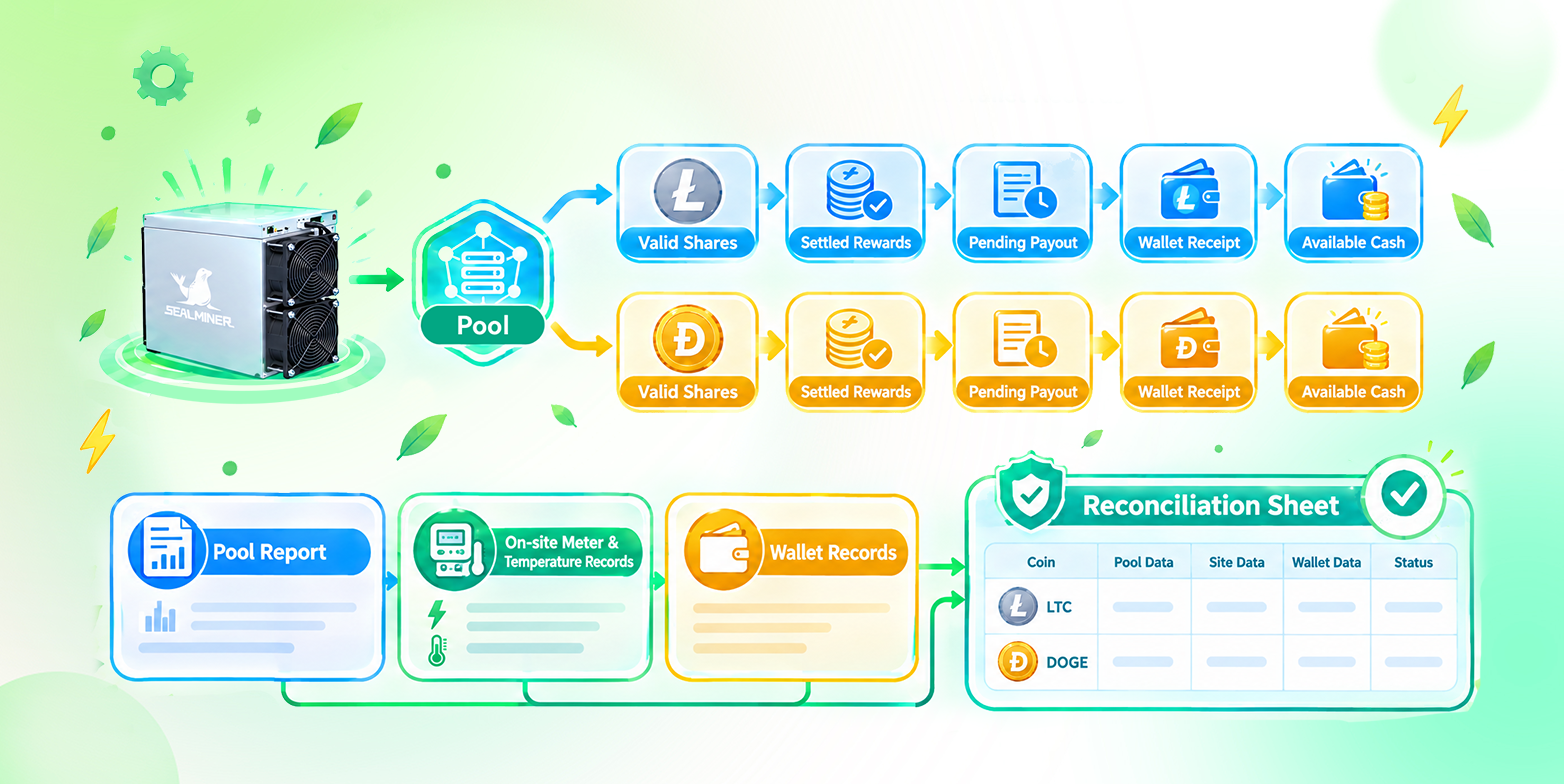
Pool dashboards often show shares, rewards, and payouts as separate statuses. Confirm the payout method, then distinguish estimated rewards, settled rewards, pending payouts, wallet receipts, and funds available to spend. This keeps a dashboard estimate from being mistaken for cash on hand.
Check How Your Mining Pool Pays Rewards
Common payout methods include PPS, FPPS, and PPLNS. They differ in how rewards are calculated, how much short-term volatility miners bear, and whether transaction fees are included. Definitions, fee coverage, rates, and payout rules vary by pool, so check the documentation for the pool you plan to use.
PPS (Pay Per Share) calculates payouts from valid shares submitted and accepted under the pool's rules. Payouts are generally smoother because the pool absorbs some short-term block-finding volatility. Check how the pool defines a valid share, along with its fee rate, fee treatment, and payout conditions.
FPPS (Full Pay Per Share) usually builds on PPS and adds distributable transaction fees according to the pool's rules. Because pools may define “full” differently, confirm how transaction fees are calculated and which fee rates apply.
PPLNS (Pay Per Last N Shares) distributes the pool's actual block revenue based on valid shares submitted during a specified window. Payouts are generally more volatile and may be affected by block discovery, uptime, and when you switch pools. Check the window length, fee treatment, and payout cycle.
| Payout Method | How Rewards Are Calculated | Short-Term Volatility |
| PPS | Pays a preset reward for valid shares | Usually lower |
| FPPS | Builds on PPS and includes transaction fees according to pool rules | Usually lower |
| PPLNS | Distributes actual block revenue based on shares submitted during a specified window | Usually higher |
For merged mining, a pool may use different reporting and payout rules for LTC and DOGE. Some dashboards list the coins separately, while others show only a combined figure. Fees, payout thresholds, and settlement schedules may also differ by asset. Before comparing pools, confirm that both coins are included in the distribution, how fees are handled, and whether dashboard figures are estimates or settled amounts.
Accepted Shares: How Much Work Did the Pool Record?
Your miner dashboard shows the miner's locally estimated hashrate. The pool estimates effective hashrate from the shares it receives and validates. Network latency, rejected or stale shares, connection interruptions, and miner restarts can cause the pool reading to fall below the local reading. A short-term gap can occur during normal reporting variation.
If local hashrate stays stable while effective hashrate remains materially lower across several reporting windows, check the network connection, pool endpoint, miner logs, and temperature records. Look for trends and for rejected or stale shares changing at the same time. Treat a brief fluctuation as a signal to continue monitoring rather than as a standalone finding.
Estimated vs. Settled Mining Rewards
Estimated pool rewards change with submitted shares, network conditions, and the settlement cycle, so use them to track trends. For operating reconciliation, record rewards as settled only after the pool completes settlement. If the dashboard shows a fiat estimate, note the valuation time and price source so you do not add values from different points in time.
Pool Payouts: From Settlement to Available Cash
Settled rewards may not have reached your wallet yet, and crypto received in your wallet may still need to be converted before it becomes available as cash. Minimum payout thresholds, payout batches, wallet-address status, pool deductions, on-chain confirmation time, and the later conversion process all affect when funds become available. For reconciliation, record settled rewards, pending payouts, wallet receipts, and amounts converted to cash separately. Do not deduct fees twice or count rewards below the payout threshold as available cash.
Use these fields to build a merged-mining reconciliation sheet. Keep pool reports, wallet transaction records, and on-site meter readings as supporting records:
| Reconciliation Field | What to Record | Purpose |
| Settlement period | Start and end time, including time zone | Use a consistent comparison window |
| LTC rewards | Coin amount, valuation time, and converted fiat value | Calculate LTC revenue |
| DOGE rewards | Coin amount, valuation time, and converted fiat value | Calculate DOGE's revenue share |
| Pool fees | Rate, asset charged, and time of deduction | Avoid counting fees twice |
| Payout status | Settled, pending payout, received in wallet, and converted to cash, with timestamps | Separate settled amounts, wallet receipts, and available cash |
| Miner data | Effective hashrate, uptime, and rejected-share rate | Explain revenue differences |
Four Metrics to Monitor Merged Mining Performance
Changes in merged-mining revenue can come from rewards or prices on either network, as well as from miner hashrate, electricity use, and payout timing. Track these factors separately to see whether a variance comes from the revenue mix or equipment operation.
LTC and DOGE Revenue Mix
A change in revenue mix can show which asset accounts for more income, but it does not by itself indicate a change in miner efficiency. Also track effective hashrate, uptime, settled revenue per unit of electricity, and actual wallet receipts.
Gap Between Effective and Local Hashrate
The miner dashboard reports locally estimated hashrate, while effective hashrate reflects the work the pool receives and accepts. Short-term differences can result from reporting windows, network latency, or share variance. If the gap continues to widen over several periods, review rejected and stale shares, uptime, the network connection, and temperature logs. Effective hashrate and power efficiency can provide additional context about operating performance.
Settled Revenue per Unit of Electricity
For a settlement period, convert settled LTC and DOGE revenue using the same valuation time, add the values, and divide the total by the actual electricity consumed by miners and required auxiliary systems within the same meter boundary. If the pool reports only a combined settled value, use it as reported rather than creating an artificial split. When comparing operating modes, keep the valuation time, reporting period, uptime, and meter boundary consistent.
Payout Lag and Time to Available Cash
This metric measures the time between reward settlement and receipt in the wallet. The interval can vary with the minimum payout amount, address status, pool notices, fee records, and on-chain confirmations. To estimate cash available for electricity or operating expenses, also track how long conversion and withdrawal take after funds reach the wallet.
Adjust Operating Modes as Merged Mining Revenue Changes
Choose an operating mode based on settlement results, available power, and cooling conditions. The highest hashrate shown on a dashboard does not by itself identify the right mode for your operation. For example, the SEALMINER DL1 Air offers three operating modes: Low Power Mode (up to 20.5 GH/s at approximately 136 J/GH), Normal Mode (approximately 25 GH/s at 149 J/GH), and High Hashrate Mode (approximately 26.5 GH/s at 160 J/GH). Compare hashrate and power draw alongside actual uptime, shares accepted by the pool, and settled LTC and DOGE revenue. Use the delivered equipment and on-site measurements for your final assessment.
When to Use Low Power Mode
Consider testing Low Power Mode when power capacity is constrained, ambient temperatures are high, or settled revenue per unit of electricity falls. Compare the electricity saved with the reduction in settled LTC and DOGE value over the same reporting period, and confirm that effective hashrate and uptime remain stable after the change.
After changing modes, keep the new setting in place for at least one complete settlement cycle. Record actual power draw, effective hashrate, rejected and stale shares, uptime, and the settled value of both coins. This comparison shows whether electricity savings offset the reduction in rewards. Local GH/s alone cannot answer that question.
Include Temperature Data in Air-Cooling Deployments
Air-cooling Scrypt miners can be affected by hot-air recirculation, dust, and intake temperature. Higher temperatures may cause throttling, restarts, or more rejected shares, although these effects may not appear in settlement data right away. During troubleshooting, log intake and chip temperatures, fan status, restart times, and effective hashrate on the same timeline. Check whether the changes coincide before inspecting airflow, filtration, and power delivery.
During commissioning, verify power circuits, PDUs, cabling, and airflow paths one by one. When earnings or effective hashrate changes, check on-site factors such as uptime, temperature, and power delivery before reviewing pool rewards and settlement rules.
Choose a Miner for Your Operating Conditions
The value of merged mining should ultimately be validated against actual pool settlements and on-site operating results. When choosing a miner, consider your available power, cooling conditions, and preferred operating mode. If you are evaluating a Scrypt miner with multiple power modes, learn more about SEALMINER DL1 Air.
*Information provided in this article is for general information and reference only and does not constitute nor is intended to be construed as any advertisement, professional advice, offer, solicitation, or recommendation to deal in any product. No guarantee, representation, warranty or undertaking, express or implied, is made as to the fairness, accuracy, timeliness, completeness or correctness of any information, or the future returns, performance or outcome of any product. Bitdeer expressly excludes any and all liability (to the extent permitted by applicable law) in respect of the information provided in this article, and in no event shall Bitdeer be liable to any person for any losses incurred or damages suffered as a result of any reliance on any information in this article.


