
Dogecoin Mining in 2026: How to Improve Effective Hashrate and Power Efficiency
Jun 30th, 2026
Low Dogecoin mining returns? See how hashrate, power modes, cooling, power delivery, and pool settings influence efficiency and net profitability.
Competition in Dogecoin mining is no longer just about comparing spec sheets. For operators, profitability depends on how efficiently equipment converts electricity into pool-accepted shares over time. A short-term increase in dashboard hashrate means little if it also brings higher power draw, rising temperatures, more rejected shares, or repeated disconnects.
This is one of the most overlooked parts of Dogecoin mining optimization. Miners often jump straight to overclocking or higher-hashrate hardware before checking whether cooling, power delivery, or network instability is already reducing usable output. A better workflow starts with a stable operating baseline, identifies where losses occur, and only then considers changing operating modes or raising performance limits.
Three Hashrate Metrics That Matter
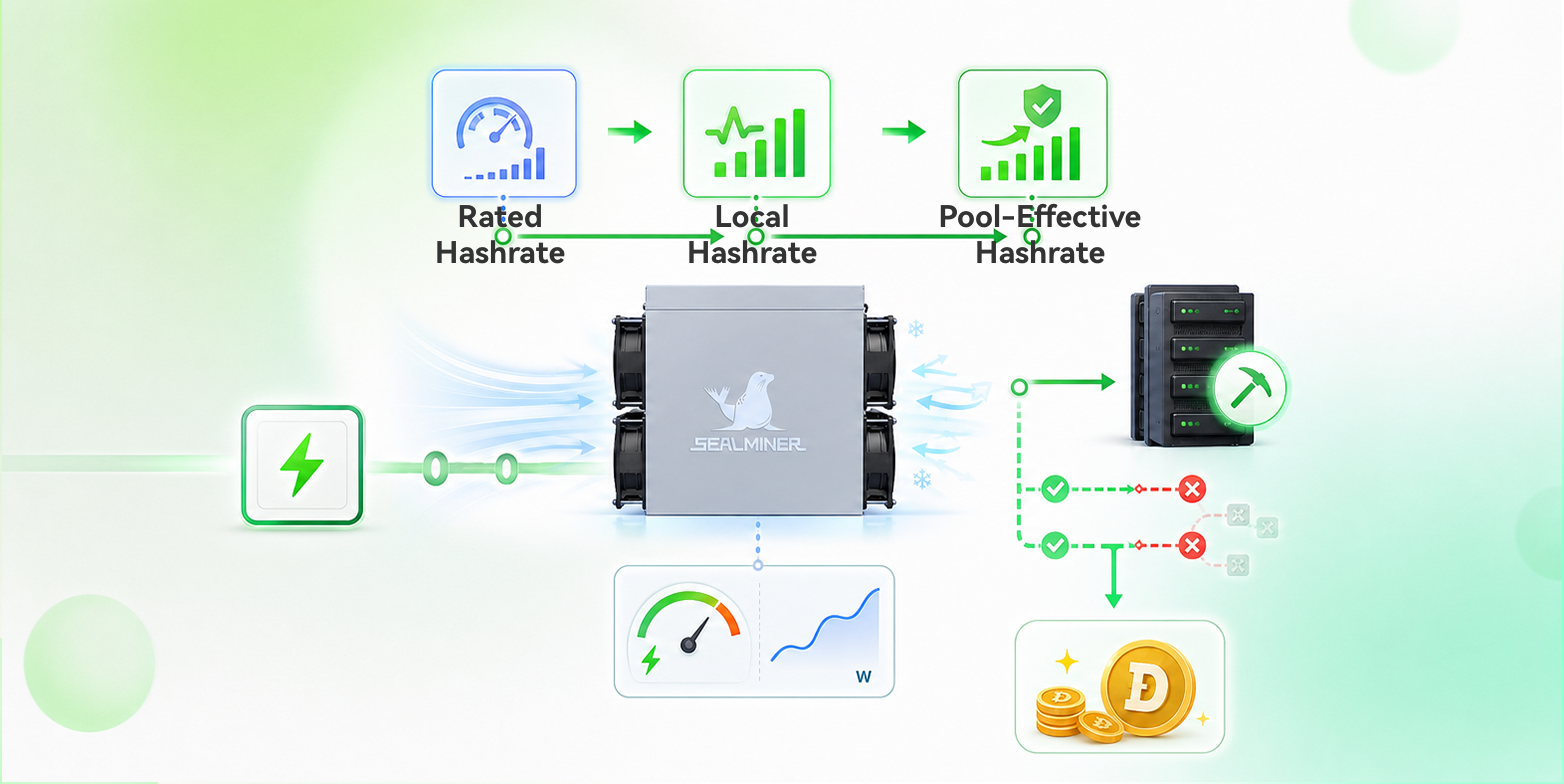
Dogecoin runs on Scrypt, so it requires ASIC miners built specifically for that algorithm. Bitcoin miners process SHA-256; despite their much larger TH/s figures, they cannot mine DOGE. The two miner types execute different workloads, so comparing GH/s directly with TH/s is misleading. Before selecting hardware, review how Scrypt and SHA-256 differ at the hardware level. Once the algorithm fit is clear, operators also need to separate rated hashrate, local hashrate, and pool-effective hashrate because they represent design capacity, live machine performance, and revenue-producing output, respectively.
Rated hashrate is the manufacturer-specified performance measured under defined temperature, voltage, and operating-mode conditions. It represents the machine’s design capacity. A miner rated at 25 GH/s, for example, is expected to reach that level under standard test conditions, not at every site or at every moment of operation.
Local hashrate is the real-time or average output shown in the miner dashboard. It reflects the computation currently being completed by the chips and hashboards. Operating mode, intake-air temperature, chip temperature, input voltage, firmware status, dust buildup, and hardware faults can all affect this figure. When local hashrate remains below the rated value, thermal throttling, hashboard faults, power input, and airflow should be checked first.
Pool-effective hashrate is estimated from the valid work shares a mining pool receives during a defined reporting window. It is therefore more closely tied to revenue-producing performance. Normal local output does not guarantee a similar pool result: network latency, brief disconnects, stale shares, and rejected shares can all reduce accepted work. Over time, pool-effective hashrate provides a clearer view of whether electricity is turning into payable mining revenue.
Short-term gaps among these three figures do not automatically indicate a fault. Rated hashrate serves as a reference point, local output moves with short-term workload and thermal conditions, and pool-effective hashrate also reflects the reporting window and share variance. A single snapshot rarely supports a reliable conclusion. Compare averages across at least one complete pool reporting cycle.
When pool-effective hashrate stays well below average local hashrate, investigate network stability, pool endpoint distance, reject rate, and share-submission performance. When local and pool-reported output decline together, cooling, power delivery, or hardware condition becomes the more likely source.
J/GH adds the cost dimension to the comparison. GH/s measures computational output, while J/GH measures the energy required to produce each unit of hashrate. More hashrate does not automatically create stronger margins. A higher operating level delivers economic value only when the added pool-effective output generates more revenue than the incremental electricity, cooling, and equipment costs.
The operational goal, then, is not simply to push dashboard hashrate toward or beyond the rated figure. The real objective is to turn stable local output into pool-accepted work at a controlled power cost.
Why Higher Hashrate Can Reduce Profitability
As an ASIC miner approaches its performance ceiling, each additional unit of hashrate becomes more expensive to produce. Raising frequency increases computational throughput, chip power draw, and thermal load at the same time. Fans spin faster, sensitivity to intake temperature and power quality rises, and small network or hardware weaknesses become more visible.
Take the air-cooling SEALMINER DL1 Air as an example. Its three operating modes reflect different operational trade-offs:
| Mode | Hashrate (GH/s) | Efficiency (J/GH) | Power Draw (kW) | Best Use Cases |
| Low Power | 20.5 | 136 | 2.79 | High electricity rates, hot weather, or limited power capacity |
| Normal | 25 | 149 | 3.725 | Routine operation, commissioning, and baseline testing |
| High Hashrate | 26.5 | 160 | 4.24 | Low electricity rates, ample cooling, and strong margins |
Moving from Normal Mode to High Hashrate Mode raises theoretical hashrate by about 6% while power draw climbs roughly 14%. At an electricity rate of $0.06/kWh, daily power cost increases by around $0.75. Added Litecoin (LTC) and Dogecoin (DOGE) revenue must first cover that bill, then cover the added cost of heavier fan load, greater downtime risk, and accelerated hardware wear. For a mining farm, these settings are not simple speed tiers. They are operating tools for matching hardware behavior to electricity prices, ambient temperature, and cash-flow conditions.
Low Power Mode trades some of the machine’s total hashrate for lower energy use per unit of output and less heat to remove. In high-cost power markets, or when network revenue per unit of hashrate declines, this setting often keeps the machine cash-flow positive for longer. Operating mode belongs in a seasonal and market-based schedule, not a year-round fixed setting. For a deeper comparison, see Mining Machine Operation Modes: Differences and Use Cases.
Why Establish a Baseline Before Increasing Hashrate?
Without baseline data, tuning quickly becomes guesswork. Before switching modes, run the miner at standard settings through one full pool reporting cycle and record average local hashrate, pool-effective hashrate, reject rate, uptime, ambient temperature, and actual power draw.
This data set helps identify where performance is being lost. When local and pool-reported hashrate fall together, focus on temperature, fans, hashboards, and power input. When local output stays normal while the pool result remains low, network conditions, endpoint latency, or share-submission errors move to the top of the list.
Differences among hashboards also matter. One board that consistently trails the others often points to localized power delivery, connectivity, thermal, or hardware issues. Increasing system-wide frequency at that stage usually magnifies the fault. A disciplined tuning process restores expected performance first and adds load only after the machine reaches a healthy baseline.
How Cooling and Power Delivery Affect Real-World Efficiency
Rated efficiency comes from controlled test conditions; real-world results depend on whether the site can maintain a comparable environment. In Normal Mode at 3.725 kW, a SEALMINER DL1 Air releases roughly 12,700 BTU of heat per hour. That load is manageable for one unit, but a 20-machine deployment quickly turns it into a major site-level thermal challenge.
The goal of a cooling system is not simply more airflow, but a clear, one-way air path. Cool intake air needs consistent access to the miners, while hot exhaust must leave the work area without recirculating. When hot exhaust returns to the intake side, fan speed and chip temperature rise, followed by frequency throttling, hardware alerts, or invalid shares.
Air-cooling hardware offers flexible deployment for small fleets, well-ventilated sites, or rapid installation. Hydro-cooling systems support higher density and more stable temperatures, but they also require pumps, piping, filtration, and water-quality management. The right architecture depends on fleet size, climate, noise constraints, and maintenance capability. For a broader comparison, see Air Cooling vs. Hydro Cooling Miner: Which One Fits You Best?
Power delivery determines whether performance lasts. Voltage fluctuations, undersized power distribution units (PDUs), hot connectors, or circuits operating near full load often lead to restarts and lost hashrate. Before enabling High Hashrate Mode, the electrical system needs headroom for the added load, higher ambient temperature, and line losses. Hashrate gains built on overload risk rarely offset the cost of downtime or equipment damage.
How the Mining Pool Affects What You Actually Earn
A mining pool does not change the physical hashrate ceiling of the chips, but it affects how much existing output is accepted and paid. Beyond pool fees, compare server proximity, rejected-share rates, payout thresholds, settlement methods, and the stability of backup endpoints.
Dogecoin and Litecoin usually form a combined revenue stream through merged mining. The same Scrypt workload contributes to validation on both compatible networks without a second, equivalent power load for DOGE. Actual earnings still depend on how the pool calculates and distributes rewards across LTC, DOGE, and other supported Scrypt assets.
High network latency can cause a miner to submit outdated work after a new block appears, creating stale shares. Brief outages keep the machine drawing power while it waits for new jobs. A stronger setup connects to a geographically close primary endpoint, configures an independent backup, and compares reject rate and effective hashrate across matching reporting windows instead of judging a pool by a single day of revenue.
Payout setup also affects cash availability. When using an exchange deposit address, verify the asset, network, and minimum deposit threshold in advance. A pool payout below the exchange’s crediting minimum remains unavailable until the balance meets the threshold, even after the pool has sent the funds.
How to Tell Whether an Optimization Worked
A successful change improves hashrate, electricity economics, and stability together. One useful metric is:
Effective Hashrate Efficiency = Average Pool-Effective Hashrate ÷ Average Actual Power Draw
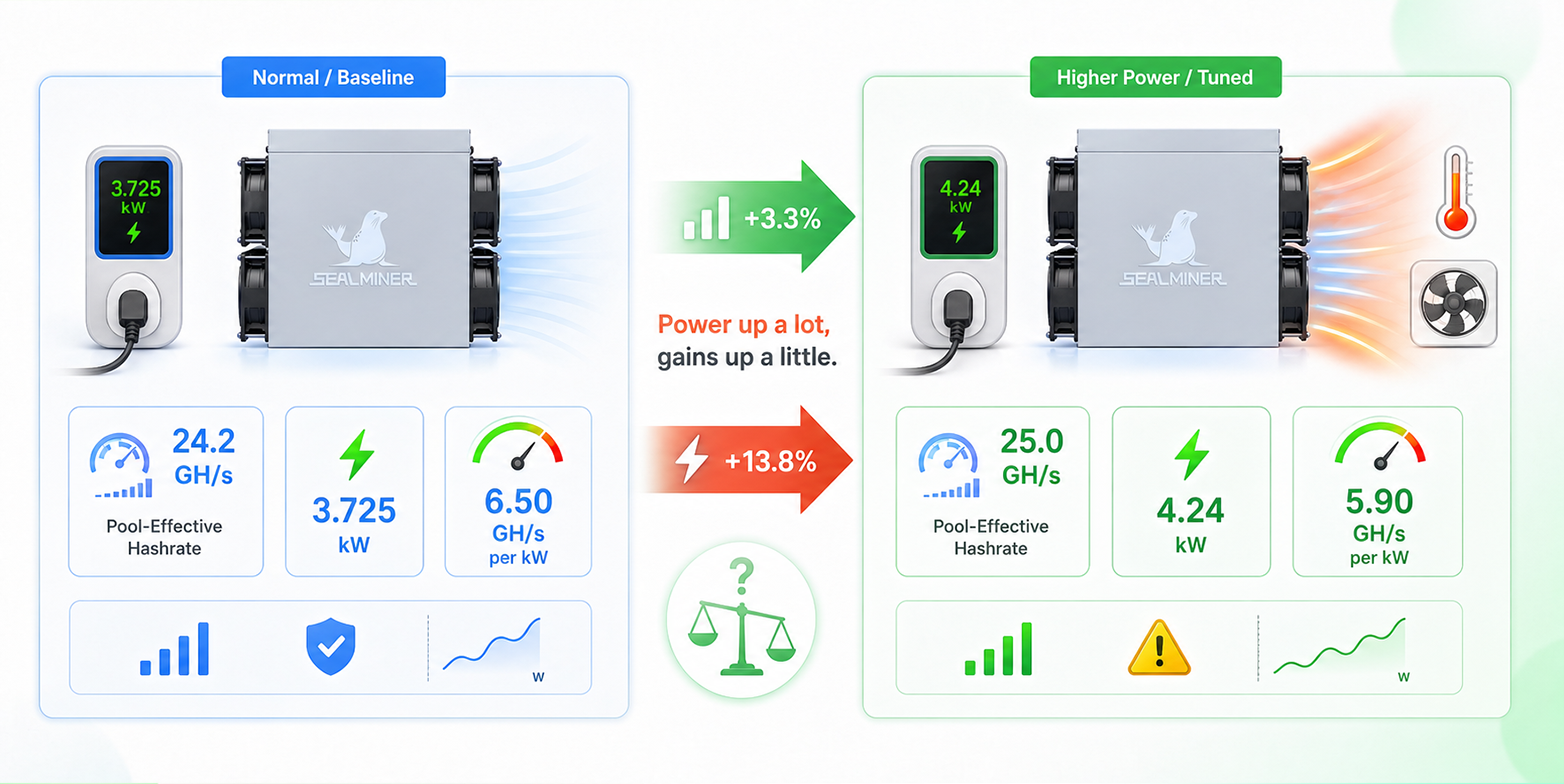
For example, a miner averaging about 24 GH/s of pool-effective hashrate at about 3.7 kW delivers roughly 6.5 GH/s per kW. If tuning raises power draw to 4.24 kW while effective hashrate reaches only 25 GH/s, the ratio falls to roughly 5.9 GH/s per kW. In this case, the additional electricity does not produce a proportional increase in paid work.
Another core metric is:
Daily Net Earnings = LTC and DOGE Revenue − Electricity Cost − Pool Fees − Operations, Maintenance, and Downtime Costs
Suppose High Hashrate Mode lifts local hashrate by 6%, but pool-effective hashrate rises only 3% while power draw increases 14%. The extra electricity is not translating efficiently into accepted, paid work. By contrast, clearing an obstructed airflow path or repairing a network issue often raises pool hashrate and uptime without changing power consumption. Those improvements usually create more durable value.
When testing different configurations, keep the pool, reporting window, and environmental conditions as consistent as possible. Stress-test the result against higher electricity rates, lower coin prices, rising network difficulty, and summer heat. A setting that barely breaks even under current conditions lacks the margin of safety required for sustainable operation.
Optimize for Effective Output per Kilowatt-Hour
Dogecoin mining optimization starts by recovering lost hashrate. Poor cooling, unstable networking, and fluctuating power delivery often waste output that can be restored without increasing chip load, making these fixes more durable and less risky.
Normal Mode provides a reliable operating baseline. High electricity prices, hot weather, or constrained power capacity favor an evaluation of Low Power Mode. High Hashrate Mode deserves long-term use only when the added settled revenue covers incremental electricity, heat-removal requirements, and equipment stress.
The final assessment comes down to three questions: Did pool-effective hashrate increase? Did power cost remain under control? Did the miner continue to run reliably? An improvement across all three dimensions confirms that the optimization created lasting value. To view the latest specifications, operating modes, and availability information for the SEALMINER Scrypt miner, visit the Bitdeer shop.
*Information provided in this article is for general information and reference only and does not constitute nor is intended to be construed as any advertisement, professional advice, offer, solicitation, or recommendation to deal in any product. No guarantee, representation, warranty or undertaking, express or implied, is made as to the fairness, accuracy, timeliness, completeness or correctness of any information, or the future returns, performance or outcome of any product. Bitdeer expressly excludes any and all liability (to the extent permitted by applicable law) in respect of the information provided in this article, and in no event shall Bitdeer be liable to any person for any losses incurred or damages suffered as a result of any reliance on any information in this article.


