

How to Choose Bitcoin Mining Hardware: From Energy Efficiency to Upgrade Timing
2026.08.24
Need better Bitcoin mining hardware? Learn how to evaluate energy efficiency, hashrate, TCO, repair support, and upgrade timing for smarter decisions.
Bitcoin miners are advancing faster than ever, and the differences on spec sheets are increasingly clear. Yet once procurement begins, the real challenge is not finding the model with the highest headline specifications. It is determining whether the hardware investment can generate more usable hashrate and cash flow over the planned holding period. For an ASIC miner, purchase price, energy efficiency, batch performance, repair turnaround, and room for future upgrades all shape long-term value. The same machine can lead to different investment decisions under different electricity prices, financing costs, and revenue cycles.
A more effective way to choose Bitcoin mining hardware is therefore to define the procurement objective first and compare device specifications second. This guide builds a screening method around five factors: hashrate per unit of power, capital efficiency, real-world delivery against specifications, repair availability, and the opportunity cost of delaying an upgrade. Together, they provide a clearer view of procurement returns and long-term operating results.
Identify the Input That Most Limits Returns
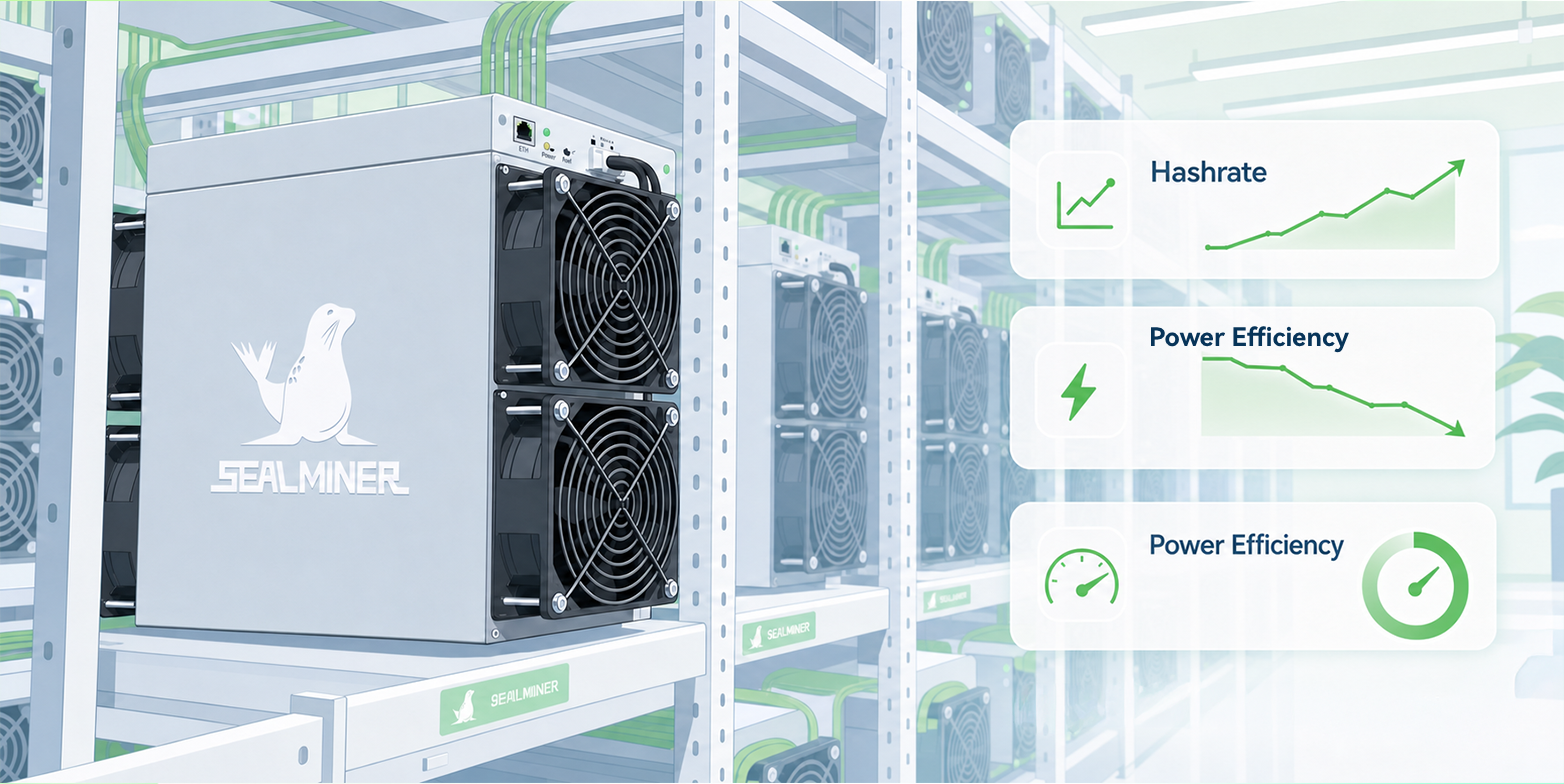
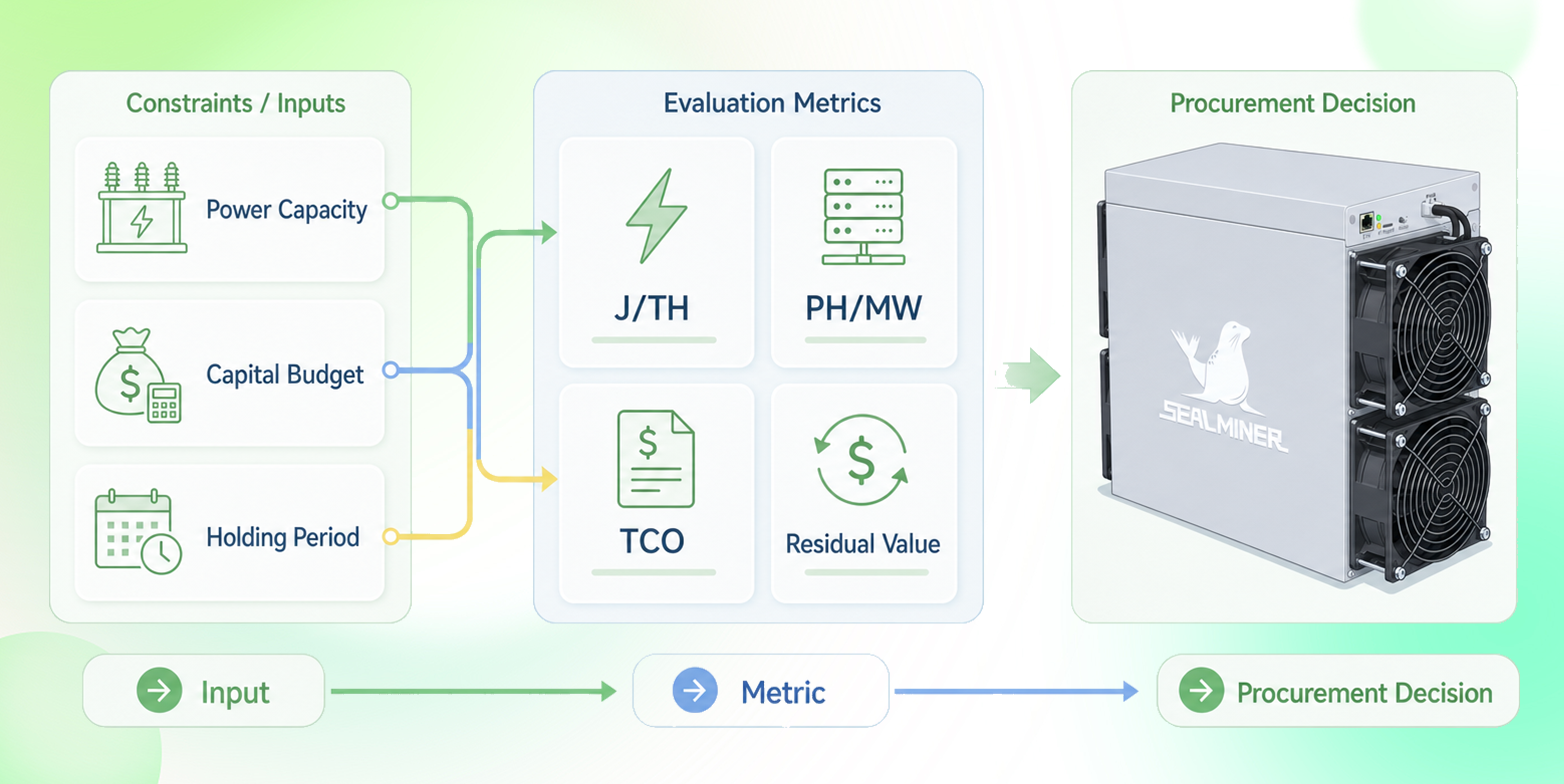
J/TH is useful for an initial screen because it shows how much energy a miner theoretically needs to produce 1 TH/s of hashrate. For a procurement decision, however, you also need to identify which constraint actually limits returns: capital, available power, the holding period, or operating capacity. At the project level, efficiency ultimately comes down to how much stable hashrate and sustainable cash flow each unit of the scarcest input can produce.
The priority metric should change with the primary procurement constraint:
| Primary Constraint | Metrics to Prioritize | Procurement Question |
| Power capacity | PH/MW and J/TH | Can fixed power capacity produce more effective hashrate? |
| Capital budget | Cost per unit of hashrate and total cost of ownership (TCO) | Can the equipment premium be recovered during the holding period? |
| Holding period | Residual value and upgrade frequency | Is the hardware likely to be replaced sooner than planned? |
| Operations | Typical repair turnaround time (RTAT), dead on arrival (DOA), and spare-parts path | Could downtime losses offset the efficiency advantage? |
| Revenue volatility | Hashprice stress testing | Does the hardware retain operating headroom in a downside scenario? |
This step turns a device ranking into a procurement priority. The specifications have not changed, but the comparison shifts from which machine is stronger to which machine is worth deploying under the current conditions.
The Capacity Value of J/TH at Power Constrained Sites
Put simply, a lower J/TH means less electricity is required to produce 1 TH/s of hashrate. At a mining site with a fixed power allocation, that allows more working hashrate to fit behind the same meter. Power capacity stays the same, while total hashrate increases.
Consider a miner rated at 10 J/TH. Producing 1 PH/s requires about 10 kW, so 1 MW (= 1,000 kW) of capacity can support roughly 100 PH/s. With hardware rated at 8 J/TH, the same 1 MW can support about 125 PH/s, a 25% increase in hashrate.
For a power-constrained mining site, the value of a lower J/TH is therefore not limited to lower electricity costs. The same power allocation can support more revenue-generating hashrate.
Consider the SEALMINER A4 models, which use a standard 2U hydro-cooling architecture:
| Model | Rated Hashrate | Energy Efficiency | Typical Power | Deployable Hashrate Per MW |
| A4 Pro Hydro | 680 TH/s | 10.9 J/TH | 7,412 W | Approx. 91.7 PH/s |
| A4 Ultra Hydro | 886 TH/s | 9.45 J/TH | 8,372.7 W | Approx. 105.8 PH/s |
Based on a theoretical efficiency conversion, 9.45 J/TH allows the same 1 MW of capacity to support about 15.4% more hashrate than 10.9 J/TH. This result compares device-level capacity only; it is not the same as final profitability. The more useful procurement question is how much incremental cash flow that additional hashrate can generate during the target holding period, and whether it is enough to cover the higher equipment investment.
Balancing Purchase Price and Total Cost With a Fixed Budget
Purchase price determines the initial cash outlay, but it does not represent the true cost of the hardware over its entire holding period. When comparing candidate miners, evaluate the price difference, cumulative electricity costs, repair-related downtime losses, switching costs, and expected residual value over the same time horizon.
For a simple example, assume an older model costs $1,000 less than a newer model but uses an additional $3 of electricity per day because it is less efficient. Electricity alone would add $1,095 in annual cost. If the older machine also has a higher failure rate, longer repair downtime, and an earlier risk of economic obsolescence, the initial $1,000 savings could be fully offset in less than a year and may begin to create a net loss.
TCO is therefore a better way to answer whether paying more is worthwhile. An upgrade to a higher-spec machine is justified only when electricity savings, incremental output, reduced downtime, and residual-value advantages continue to exceed the equipment premium and switching costs over the expected holding period. If the planned holding period is short, lower-priced hardware may preserve more financial flexibility.
Why Batch Purchases Require Performance Distribution and Consistency Data
A specification sheet is useful for screening models, but a large-scale deployment depends on whether those specifications can be reproduced consistently. Product documentation for the A4 series states delivery tolerances of approximately ±10% for hashrate and power consumption and approximately ±5% for energy efficiency, with delivered units serving as the final reference. These tolerances do not mean every machine will reach the boundary. They do mean that nominal specifications should be treated as a baseline and that procurement models should allow for batch variation rather than assuming every unit is identical.
A more rigorous approach preserves three layers of data: published specifications for initial screening, acceptance-test data to confirm batch performance, and steady-state averages after deployment to refine the revenue model. The question is not how high one machine can run, but how the entire batch performs on average, how widely results vary, and whether any units are significant underperformers. For deployments involving hundreds of machines, the batch mean, dispersion, and outliers are more informative than the peak result from a single unit. They directly affect realizable total hashrate, cost per unit of output, and payback estimates.
How Repair Capacity Changes Long Term Hardware Value
As hashrate per machine rises, fewer units are generally needed to reach the same target hashrate. At the same time, the hashrate lost when one unit goes offline becomes more concentrated. A procurement model should therefore estimate more than efficiency during normal operation. It should also account for the effective hashrate lost each day after a failure, the time required to restore the unit, and whether the opportunity cost of downtime could offset the machine's on-paper advantage.
SEALMINER provides a 365-day warranty for manufacturing defects. Repair turnaround time(RTAT) is approximately seven business days and refers to the total time from reporting a failed unit to completing the repair and returning it to operation. Actual turnaround depends on repair volume, fault complexity, and parts availability. For batch purchases, buyers should confirm not only the warranty term but also dead-on-arrival, or DOA, procedures, service-center coverage, spare-parts logistics, and on-site support. A shorter recovery path reduces idle time and hashrate lost to downtime. After-sales terms should explain how a failed unit is classified, who pays for shipping, where parts are stocked, and whether a rapid on-site replacement is available.
When to Replace Older Machines as Hashprice Falls
Hashprice represents the revenue generated by a unit of hashrate over a given period. It is affected by the BTC price, network difficulty, the block subsidy, and transaction fees. At a power-constrained mining site, the upgrade decision can be reframed as a comparison of revenue per 1 MW:
Daily Revenue Capacity Per MW ≈ Deployable Hashrate Per MW × Hashprice
Incremental Daily Gross Revenue From An Upgrade ≈ (New Hardware PH/MW - Old Hardware PH/MW) × Hashprice × MW Allocated To The Upgraded Hardware
Next, subtract the annualized cost of the equipment price difference, the downtime impact during the transition, and any additional maintenance expense, then account for changes in the residual value of the older hardware. An older machine can still generate positive cash flow without being the best asset to keep. If the incremental contribution from new hardware consistently exceeds the upgrade cost and loss of residual value, phased replacement can be more proactive than waiting until older machines are no longer profitable.
In other words, the upgrade decision is not simply whether an older machine can still make money. It is whether assigning the same power to a new machine can generate enough additional revenue to cover the replacement cost and the loss in the older machine's residual value.
A Five-Gate Check List for Final Hardware Selection
The preceding analysis can be condensed into five gates that quickly eliminate machines with attractive specifications but a weak investment case:
| Screening gate | What to confirm | If it fails |
| Algorithm fit | Is the hardware designed for Bitcoin's SHA-256 workload? | If the algorithm does not match, the other specifications are irrelevant to the purchase. |
| Resource efficiency | Does the hardware increase output from the project's scarcest resource? | It may optimize a metric that does not constrain the project. |
| Holding period | Can the equipment premium be recovered during the target holding period? | Higher efficiency may not translate into a higher investment return. |
| Spec delivery | Does batch performance fall within acceptable power and hashrate ranges? | The revenue model will systematically overestimate actual returns. |
| Economic headroom | Can the project remain viable if hashprice falls by 10%, 20%, or 30%? | The hardware may lack enough operating margin to withstand a full market cycle. |
The Standard for Making the Final Hardware Choice
A final hardware decision can follow a consistent sequence. First, identify the scarcest input and compare the hashrate produced by each unit of that input. Then use TCO and batch data to test whether long-term performance can cover the price premium. Add repair turnaround and the residual value of older machines to the holding-period analysis. Finally, stress-test hashprice and set an upgrade threshold. J/TH, batch consistency, RTAT, and TCO each answer a different question. They become truly comparable only when used in the same procurement model.
Next-generation hardware such as the SEALMINER A4 can increase theoretical output per unit of power through a lower J/TH, but the procurement decision should not stop at the conclusion that newer hardware is more efficient. Before buying, model the equipment price, efficiency, electricity cost, holding period, and expected hashprice in the Bitdeer mining calculator. can help compare payback periods, daily net income, and stress-scenario outcomes across different models. You can then review current SEALMINER delivery information and deployment options based on the results.
This process produces a decision that more closely reflects actual investment returns and helps determine whether to upgrade immediately, replace hardware in phases, or continue operating the existing fleet. For more mining methods and industry knowledge, visit the Bitdeer Learning Hub.
*Information provided in this article is for general information and reference only and does not constitute nor is intended to be construed as any advertisement, professional advice, offer, solicitation, or recommendation to deal in any product. No guarantee, representation, warranty or undertaking, express or implied, is made as to the fairness, accuracy, timeliness, completeness or correctness of any information, or the future returns, performance or outcome of any product. Bitdeer expressly excludes any and all liability (to the extent permitted by applicable law) in respect of the information provided in this article, and in no event shall Bitdeer be liable to any person for any losses incurred or damages suffered as a result of any reliance on any information in this article.


