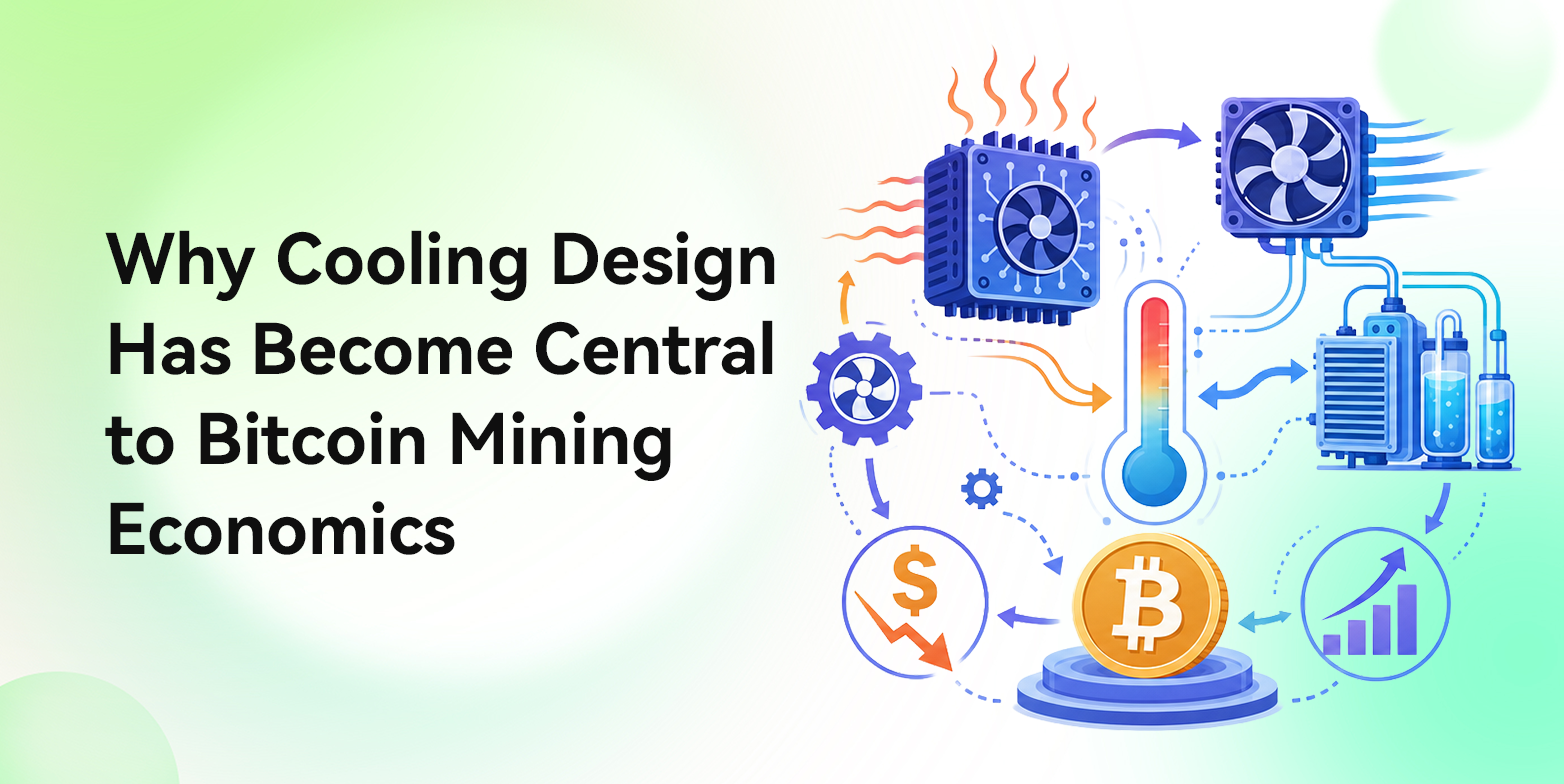
Why Cooling Design Has Become Central to Bitcoin Mining Economics
27.05.2026
Cooling design is key for Bitcoin mining profits: air vs hydro cooling, efficiency, and uptime.
Bitcoin mining is no longer a simple race to stack more hashrate. In 2026, the tougher question is how much power, cooling capacity, rack space, and maintenance effort are required to keep that hashrate online.
Cooling is now part of the profit model. It affects chip temperature, power stability, repair frequency, noise, deployment density, and downtime. Pew Research Center, drawing on the International Energy Agency’s 2025 data center analysis, notes that cooling systems account for about 7% of energy use at efficient hyperscalers and more than 30% at less efficient enterprise facilities. For mining sites, poor thermal design does not just waste energy; it weakens the economics of every terahash deployed.
That is why cooling design should be treated as an operating strategy rather than a secondary hardware detail. The practical question is no longer whether a miner needs cooling, but which thermal architecture best matches the site’s power profile, density target, maintenance capability, and long-term cost structure. Air cooling and hydro cooling solve different operational problems; understanding that distinction is now central to building a more resilient mining economics model.
Cooling Is Now a Mining Economics Problem
Why Lower J/T Changes Both Power Cost and Cooling Load
Power efficiency measures how much energy a miner uses to produce one terahash. That matters for cooling design because nearly every additional watt consumed by a miner eventually becomes heat the site must remove. Lower J/T therefore reduces both direct electricity cost and the cooling burden attached to each terahash.
To make that relationship concrete, Bitdeer lists the SEALMINER A4 Pro Air at 336T, 3,662.4W, and 10.9 J/T, while the SEALMINER A4 Ultra Hydro is listed at 886T, 8,372.7W, and 9.45 J/T. The 1.45 J/T efficiency gap compounds at scale. (The following calculation isolates efficiency by normalizing to the same hashrate output; it is not a direct claim that two different machines have the same native output.)
For every 1 PH/s of deployed hashrate, the 1.45 J/T difference reduces power demand by about 1.45 kW.
Over 24 hours, that equals roughly 34.8 kWh saved.
At an illustrative electricity price of $0.05/kWh, the difference is about $1.74 per PH/s per day, or about $635 per PH/s per year.
For a 100 PH/s fleet, that approaches $63,500 in annual electricity savings before accounting for the additional benefit of lower heat load.
The same logic appears at the machine level when output is normalized. Producing 886T at 10.9 J/T would require roughly 9.66 kW. By comparison, the A4 Ultra Hydro’s listed power demand at 886T is 8.37 kW. On a same-hashrate basis, that is about 1.28 kW less power for 886T of output, or around 30.8 kWh saved per day per normalized 886T deployment.
This is why efficiency and cooling design now need to be evaluated together in a mature mining cycle. Lower power draw widens the margin between running profitably and merely staying online. It can also reduce the shutdown BTC price, the point at which electricity expense overtakes mining revenue, which operators can model through Bitdeer’s Mining Insights Explorer as price, electricity cost, and machine efficiency change. Operators can also translate power, hashrate, and electricity rate into daily economics through a mining profitability framework.
Thermal Stability Protects Uptime
ASIC miners run continuously. Once thermal conditions become unstable, the result may be hashrate fluctuation, throttling, more frequent service intervention, or avoidable downtime.
The SEALMINER A4 line also illustrates how cooling architectures are designed for different operating envelopes: Bitdeer states that the A4 Ultra Hydro and A4 Pro Hydro support stable operation across 20°C to 55°C, while the A4 Pro Air is designed for -20°C to 50°C. These ranges matter because professional mining facilities do not operate in ideal laboratory conditions. Outdoor climate, intake-air quality, seasonal grid stress, and site-level airflow constraints all influence machine behavior.
A miner is only efficient when it can remain efficient under the real operating conditions of the farm.
Why Air Cooling Bitcoin Miners Still Matter
Bitcoin mining hardware is moving quickly, but air cooling is not obsolete. Its remaining value is low-friction deployment.
For second-tier and third-tier mining sites that already have workable ventilation paths, fan-based maintenance routines, and limited appetite for cooling-system reconstruction, air cooling machines remain economically relevant. These operators may not need maximum rack density. They may need stronger efficiency without changing the physical boundaries of the facility.
This is why air cooling platforms remain economically relevant in a wide range of upgrade scenarios.
Lower Complexity, Easier Upgrades
As one example, the A4 Pro Air is listed at 336T, 3,662.4W, and 10.9 J/T. That specification illustrates the role newer air cooling miners can play: improving efficiency while preserving familiar operating logic, including fans, ducts, airflow direction, dust management, and routine inspection.
This matters because an air cooling architecture avoids several layers of hydro cooling complexity. There are no coolant loops to commission, no manifold pressure to balance, no water-quality regime to maintain, and no leak-response protocol to build across every rack. Installation and basic operating workflows also tend to be easier to standardize when an air cooling user guide fits the fan-based routines teams already know.
For phased upgrade plans, that simplicity can be an operational advantage.
Where Air Cooling Systems Fit Best
Air cooling systems are generally most relevant for professional deployments with:
- existing ventilation capacity,
- moderate density targets,
- trained fan-based maintenance teams,
- and limited willingness to fund hydro cooling reconstruction.
Their value is not that they win every density contest. Their value is that they can move a site into a more competitive efficiency bracket while keeping infrastructure friction under control.
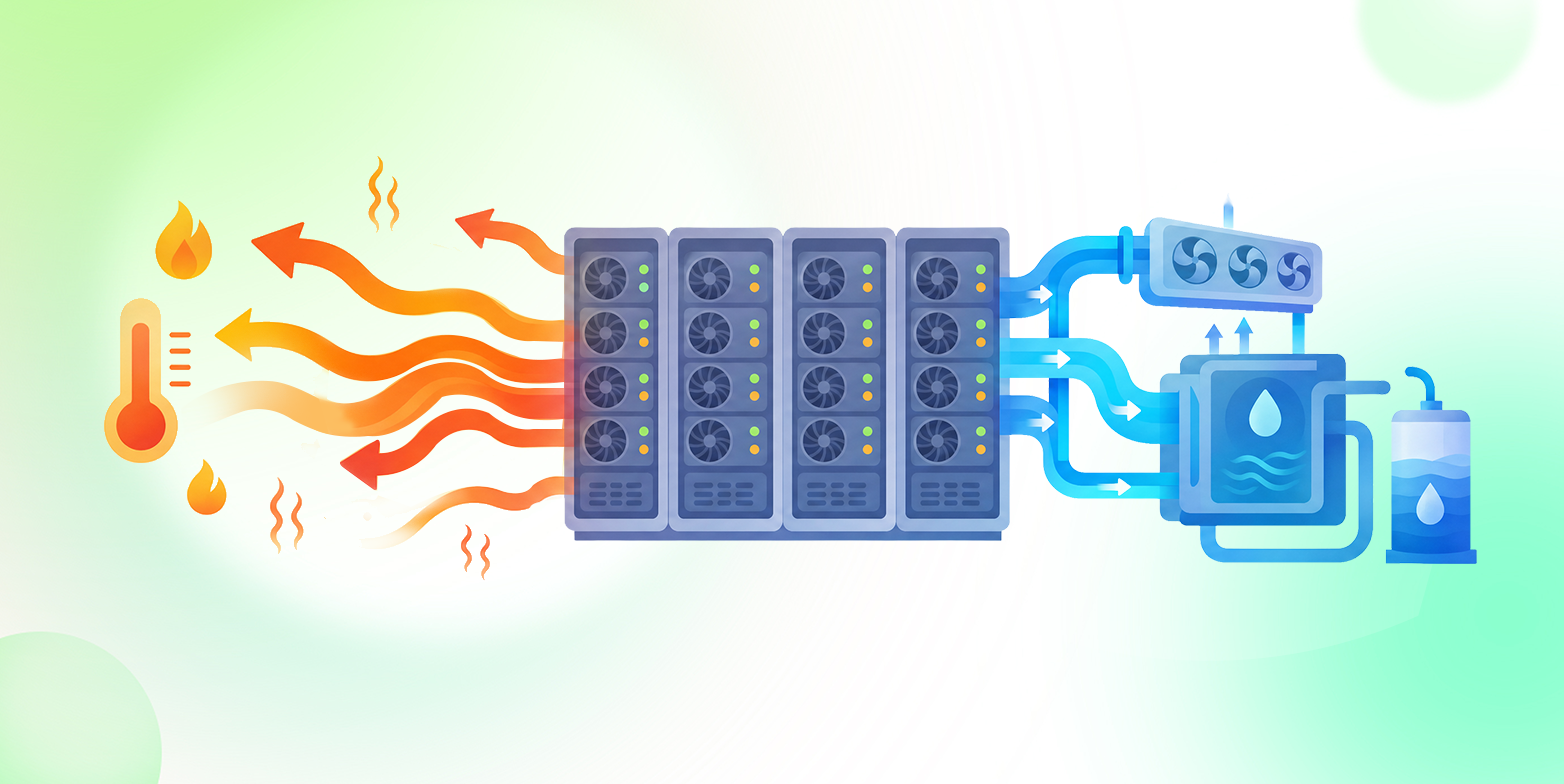
Why Hydro Cooling Designs Become More Attractive at Industrial Scale
Hydro cooling becomes more compelling when space, airflow, and thermal density, not merely machine price, become the binding constraints.
At similar efficiency levels, hydro cooling designs can package materially more hashrate into a single unit. The A4 Pro Air and A4 Pro Hydro illustrate this contrast: 336T versus 680T at the same listed 10.9 J/T efficiency. That difference matters for facilities where rack density, service lanes, airflow capacity, and acoustic limits are already expensive constraints.
The A4 Ultra Hydro illustrates another path: 886T at 9.45 J/T, showing how a hydro cooling platform can combine density gains with lower energy intensity.
Why Operational Maturity Matters
The advantage of hydro cooling is real, but so is its operating burden.
A hydro cooling fleet requires more than miners and power cables. The site must manage coolant circulation, loop pressure, inlet and outlet conditions, fittings, filtration, fluid quality, and leak detection. Commissioning becomes more procedural. Troubleshooting requires greater coordination between mining, facility, and maintenance teams.
Professional buyers should therefore assess hydro cooling through a risk-control lens:
Can the team identify pressure anomalies early?
Can it maintain water quality and filtration discipline?
Can it respond quickly to leakage before localized faults spread?
Can it preserve warranty compliance by following approved procedures?
Hydro cooling can unlock higher density, but it also raises the standard for engineering discipline. Teams preparing their operating playbook need repeatable procedures for installation, startup, coolant, pressure, and maintenance, and a hydro cooling guide can help define those controls before deployment.
Why Implementation Support Still Matters
Cooling architecture is only one part of a successful deployment. As systems become denser and more procedural, documentation, commissioning discipline, repair workflows, and reliable after-sales support become more important to total operating fit.
This is especially true for hydro cooling deployments, where pressure management, water quality, and fault isolation may involve both miner-side and facility-side teams.
In that sense, operators should evaluate not just the machine specification, but also whether the surrounding support framework is mature enough for the architecture they plan to run.
Air Cooling vs. Hydro Cooling: The Real Cost Question
The cooling choice should not be reduced to “cheaper machine versus stronger machine.” The better metric is total cost per stable terahash.
That includes electricity consumption, cooling infrastructure, power distribution, density, service complexity, spare-part planning, downtime risk, and the value of future expansion.
Mining profitability is highly sensitive to electricity cost. Current U.S. Energy Information Administration electricity price tables show that electricity prices vary materially by region and end-use sector, so site economics should be stress-tested against local power rates rather than a single universal assumption. Every incremental watt must be paid for continuously, and every watt also becomes heat the site must manage. Lower J/T reduces direct energy expense and lowers thermal burden per unit of hashrate. At the site level, it also reflects a broader shift: power infrastructure increasingly defines long-term mining competitiveness.
Air cooling fleets still require good ventilation design, dust control, and fan maintenance. Hydro cooling fleets require those broader facility capabilities plus coolant management, pressure monitoring, leak-response readiness, and more structured commissioning. The right answer depends on the site’s limiting constraint.
Three Cooling Profiles, Three Operational Trade-Offs
A useful way to summarize the trade-off is to think in terms of the operating problem each architecture is trying to solve. For buyers, the practical fit of air cooling vs. hydro cooling miners depends on whether the main constraint is deployment friction, density, or energy margin.
An air cooling profile addresses a low-friction deployment problem: how to gain efficiency without rebuilding the entire cooling stack. The A4 Pro Air is one example of that logic.
A hydro cooling profile addresses a scale problem: how to add more hashrate per unit while preserving a controlled thermal environment. The A4 Pro Hydro illustrates that trade-off.
A more advanced hydro cooling profile addresses a margin problem: how to push energy intensity lower while supporting higher-density deployments. The A4 Ultra Hydro illustrates that direction.
Seen this way, cooling should be evaluated as a mining-system design choice, not merely as an accessory.
Match Cooling Architecture to the Site Constraint
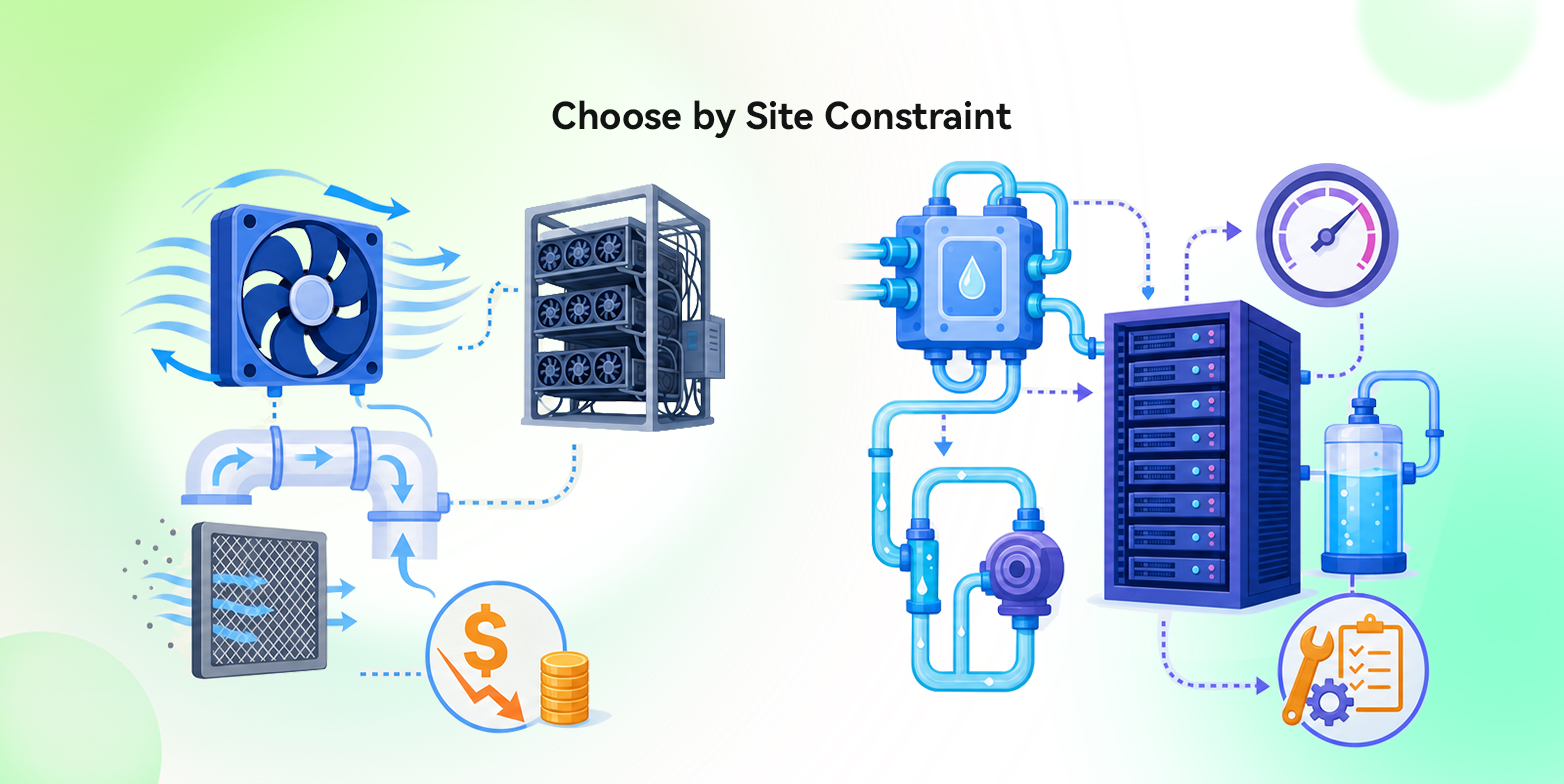
Cooling design now sits closer to the center of mining economics. The right question is not whether cooling matters, but which architecture best matches a site’s power profile, heat-removal capacity, density target, and maintenance maturity.
For operators prioritizing lower deployment friction, air cooling systems may offer a practical path to stronger efficiency without forcing a full facility redesign. For farms pursuing higher density and tighter thermal control, hydro cooling systems can provide a more scalable path, provided the site can support the added engineering discipline.
The best cooling decision is therefore not the one with the most impressive headline specification. It is the one that turns deployed hashrate into stable, serviceable, and economically resilient hashrate under the conditions of the actual mining site.
*Information provided in this article is for general information and reference only and does not constitute nor is intended to be construed as any advertisement, professional advice, offer, solicitation, or recommendation to deal in any product. No guarantee, representation, warranty or undertaking, express or implied, is made as to the fairness, accuracy, timeliness, completeness or correctness of any information, or the future returns, performance or outcome of any product. Bitdeer expressly excludes any and all liability (to the extent permitted by applicable law) in respect of the information provided in this article, and in no event shall Bitdeer be liable to any person for any losses incurred or damages suffered as a result of any reliance on any information in this article.