
5 Security Mistakes That Can Cost Litecoin Miners Revenue
2026.08.11
Worried about losing Litecoin mining income? Discover 5 security mistakes that can threaten mining revenue and learn how to protect your LTC operation.
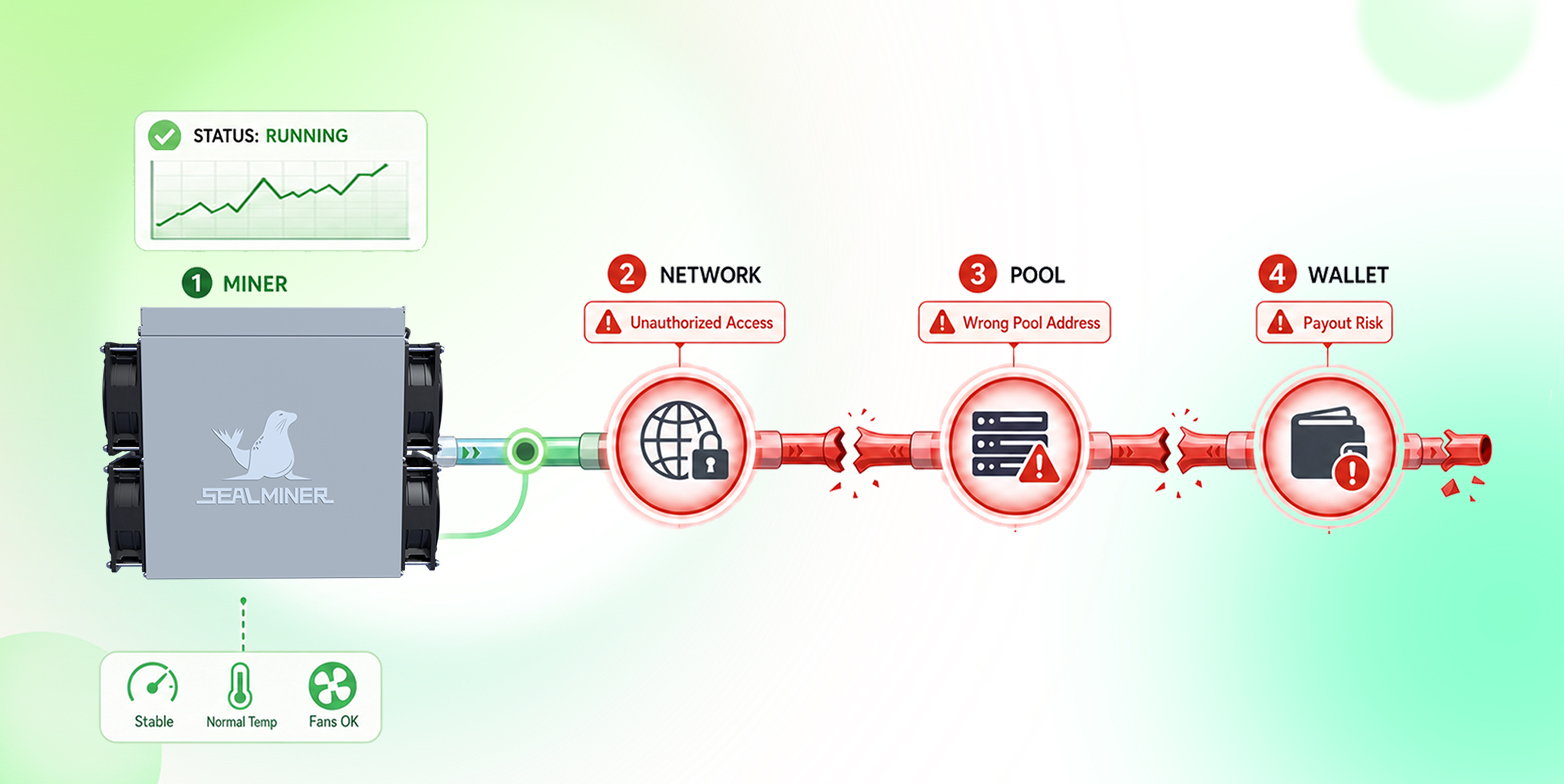
For Litecoin miners, one of the most dangerous security problems is a mining operation that appears to be running but is no longer paying you. The hardware may still be online, fans may be spinning, and the dashboard may continue to show hashrate, while the pool address, worker label, or payout details have been changed. The result: electricity costs keep accruing, but the revenue that actually reaches your account may shrink or stop altogether.
Litecoin (LTC) uses the Scrypt proof-of-work algorithm. Dogecoin (DOGE) also uses Scrypt and can share proof-of-work through merged mining. For miners, the asset that needs protection is therefore not just the machine itself, but the entire revenue path:
Mining Machine → Network → Pool → Payout Settlement → Wallet
If control is lost at any one point, steady hashrate may no longer turn into revenue that belongs to you.
Before Scaling Up, Answer These Five Questions
Before deciding whether a Litecoin mining deployment is ready to expand, answer these five questions:
1. Who has administrative access to the mining machine dashboard?
2. Is the management entry point protected by network isolation and access controls?
3. Which pool and worker are currently receiving the hashrate?
4. Which address ultimately receives the LTC and DOGE payouts?
5. Who controls the wallet private key and seed phrase?
If any answer is unclear, adding more devices will expand the risk at the same time.
Mistake 1: Keeping Default Login Credentials After Setup
An ASIC miner's management dashboard is the control entry point for the device. Administrators can typically view operating status, set pool addresses, configure workers, and adjust network and hardware parameters there.
That means an attacker does not necessarily need to take the machine offline. Gaining dashboard access may be enough to redirect where the hashrate is submitted. SEALMINER follows the same management workflow for pool addresses, workers, and network parameters, making the admin account an important security node in the revenue chain.
After the initial setup, change the default account password immediately. Do not reuse a password from your email, exchange, or mining-pool account. The management page should not be exposed directly to the public internet.
A simple rule of thumb:
Any account that can change where hashrate goes should be protected like a financial account.
Trying to fix this one machine at a time after deploying dozens of devices costs far more than establishing a security baseline up front.
Mistake 2: Watching Hashrate While Ignoring Network Isolation
Mining machines typically need an always-on internet connection. If they share an insufficiently isolated network with office computers, personal devices, storage systems, or public Wi-Fi, a problem on one device can increase the exposure of the entire network.
At a minimum, small deployments should place miners behind a router and firewall and disable unnecessary external access. As the fleet grows, consider a dedicated mining network or virtual LAN (VLAN) to separate miners from other business devices.
Network issues can also hit revenue directly.
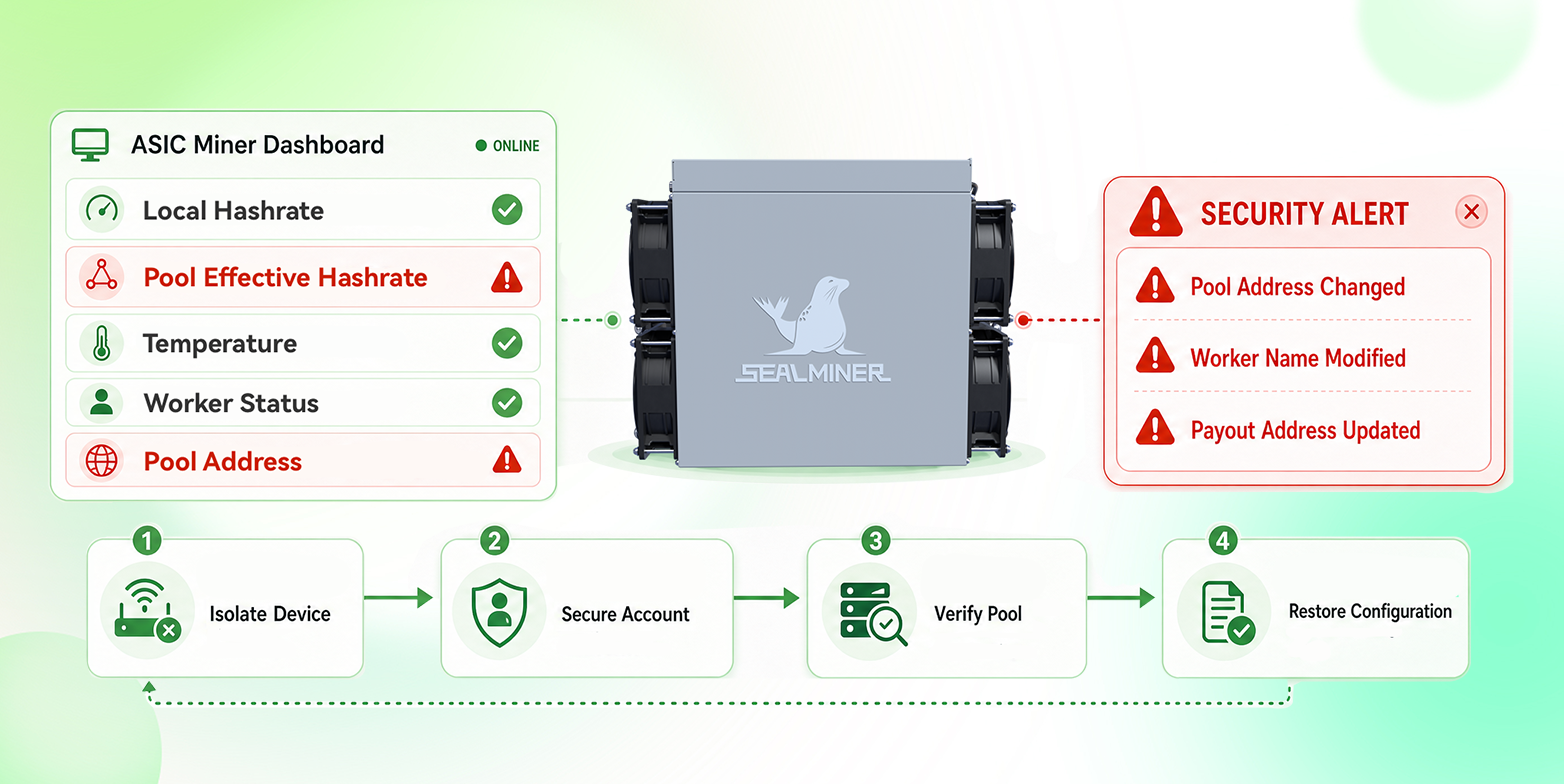
The miner dashboard shows local computation status, while the pool records and settles based on pool-effective hashrate. Local hashrate is the computing status reported by the miner; pool-effective hashrate is the work the pool actually receives and uses for settlement. If local hashrate is stable but the pool side stays significantly lower for an extended period, check network latency, node selection, rejected shares, and the pool connection. Understanding the relationship between effective hashrate and power efficiency helps you determine whether the electricity you are paying for is really becoming valid work accepted by the pool.
Security and efficiency point to the same question here: is the electricity you invest consistently becoming valid work that the pool accepts and settles?
Mistake 3: Choosing a Mining Pool by Fee Alone
A lower pool fee can improve returns, but it should never be the only criterion.
Fees matter, but they are only one part of the decision. More practical questions include: Are you connecting to the official website? Are the server nodes stable? Does the account support 2FA? Could the minimum payout threshold leave revenue sitting in the pool for a long time? Are LTC and DOGE settled together or paid under separate rules?
Merged mining means the same Scrypt hashrate can participate in rewards on compatible networks, but it does not mean every pool settles in exactly the same way. Which assets you receive, when they are paid, and the minimum payout amount all depend on the pool's rules. Some beginners focus on a low fee and overlook the minimum payout threshold. With a small deployment, it may take a long time to reach the threshold. The miner appears to be working, but nothing shows up in the wallet.
Before adding substantial hashrate, the safer approach is to use a small number of devices to complete one full payout test:
Confirm The Worker Is Operating → Check Pool‑Effective Hashrate → Wait Until Settlement Conditions Are Met → Verify The Funds Actually Arrive In The Wallet
Expand the deployment only after the entire path works end to end.
If the pool account supports two-factor authentication (2FA), payout-address change verification, or login alerts, enable those protections first. A payout address is a high-value setting, so changing it should require security at least as strong as changing the password.
Mistake 4: Assuming the Wallet Is Safe Because the Payout Address Is Correct
A pool status of “paid” does not mean the entire funds flow is complete.
First, confirm that the asset and payout address match. If you use an exchange address, also check the exchange's currently supported assets, deposit rules, and minimum crediting threshold. If the pool payout is below the exchange's minimum deposit requirement, the pool may settle successfully while the funds fail to reach your available balance as expected. Also confirm that the exchange still supports the asset and network, and that the deposit address has not changed; do not assume an old address will remain valid forever.
More importantly, true wallet control comes from the private key or seed phrase.
Mining pools, miner-management tools, and normal payout settlement never require you to provide a seed phrase to a third party. Any page that asks you to upload, send, or enter a seed phrase to “claim mining rewards” should be treated as a high-risk signal.
For people just starting with LTC+DOGE mining, the more sensible order is to establish a verified payout path before expanding hashrate. Compared with chasing a higher theoretical income figure, this reduces losses caused by an incorrect address, account anomalies, or misunderstandings about settlement rules. To better understand the relationship between DOGE and LTC revenue, you can also explore the different ways to acquire Dogecoin and how merged mining works.
Mistake 5: Updating Firmware Without Testing or Revenue Baseline
Firmware determines how a miner operates and may affect pool configuration, device stability, and system management. Downloading firmware from forum attachments, unfamiliar file hosts, or unverified third-party links introduces additional risk.
Use trusted sources for device upgrades. For multi-machine deployments, do not update every miner at once without testing. Observe the results on a small number of devices first, then expand the rollout gradually. This reduces the chance that one bad update affects the entire fleet.
Daily monitoring should go beyond whether a miner is online and what its hashrate is. Establish at least a few normal operating baselines - in other words, know what these metrics usually look like when the device is healthy. You can only recognize an anomaly after you know what normal looks like:
| Metric to Watch | Warning Signs |
| Local hashrate | Consistently outside the normal range |
| Pool-effective hashrate | Persistently and significantly out of line with local hashrate |
| Worker label | Unexpected disconnects, name changes, or configuration changes |
| Pool address | Changed without authorization |
| Temperature and reboot count | Sudden increases or frequent reboots |
| Payout records | Unusual payout frequency, address, or amount |
SEALMINER's device-management interface can show total hashrate, individual-board status, temperature, and pool connectivity, and it supports configuration and firmware management. Taken together, these signals are far more useful than watching a single GH/s number.
For example, a miner may continue to report normal local hashrate while the worker in the original pool dashboard suddenly stops submitting valid shares. Raising the frequency or repeatedly rebooting the machine is unlikely to help. Check the pool address, worker, network connection, and whether any configuration changed recently.
What to Do First If You Suspect a Litecoin Miner Has a Security Problem
Once you spot an anomaly, do not keep the device running while you investigate at your leisure.
Isolate the affected device → Use a trusted device to change the miner dashboard password and pool account password → Confirm 2FA is enabled and the authenticator device has not been replaced → Check the pool address and worker settings → Verify that the LTC/DOGE payout address has not been changed → Review recent payout records → Bring the miner back online with a trusted configuration
The relevant account credentials include the miner dashboard password and the pool account password. During the investigation, also confirm that 2FA is functioning normally and review the pool address, worker settings, payout address, and recent payout records for anything unusual.
After recovery, confirm that these three results line up again:
Local hashrate is normal, pool-effective hashrate is normal, and revenue reaches the correct wallet.
Only when all three correspond again has the revenue path truly been restored.
Build a Verifiable Revenue Path
Before calculating ROI, comparing electricity prices, or chasing higher hashrate, miners should establish a revenue path they can verify. If you plan to deploy more Scrypt miners, evaluate power, cooling, network isolation, pool settlement, and wallet security together.
When reviewing miners such as SEALMINER, do not look only at hashrate and efficiency. Also confirm that device management, firmware updates, and the revenue path can be maintained over the long term.
For more guidance on Litecoin mining setup, payout security, and Scrypt mining operations, explore Bitdeer Learning Hub.
*Information provided in this article is for general information and reference only and does not constitute nor is intended to be construed as any advertisement, professional advice, offer, solicitation, or recommendation to deal in any product. No guarantee, representation, warranty or undertaking, express or implied, is made as to the fairness, accuracy, timeliness, completeness or correctness of any information, or the future returns, performance or outcome of any product. Bitdeer expressly excludes any and all liability (to the extent permitted by applicable law) in respect of the information provided in this article, and in no event shall Bitdeer be liable to any person for any losses incurred or damages suffered as a result of any reliance on any information in this article.


