
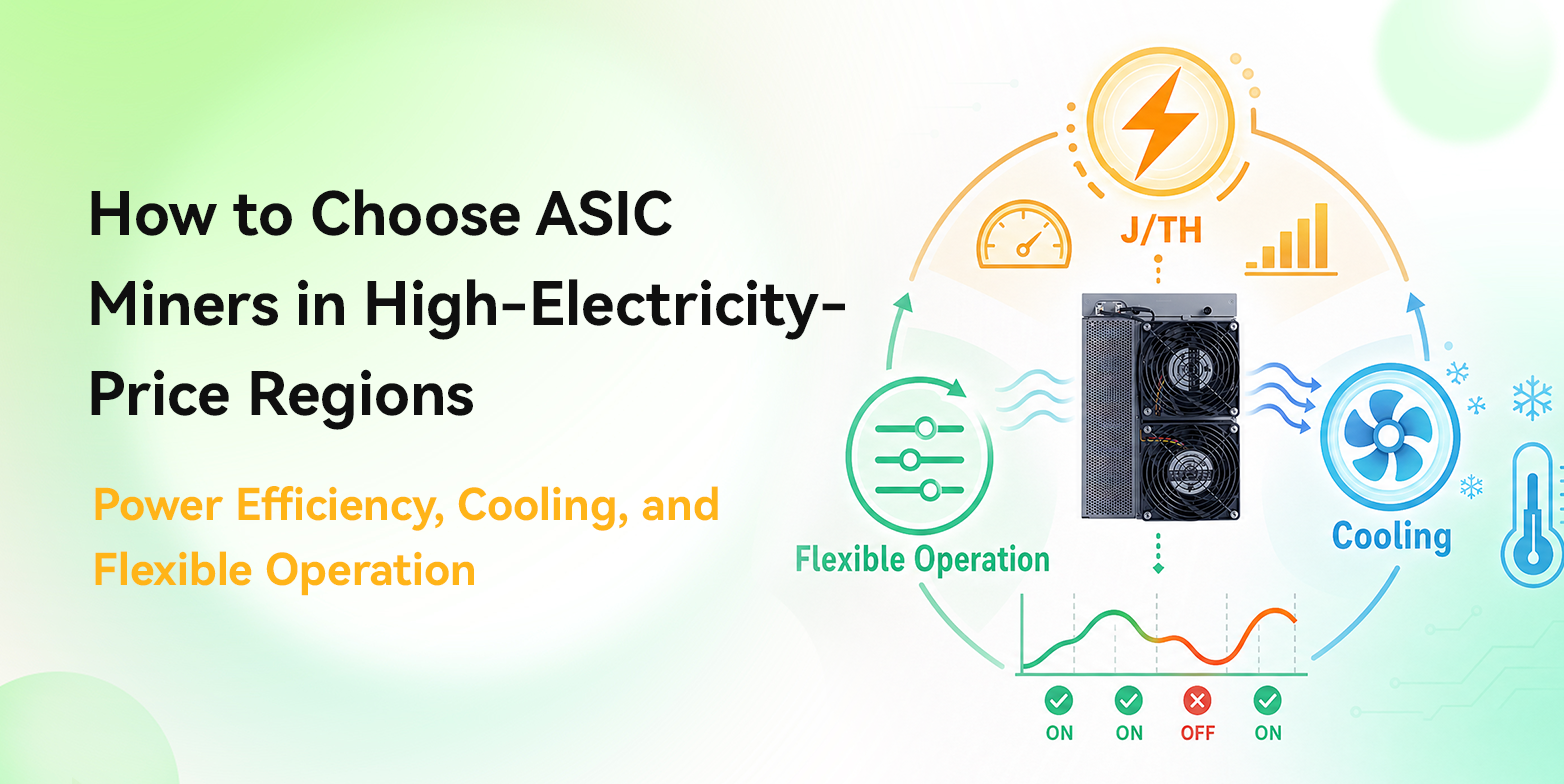
How to Choose ASIC Miners in High-Electricity-Price Regions: Power Efficiency, Cooling, and Flexible Operation
2026.06.15
High power costs hurting mining returns? Compare J/TH, cooling, hourly power prices, and load strategy before choosing ASIC miners.
In high-electricity-price regions, mining decisions revolve around managing power cost and operational flexibility. Average annual power price, peak-valley spreads, demand charges, load restrictions, cooling conditions, and outage schedules all shape the real cash flow of an ASIC miner. If you compare only hashrate or miner price, you may miss the cost that happens most steadily every day: electricity.
A more reliable selection method is to first break down the mining site’s hourly power price and cooling capacity, then judge whether the miner maintains enough operating margin under different power-price periods, temperature conditions, and different hashprice levels. In high-electricity-price regions, miner selection is not about chasing the highest TH/s alone. It is about whether each kilowatt-hour continuously delivers into enough effective hashrate.
Why Should High-Electricity-Price Regions Start with Hourly Power Prices?
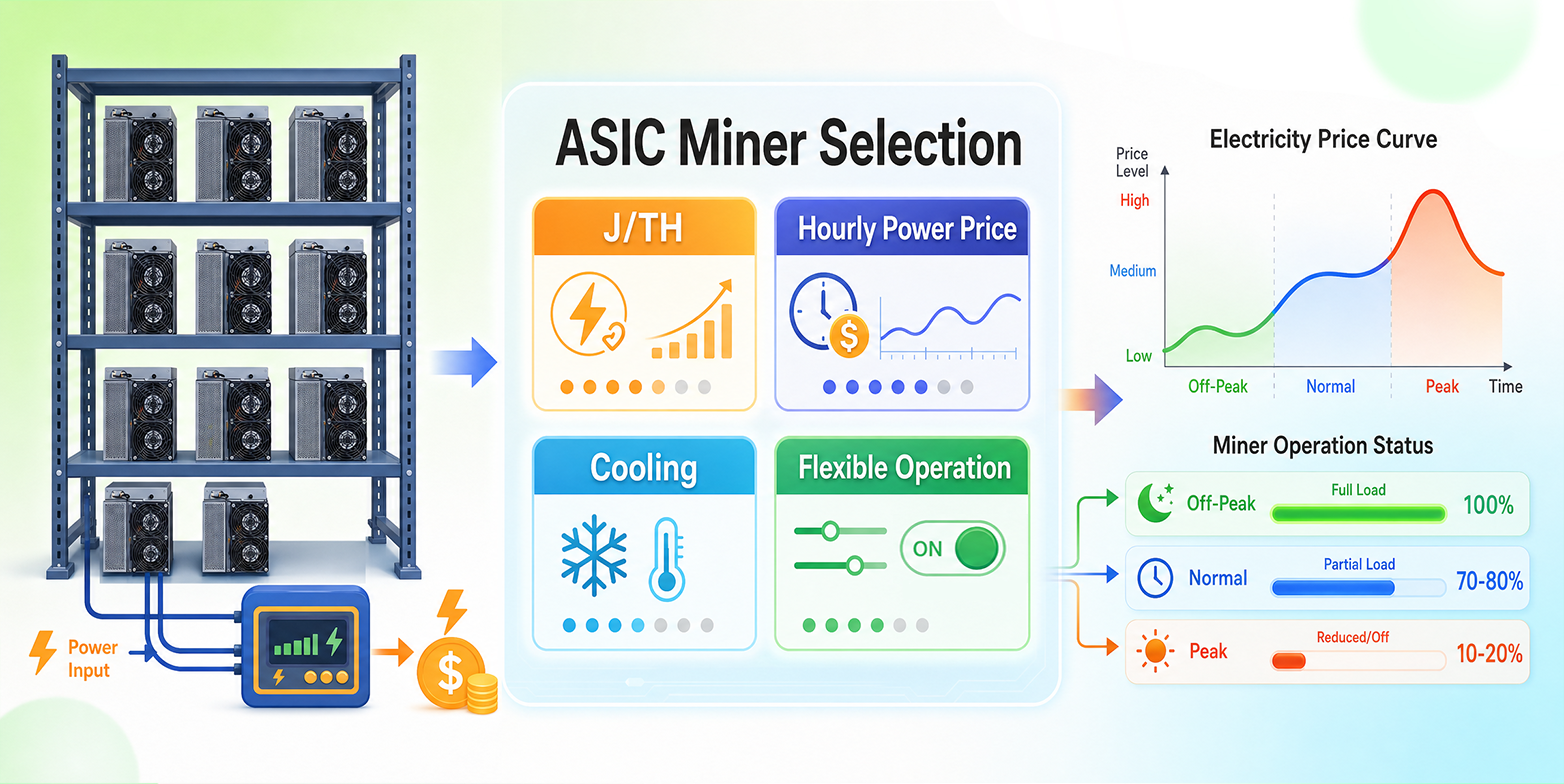
High electricity prices usually mean two things. The first is a high average annual power price. The second is a complex electricity-pricing structure, such as peak-valley spreads, demand charges, minimum load clauses, curtailment notices, and hosting power surcharges. The second layer is easier to ignore, but it often determines how miners actually run.
A miner consumes electricity every hour, while its revenue changes with network difficulty, block transaction fees, and the BTC price. The more obvious the power-price swing is, the more mining operators needs to divide miners into base load and flexible load. The base load stays online for long-term operation, while the flexible load downshifts or pauses based on peak power prices, temperature, and grid dispatch.
Hourly electricity cost = Miner power consumption (kW) × power price in that hour
| Power-price Scenario | Typical Pattern | Operation Strategy | Selection Preference |
| Stable high power price | Annual power price is high, with small intraday fluctuation | Improve uptime and strictly control electricity use per unit of hashrate | Prioritize models with smaller J/TH degradation in high-temperature environments |
| Clear peak-valley spread | Daytime or peak-hour power price rises significantly | Downshift during peak hours and restore target hashrate during valley hours | Requires flexible operation modes and remote management |
| Frequent demand response | Grid dispatch or hosting provider requires short-term peak shaving | Preset downshift rules to reduce losses from sudden shutdowns | Focus on restart stability and monitoring system |
| Obvious thermal pressure | Summer temperature is high, and air ducts or water loop approach their limits | Use cooling capacity to limit rack density | Prioritize matching the mining site’s hydro cooling system |
Why J/TH Matters More Than Miner Price
J/TH can be read as “how much electricity is needed to produce 1 TH/s of hashrate.” The lower the number, the more effective hashrate the same electricity cost buys, and the lower the thermal pressure. For high-electricity-price regions, this metric matters more than miner price alone because electricity costs occur every day.
In other words, a high-price mining facility should not only ask, “How much electricity does this machine use per day?” It should also ask, “With the same cable, rack position, and cooling system, how much effective hashrate does it produce?” A miner with weaker power efficiency does not only use more electricity. It also fills power distribution and cooling capacity faster.
Theoretical hashrate per 1 kW (TH/s) = 1,000 ÷ J/TH
| Power Efficiency | SEALMINER Model | Hashrate/1 kW | Hashrate/100 kW | Hashrate/1 MWh |
| 9.45 J/TH | SEALMINER A4 Ultra Hydro (hydro cooling) | Approx. 105.82 TH/s | Approx. 10.58 PH/s | Approx. 381 million TH |
| 10.9 J/TH | SEALMINER A4 Pro Air / A4 Pro Hydro | Approx. 91.74 TH/s | Approx. 9.17 PH/s | Approx. 330 million TH |
| 12.5 J/TH | SEALMINER A3 Pro Hydro | Approx. 80.00 TH/s | Approx. 8.00 PH/s | Approx. 288 million TH |
| 14.0 J/TH | SEALMINER A3 Air | Approx. 71.43 TH/s | Approx. 7.14 PH/s | Approx. 257 million TH |
The theoretical values in the table do not include operator-side losses, auxiliary cooling power, or actual uptime. Based on a 100 kW power distribution capacity, the theoretical hashrate gap between 9.45 J/TH and 14.0 J/TH is about 3.44 PH/s. Buying a miner is a one-time expense. Electricity is not. Power costs continue every day, which is why efficiency matters far more over the long run. More relevant models are available at Bitdeer shop.
How Operating Modes Reduce Peak-Power Costs
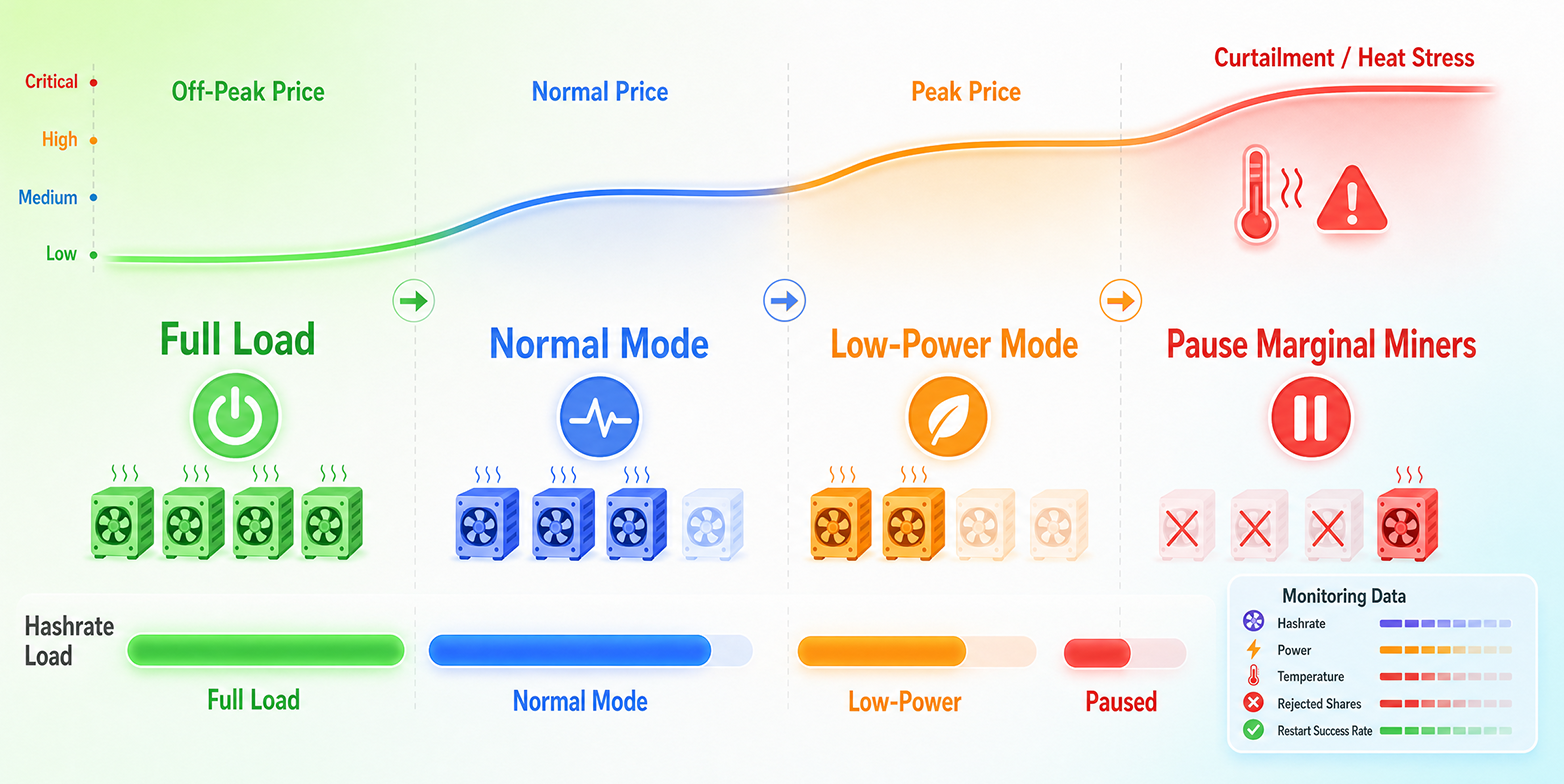
In high-electricity-price regions, miners do not necessarily need to run at the same power level all year. A more mature approach is to connect miner operation modes with power-price periods, allowing hashrate load to change with electricity cost. During valley-price periods, the site prioritizes higher hashrate. During peak-price periods, it should pursue higher efficiency. During extreme weather or curtailment periods, planned shutdowns help protect both miners and the power system.
When a miner supports low-power, normal, and high-performance modes, a mining site can move from a simple “on or off” strategy to four layers: full load, downshift, observation, and pause. This layered control is smoother than sudden shutdowns and helps reduce the risk of forcing miners to run through peak electricity prices.
| Operation Period | Risk | Recommended Action | Data to Monitor |
| Valley-price period | Revenue window is relatively wide | Raise target hashrate and check temperature and rejected share rate | Hashrate, power consumption, temperature, mining pool connection |
| Flat-price period | Profit is affected by hashprice | Maintain normal mode and monitor net revenue per unit of hashrate | Electricity cost, hashprice, uptime |
| Peak-price period | Electricity cost quickly compresses profit | Switch to low-power mode or downshift in batches | Real-time power price, load limit, fan or pump power consumption |
| Curtailment or high temperature | Shutdown and hardware failure risks rise | Keep the core load and pause marginal miners | Inlet and outlet air temperature, water temperature, alarms, restart success rate |
How to Match Cooling Systems to Your Miners
In high-electricity-price regions, cooling is not only about “whether the system removes heat effectively. ” The electricity consumed by miners eventually turns into heat, while fans, pumps, heat-exchange systems, and cooling towers also continue to consume power. The operator needs to judge which cooling method supports the steady conversion of nominal efficiency into settleable hashrate under the existing air ducts, water loop, rack density, and maintenance capability.
Air cooling deployment is more direct and suits miners that already have ventilation conditions and maintenance teams familiar with fan and filter management. Hydro cooling is more suitable for high-density cabinets, noise-restricted sites, or mining facilitiss with higher long-term temperature-control requirements. Before procurement, the cooling system should be included in the electricity-cost model because excessive temperature affects uptime, repair frequency, hashrate, and J/TH.
If a mining site already has stable hydro cooling infrastructure, hydro cooling miners are usually better suited as the core choice for high-density hashrate deployment. They allow operators to deploy higher hashrate within the same rack space, while transferring heat in a more centralized way to the water loop, heat-exchange system, and cooling tower. Temperature control is also easier to standardize. In contrast, if the mining site does not yet have mature pump, pipeline, filtration, leakage monitoring, and cooling tower maintenance capability, the decision should not be based only on the miner’s nominal power efficiency. In that case, the construction cost of the hydro cooling system, daily maintenance difficulty, downtime troubleshooting time, and fault-handling risk should all be included in the total cost model.
| Model | Cooling Type | Nominal specifications | More suitable role |
| SEALMINER A4 Ultra Hydro | Hydro cooling | 886 TH/s, 8372.7 W, 9.45 J/TH | Core load for high-electricity-price, high-density, mature hydro cooling mining facilitiss |
| SEALMINER A4 Pro Hydro | Hydro cooling | 680 TH/s, 7412 W, 10.9 J/TH | Hydro cooling expansion load that needs higher single-cabinet hashrate density |
| SEALMINER A4 Pro Air | Air cooling | 336 TH/s, 3662.4 W, 10.9 J/TH | Flexible load for mature air cooling infrastructure and limited retrofit budget |
These specifications should enter the same mining site model. Hydro cooling models may increase hashrate density per unit of space, but they require a more complete cooling system. Air cooling models have lower engineering retrofit pressure, but rack density and ambient temperature can limit long-term performance. Equipment modeling should also leave room for deviations caused by environment, delivery batches, and operating conditions.
Why Is a Miner Portfolio More Suitable for High-Electricity-Price Regions?
A single model is easier to purchase and maintain, but in regions with obvious power-price fluctuations, a miner portfolio is usually more flexible. The core load focuses on low J/TH and high uptime. The flexible load releases extra output during valley-price periods. The test load is used to verify new models, cooling routes, or hosting conditions.
This portfolio approach helps lower the cost of a one-time judgment error. The biggest risk in high-electricity-price regions is putting the whole budget into miners that only fit one power-price pattern or one cooling condition. After layered deployment, the operators can adjust the load ratio based on power price, temperature, and hashprice.
| Load layer | Goal | Miner requirements | Management focus |
| Core load | Stay online as much as possible all year | Low J/TH, stable power supply, mature cooling | Uptime, repair cycle, electricity cost per unit of hashrate |
| Flexible load | Release capacity during valley-price periods or high hashprice periods | Easy downshift, easy restart, clear remote management | Operation mode, load limit, restart success rate |
| Test load | Verify new miners or new cooling routes | Controlled quantity and complete data collection | 30-day power consumption, temperature, rejected share rate, and fault records |
| Backup load | Replace miners under repair or handle temporary rack positions | Simple maintenance and available spare parts | Spare parts inventory, warranty, and logistics time |
Build a 30-Day Operating Model Before You Buy
A procurement sheet for high-electricity-price regions should not stop at miner model, unit price, and nominal hashrate. A more reliable approach is to build a 30-day site model before formal bulk procurement, covering variables such as power price, temperature, uptime, and mining pool settlement. The model does not need to be as complex as a financial system, but it must expose weak points in cash flow.
Miner-side fields include hashrate, power consumption, J/TH, cooling method, input voltage, dimensions, weight, warranty, and delivery cycle. Mining site-side fields include hourly power price, power distribution capacity, PUE or auxiliary power estimate, ambient temperature, rack density, network conditions, and maintenance shifts. If the team has just started building a parameter system, it can first solidify core miner specifications into a procurement template.
Financial fields should cover miner price, freight, taxes, rack installation fees, hosting fees, mining pool fees, operation and maintenance costs, repair budget, and cash buffer. Risk fields should include three types of discounts: falling hashprice, lower uptime, and rising electricity prices. High-electricity-price regions should especially avoid using only full uptime and average power price to produce a single result.
A practical minimum standard is this: the base case decides whether procurement talks should continue; the conservative case decides the first batch deployment scale; the stress case decides when to downshift, pause, or sell miners. If all three cases lack clear action rules, procurement decisions are more likely to become reactive when market conditions fluctuate.
Use Power Constraints to Filter ASIC Miners That Can Run Long Term
In high-electricity-price regions, ASIC miner selection should start with hourly power price, mining site cooling capacity, and operation modes. J/TH determines how much hashrate each kW of electricity produces. Hashprice decides revenue per unit of hashrate. The cooling system decides whether nominal efficiency can be delivered continuously. Uptime decides whether the paper model translates into real cash flow.
The final judgment should come from the mining facility’s own power contract, hourly power price, cooling capacity, and 30-day stress test. ASIC miner deployment remains feasible in high-electricity-price regions , but the procurement logic should shift from “buying one high-hashrate miner” to “configuring a group of hashrate loads that can adjust with power price and temperature.” Miners that keep adjustment room under peak power prices, thermal pressure, and hashprice fluctuations are closer to a long-term choice for high-electricity-price regions.
If you need to further check miner parameters, cooling methods, and procurement pages, review Bitdeer, the SEALMINER A4 Series, and specific product specification pages, then put the official parameters back into the mining site’s own power-price and cooling model for recalculation.
*Information provided in this article is for general information and reference only and does not constitute nor is intended to be construed as any advertisement, professional advice, offer, solicitation, or recommendation to deal in any product. No guarantee, representation, warranty or undertaking, express or implied, is made as to the fairness, accuracy, timeliness, completeness or correctness of any information, or the future returns, performance or outcome of any product. Bitdeer expressly excludes any and all liability (to the extent permitted by applicable law) in respect of the information provided in this article, and in no event shall Bitdeer be liable to any person for any losses incurred or damages suffered as a result of any reliance on any information in this article.


