

How to Improve Profit from Long-Term Bitcoin Miner Investment: Guide to Cost, Cash Flow, and Lifecycle Management
2026.06.04
Evaluate long-term Bitcoin miner profit by managing cost baselines, cash flow, and equipment efficiency in this practical guide.
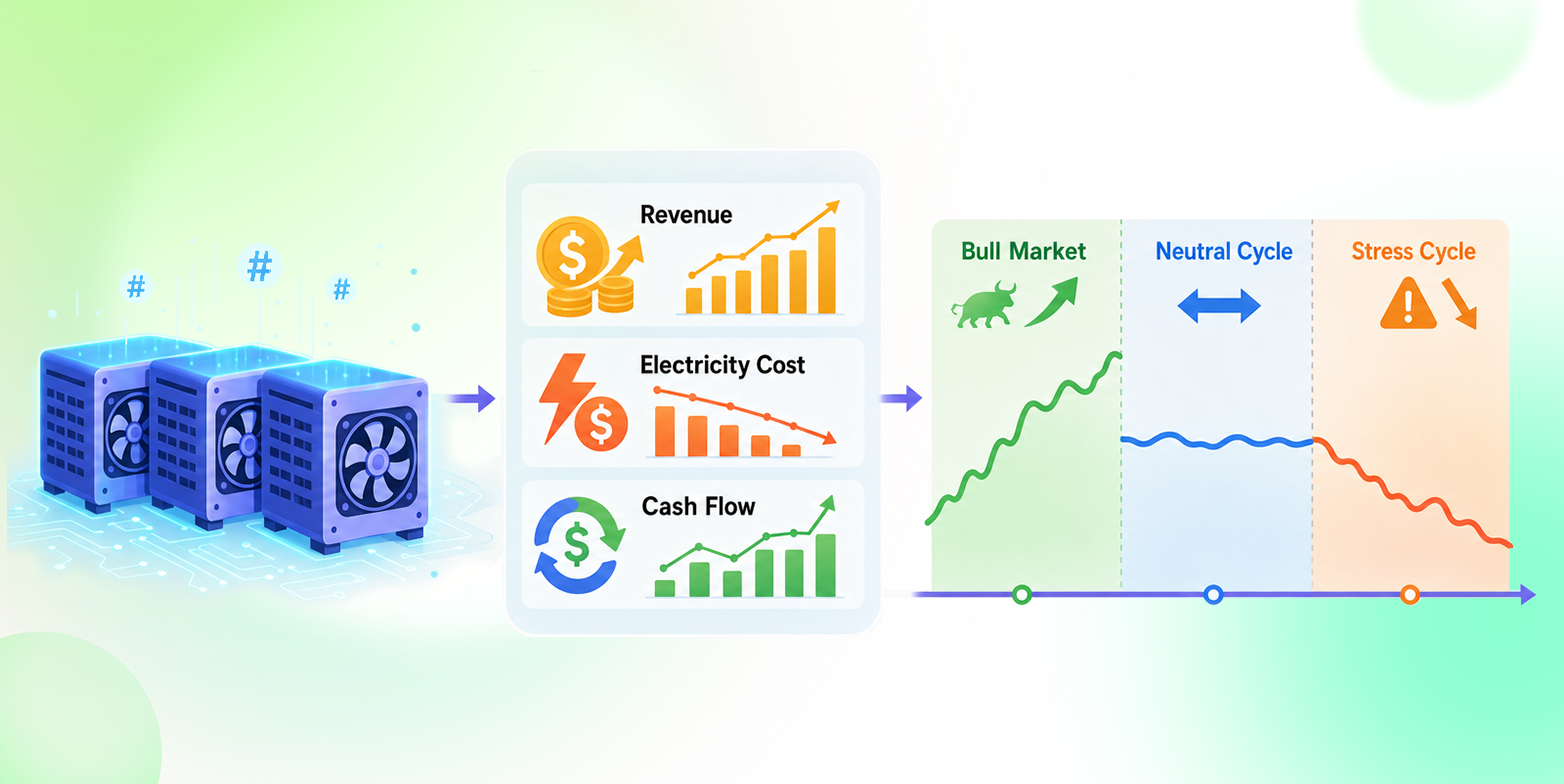
Profit assessment in Bitcoin mining can no longer stay at the level of “the higher the miner hashrate, the better.” After the fourth Bitcoin halving in 2024, the base block subsidy fell to 3.125 BTC per block, making miner revenue more sensitive to transaction fees, BTC price, network difficulty, and electricity costs. For ordinary investors, the key question is not how much a miner can produce in one ideal day, but whether it can continue to leave net profit after market volatility, difficulty adjustments, and ongoing power expenses.
The real challenge in long-term miner investment is not judging how much BTC a device can mine on a single day. It is judging whether that device can still leave net profit after several difficulty adjustments, BTC price swings, and continuous electricity bills. After the halving, miner investment looks less like a one-time hardware purchase and more like the operation of a hashrate asset that requires ongoing management of cash flow, cost baselines, and exit timing. This article looks at revenue structure, cost baselines, miner efficiency, payback assessment, cash-flow planning, and suitable investor profiles to help you evaluate how to improve the profit potential of long-term Bitcoin miner investment.
Why Should Long-Term Miner Investment Not Be Judged Only by Daily Revenue?
Daily revenue can easily create a false impression. When the BTC price rises on a given day, miner revenue may look attractive. But if network difficulty keeps increasing, or if electricity, hosting, and maintenance costs are not calculated clearly, long-term profit may not be stable.
Bitcoin miners earn revenue from block subsidies and transaction fees. The block subsidy is determined by protocol rules, while transaction fees depend on on-chain activity. The amount you finally receive is also affected by mining pool allocation, pool fees, and payout models. Therefore, when evaluating miner investment, separate “revenue” from “profit.”
A more practical way to judge it is:
Daily net revenue = daily mining revenue - electricity cost - pool fees - hosting fees - maintenance costs
Focusing solely on daily mining revenue can lead you to overestimate how quickly you’ll recoup your investment. Tracking long-term daily net income, by contrast, gives a far more accurate picture of actual investment performance. For those new to mining, grasping the logic behind mining profitability matters more than hastily comparing miner prices.
Which Data Should Be Included in Your Profit Table?
For long-term miner investment, it is better to start with a simple profit table. It does not need to be as complex as a formal financial statement, but it should at least cover four categories: revenue, costs, equipment, and risks.
The revenue side includes BTC price, revenue per unit of hashrate, mining pool payout model, and transaction fee contribution. The cost side includes electricity price, hosting fees, O&M fees, repair costs, and potential downtime losses. The equipment side includes hashrate, power consumption, J/TH, purchase cost, and estimated operating life. The risk side should record difficulty changes, BTC price drawdowns, equipment failures, and the regulatory environment.
Among these, Hashrate and hashprice are two especially important indicators to watch. Hashrate describes the scale of computational power you contribute to network competition, while hashprice is closer to “how much revenue each unit of hashrate can generate per day.” Focus solely on the price of BTC, you may easily overlook shifts in mining difficulty. Monitoring hashprice alongside it allows you to spot far more quickly whether revenue per unit of hashrate is shrinking.
How Does Electricity Cost Change a Miner’s Break-Even Line?
Miners consume electricity every day, so power cost is not a small item. It is a core variable that determines the break-even line. You can first estimate power pressure with a basic formula:
Daily electricity cost = miner power consumption (kW) × 24 hours × electricity price
Take a device with power efficiency of 10.9 J/TH as an example. Each 1 TH/s of hashrate corresponds to about 10.9 W of power consumption, and each 1 PH/s (1,000 TH/s) corresponds to about 10.9 kW of power consumption. Based on “daily electricity cost = power consumption in kW × 24 × electricity price,” 1 PH/s costs about USD 15.70 per day at an electricity price of USD 0.06/kWh. At USD 0.10/kWh, the daily electricity cost is about USD 26.16, adding about USD 10.46 per day for the same unit of hashrate. If you estimate a single 336T, 3662.4W unit, the cost is about USD 5.27/day at USD 0.06/kWh and about USD 8.79/day at USD 0.10/kWh, adding about USD 3.52 per day for one unit.
These calculations are not revenue forecasts. They only show cost sensitivity. Miner revenue changes every day, while electricity cost is relatively stable. The higher your electricity price, the more you need lower J/TH, higher uptime, and a more cautious payback model.
Long-term investors can set an “electricity break-even line” for themselves: when revenue per unit of hashrate falls below electricity cost, continued operation should be reassessed. The key to miner investment is not whether there is revenue every day, but whether revenue stays above your cost baseline.
Many investors underestimate efficiency gaps because they look at costs by single machine and single day. But the cost of miner investment does not occur only once. It accumulates 24 hours a day. The smaller the efficiency gap looks, the more it needs to be viewed over a longer period and at a larger scale before its real impact becomes clear.
Why Does Miner Efficiency Affect Long-Term Profit?
J/TH can be understood as the miner’s “fuel consumption.” For the same amount of hashrate, lower energy consumption means less electricity used over the long term. In the short term, a gap of 1 J/TH or 2 J/TH may not seem large. But when capacity ramps up and the operating period becomes longer, it turns into a very concrete electricity cost difference.
Here is a simple way to understand it. Assume two miners both provide 1 PH/s of hashrate. One has an efficiency of 10.9 J/TH, and the other has an efficiency of 9.45 J/TH. The power difference per 1 PH/s is about 1.45 kW, which equals about 34.8 kWh of electricity over a full day. If the electricity price is USD 0.06/kWh, the electricity cost difference for each 1 PH/s is about USD 2.09 per day. If the hashrate scale expands to 100 PH/s, the difference becomes about USD 208.8 per day, or about USD 76,212 per year. This shows that once an efficiency gap is multiplied by scale and time, it becomes a real cost difference.
For example, SEALMINER A4 Pro Air and A4 Ultra Hydro are not simply a higher-end and lower-end configuration pair. A4 Pro Air (336T; 3662.4W; 10.9 J/TH) is more suitable for investors who want to keep deployment flexible and control infrastructure complexity. A4 Ultra Hydro (886T; 8372.7W; 9.45 J/TH) is more suitable for scenarios with hydro-cooling conditions, higher hashrate density requirements, and long-term unit-cost optimization goals. The real comparison is not “which machine has higher hashrate,” but whether your electricity price, cooling conditions, and cash-flow model can support its long-term operation.
Therefore, the core logic of how miner efficiency affects long-term profit is this: it cannot eliminate market volatility and it does not guarantee fixed returns, but it can reduce the ongoing cost per unit of hashrate. For long-term investors, this means a lower electricity break-even line, stronger resilience during low-revenue cycles, and a clearer basis for payback calculations.
How Can You Use Three Scenarios to Judge the Payback Period?
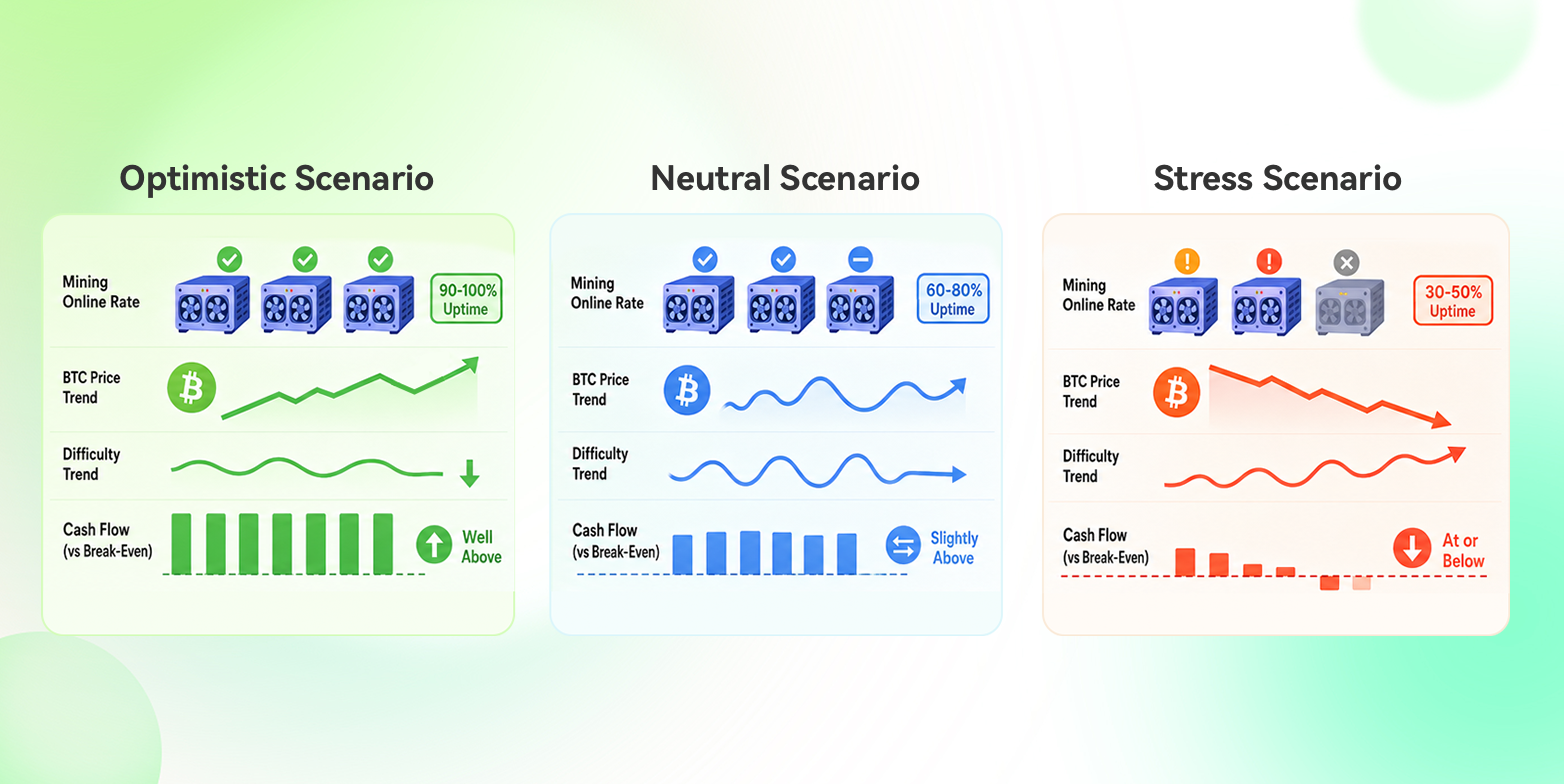
The payback period should not be calculated only under optimistic assumptions. BTC price, mining difficulty, transaction fee revenue, and miner uptime all change. A more prudent method is to build three scenarios.
| Scenario | Main Assumptions | Key Observation |
| Optimistic | BTC price rises or remains strong; hashprice improves; uptime stays above 95%-98%; electricity, hosting, and pool fees remain basically unchanged; maintenance downscaling is limited. | Payback speed is attractive enough to keep holding or moderately expand hashrate. |
| Neutral | BTC price and difficulty fluctuate around the current range; transaction fee contribution is normal; uptime is about 90%-95%; electricity and hosting fees follow the contract, with occasional short maintenance. | Average daily net revenue remains stable and cash flow can cover electricity and O&M costs. |
| Stress | BTC price falls while difficulty continues to rise; hashprice compresses ; uptime drops below 90% or longer downtime occurs; electricity, maintenance, or hosting costs increase. | The operation approaches the shutdown threshold, requiring a pause, scale reduction, or recalculated payback period. |
If an investment plan looks good only in the optimistic scenario, becomes strained in the neutral scenario, and directly loses money on electricity in the stress scenario, its safety margin is insufficient. Long-term investment is not only about pursuing the highest return. It is first about confirming how much downside you can withstand.
You can use the following simplified logic for an initial assessment:
Payback period = equipment investment cost ÷ average daily net revenue
However, average daily net revenue should not be based only on data from the most recent few days. It is better to estimate a range based on different BTC prices, different hashprice levels, and different uptime assumptions. The result will not be perfectly precise, but it will be closer to reality than a single optimistic model.
How Should Mining Revenue Be Arranged to Reduce Cash-Flow Pressure?
Many beginners hold all the BTC they mine, hoping to wait for a future price increase. This approach can look attractive in a bull market, but it may create cash-flow pressure during weak market cycles because electricity and maintenance bills usually cannot wait until the next bull market.
A more stable approach is to divide mining revenue into several uses:
One portion is used to pay electricity and O&M costs.
One portion is kept as a cash reserve for equipment repair, downtime, or revenue declines.
One portion is held as BTC according to your own judgment.
There is no universal ratio. Investors with high electricity prices and limited cash reserves should pay more attention to cost coverage. Investors with sufficient capital and stronger risk tolerance can retain a higher proportion of BTC. The key is to avoid being forced by electricity bills to sell BTC passively in an unfavorable price range.
This is also the biggest difference between miner investment and simply buying BTC. Buying BTC can be a static holding strategy, while miner investment requires continuous cash-flow management.
When Should You Adjust Your Miner Investment Strategy?
Long-term investment does not end once you buy the miner. You need to review several signals regularly.
First, is hashprice continuing to decline?
If revenue per unit of hashrate drops clearly, the market environment is becoming less favorable for miners.
Second, is electricity cost close to or higher than revenue?
If mining revenue only barely covers electricity cost, maintenance expenses and downtime risk will further compress profit.
Third, is miner uptime declining?
No matter how high the hashrate is, frequent downtime will discount actual revenue.
Fourth, does the next generation of equipment significantly improve efficiency?
When the market enters an efficiency competition stage, older equipment may still be able to run, but it may not be suitable for further expansion.
Fifth, has your personal cash flow changed?
If you cannot consistently cover operating costs, you are not suitable for expanding according to the original plan.
These signals do not necessarily mean you should exit immediately, but they do mean you need to recalculate. Rational long-term investment is not only about knowing when to buy. It also includes knowing when to pause, reduce scale, or change strategy.
Long-Term Profit Comes from Manageable Costs, Not a Single Bet
Improving profit from Bitcoin miner investment is not about finding an answer that always makes money. It is about building a judgment method that can be reviewed continuously. You need to understand revenue sources, cost structure, efficiency differences, hashprice changes, payback ranges, and cash-flow capacity.
Before making a decision, you can check yourself with five questions:
- Is my electricity price low enough to support long-term operation?
- Can my miner efficiency withstand low-profit cycles?
- Does my revenue model include a stress scenario?
- Can my cash flow cover electricity and repair costs?
- Do I know when to keep running and when to adjust?
If you do not yet have answers to these questions, it is not advisable to rush into expansion. You can first use the Bitdeer Learning Center to learn more about revenue, difficulty, hashprice, and miner efficiency. Then, based on the real parameters of Bitcoin miners, use the Bitdeer Mining Calculator for your own estimates.
The key to long-term miner investment is not making every single day look like the highest-revenue day. It is keeping costs, risks, and cash flow within a range you can understand, withstand, and adjust.
*Information provided in this article is for general information and reference only and does not constitute nor is intended to be construed as any advertisement, professional advice, offer, solicitation, or recommendation to deal in any product. No guarantee, representation, warranty or undertaking, express or implied, is made as to the fairness, accuracy, timeliness, completeness or correctness of any information, or the future returns, performance or outcome of any product. Bitdeer expressly excludes any and all liability (to the extent permitted by applicable law) in respect of the information provided in this article, and in no event shall Bitdeer be liable to any person for any losses incurred or damages suffered as a result of any reliance on any information in this article.


