

New Miners vs. Older Machines: The Real Economics of Bitcoin Mining Hardware
17.08.2026
Should you buy new efficient miners or cheaper used machines? Compare TCO, energy efficiency, and ROI factors before investing in Bitcoin mining hardware.
The evolution of ASIC miners has pushed purchasing decisions along two opposing curves: next-generation hardware keeps improving in energy efficiency, allowing the same power supply to support more hashrate; meanwhile, previous-generation and used models depreciate rapidly as new products arrive, often offering more nominal hashrate for the same budget. For anyone buying mining hardware, the most common question is simple: should you pay more for a newer machine, or buy an older one at a steep discount?
When evaluating new versus older machines, start with four variables: the purchase-price gap, energy efficiency (J/TH), your actual power rate, and remaining economic life. Together, they answer two questions: how long it takes to earn back the premium for higher efficiency, and how long a discounted older machine can continue operating with positive cash flow.
How Should You Calculate The “Cheap” Price Of An Older Miner?
For a miner that runs around the clock, the equipment quote affects only the upfront cash outlay. Energy efficiency and stability continue to shape costs throughout the operating period. A more useful reference is total cost of ownership (TCO): calculate the delivered purchase cost based on actual landed spending, then put electricity, cooling or hosting, repairs and downtime, and final residual value into the same model.
Total Cost Of Ownership ≈ Delivered Purchase Cost + Cumulative Electricity + Cooling/Hosting + Repair And Downtime Losses − Residual Value
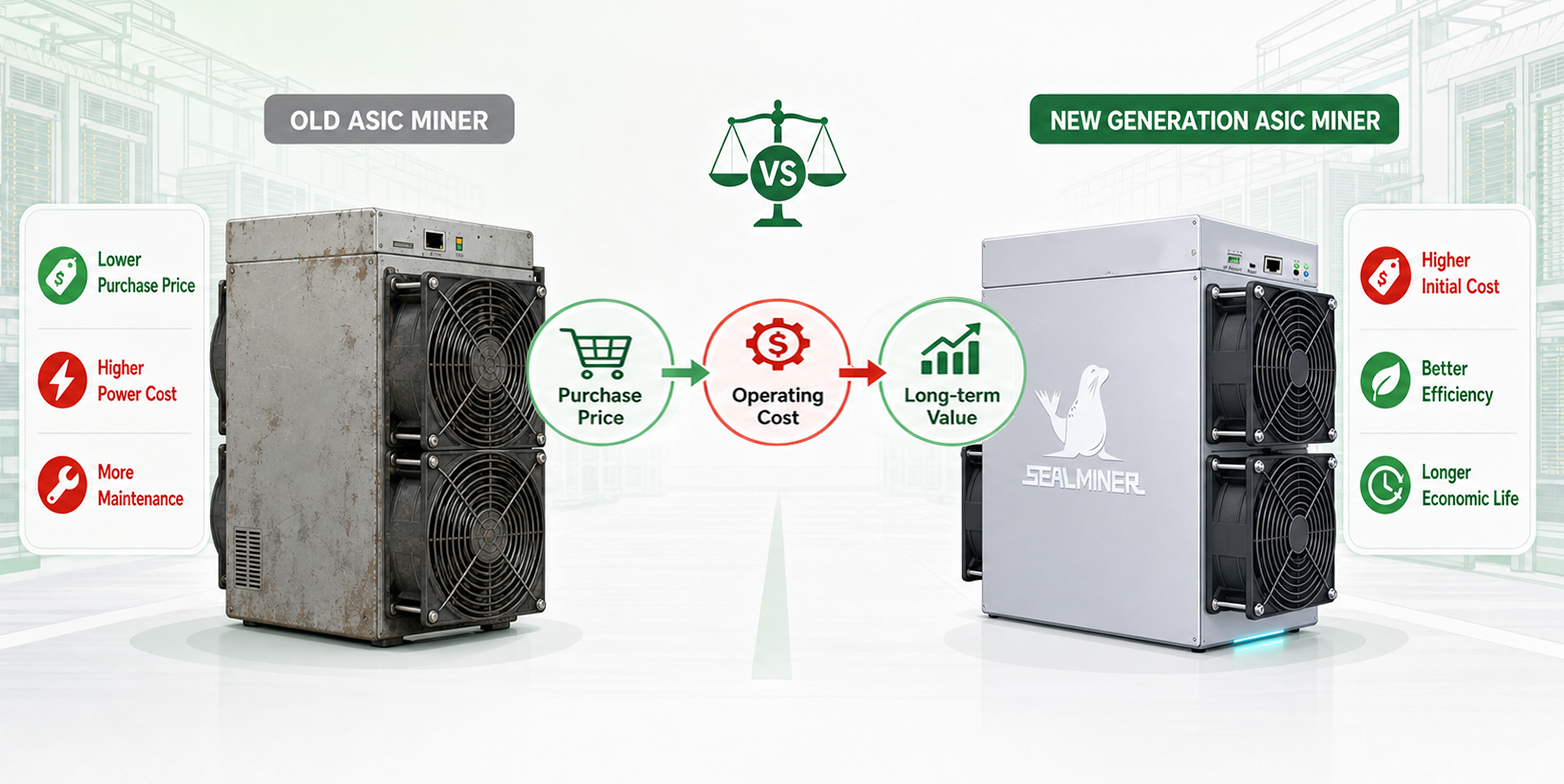
Consider two machines in the same hashrate class: a used older model costing $1,000 and a brand-new model costing $5,000. Over the full life cycle, the older machine’s lower efficiency drives up electricity cost per unit of hashrate. Aging hardware also brings a higher failure rate and greater maintenance expense; lost production during downtime adds another layer of hidden cost, while resale value declines quickly with age.
The new machine requires more upfront capital, but delivers better efficiency and operating stability, lower electricity and maintenance costs over its life, and stronger residual value retention. Once the full-cycle calculation is completed with the TCO formula, the older model’s apparent purchase-price advantage can be steadily eroded by higher electricity bills, repairs, and downtime. Over the complete life cycle, its actual total cost may even exceed that of the new machine.
The most common modeling mistake is using inconsistent definitions. If machine power is measured at the AC input, losses from the power supply and internal fans are usually already included; external exhaust, pumps, cooling towers, and other auxiliary loads must be added separately. On the revenue side, use the stable hashrate actually accepted by the mining pool. Only by putting meter-side power consumption and pool-side accepted hashrate on the same basis can you determine whether an older machine’s price advantage is being canceled out by extra electricity and downtime.
How Much Real Cost Does An Efficiency Gap Create?
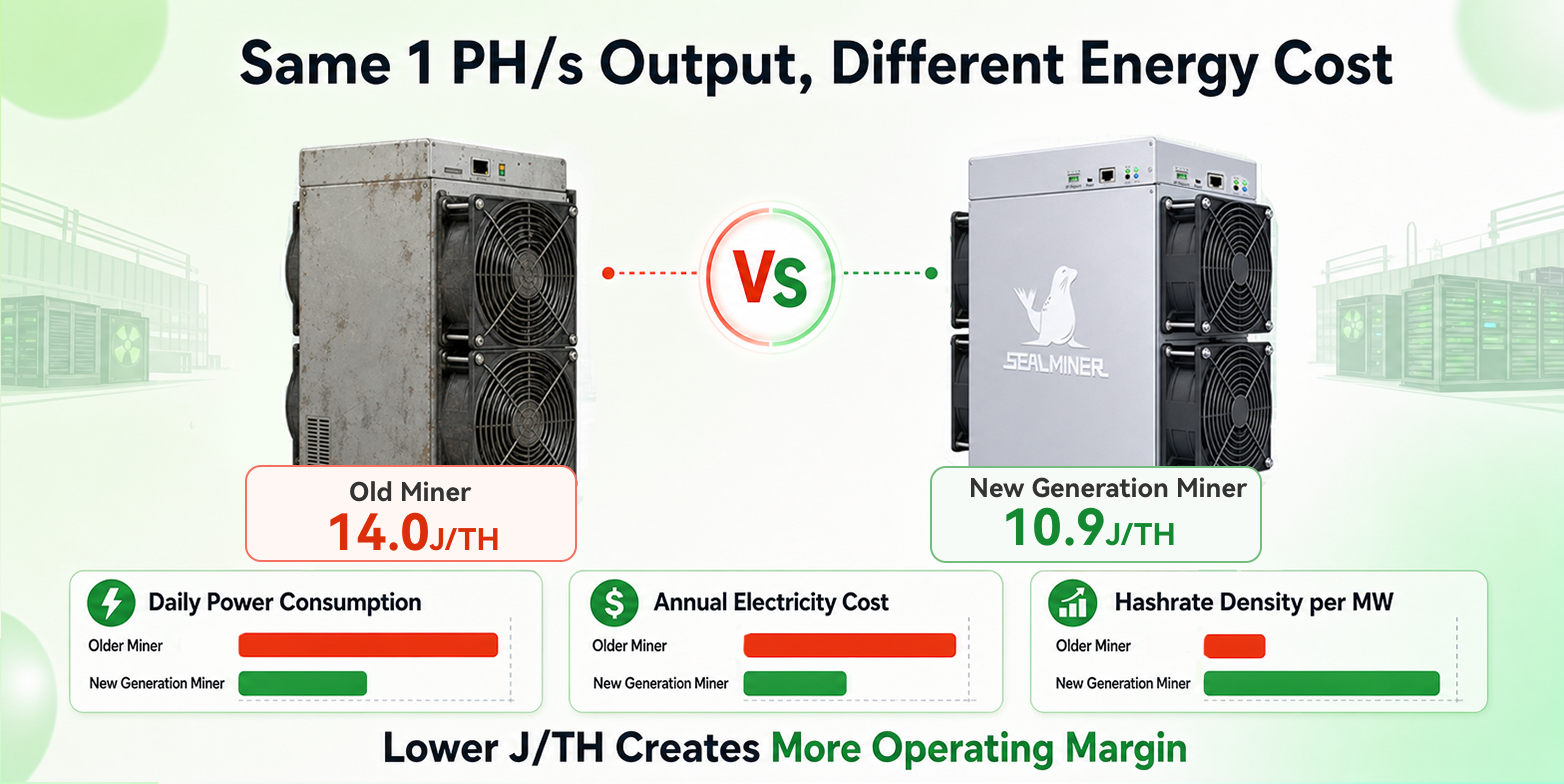
J/TH measures the energy required to produce 1 TH/s of hashrate. To avoid mixing different cooling architectures, compare two generations of air-cooling machines. The point is not which individual machine is “stronger,” but how much electricity it takes to produce the same 1 PH/s of hashrate, and how much hashrate a fixed power capacity can support.
| Comparison | A3 Air | A4 Pro Air | Operating significance |
| Efficiency | 14.0 J/TH | 10.9 J/TH | Energy use per unit of hashrate is about 22% lower |
| Daily power to maintain 1 PH/s | 336 kWh | 261.6 kWh | About 74.4 kWh less per day |
| Annual power cost for 1 PH/s ($0.06/kWh) | About $7,358 | About $5,729 | About $1,629 lower per year |
| Theoretical hashrate density at 1 MW | About 71.4 PH/MW | About 91.7 PH/MW | About 28% more hashrate at the same miner-load power |
This table translates the efficiency gap into two operating outcomes: long-term electricity cost per PH and the hashrate that can be deployed within a fixed power capacity. The $0.06/kWh figure is only a scenario assumption; in an actual purchase model, replace it with the all-in local power rate, including auxiliary power, hosting, and other fees.
For mining farms that are close to their power ceiling, the second outcome is especially important: a lower J/TH can support more productive hashrate without adding distribution capacity. Some models in the SEALMINER A4 series are already at 10.9 J/TH or below, providing one useful reference point for the efficiency level of newer-generation ASIC miners.
Note: Nameplate specifications are useful for initial screening. In an investment model, prioritize measured average power draw, stable uptime, and accepted pool hashrate.
When Is The Efficiency Premium On A New Machine Worth Paying?
To judge whether the extra cost of a new machine is justified, start with its “efficiency-premium payback period.” It answers one question: how long must the new machine run for electricity savings to recover its additional purchase cost?
Efficiency-Premium Payback Period = Delivered Price Gap Between New And Older Equipment At Equal Effective Hashrate ÷ Daily Electricity Savings
Plug in your own actual quote whenever possible, because miner prices can move quickly with market conditions, delivery batches, order size, and used-unit condition. Comparisons must also be normalized to “equal effective hashrate.” Comparing by machine count or nameplate TH/s alone can easily overstate the real value of a cheaper machine.
On the revenue side, look at both hashrate and hashprice. Put simply, hashrate is how much “production capacity” you have; hashprice is what that capacity can earn on a given day. When hashprice falls, electricity compresses the margin of high-J/TH machines faster. If the efficiency premium has not yet been recovered and an older machine is already approaching its shutdown line, the original purchase discount has not translated into a better full-cycle return.
Why “It Still Powers On” Does Not Mean “It Is Still Worth Running”
A miner’s physical life and economic life often end at different times. A machine may continue to operate normally, but once revenue per unit of hashrate falls below the marginal cost of keeping it online, its economic life is nearing the end. To gauge this pressure, start with a simplified shutdown threshold that includes only the machine’s own electricity cost.
Electricity break-even hashprice (USD/PH/day) is a core measure of a miner’s electricity break-even point. Physically, it is the minimum daily revenue required per 1 PH/s of hashrate to cover the machine’s basic operating electricity cost. The formula is:
Electricity-Shutdown Hashprice (USD/PH/day) ≈ J/TH × 24 × Power Rate
Using $0.06/kWh as the scenario assumption, 14.0 J/TH corresponds to about $20.16/PH/day, while 10.9 J/TH corresponds to about $15.70/PH/day. So when market hashprice falls below $20.16/PH/day, this type of machine may struggle to cover even its electricity bill.
To maintain 1 PH/s, a 10.9 J/TH machine consumes about 261.6 kWh per day, costing roughly $15.70 in electricity. In other words, higher efficiency lowers the electricity-shutdown line and creates more breathing room during low-revenue periods.
The Key Difference Between Electricity-Shutdown Hashprice And Shutdown Coin Price
Both metrics help miners think about when mining stops making economic sense, but they answer different questions. Hashprice focuses on revenue per unit of hashrate, while shutdown coin price focuses on the market price of a specific coin under a full operating-cost model.
1. Different measurement basis: Electricity-shutdown hashprice is measured as daily revenue per unit of hashrate and directly links hash output to electricity cost. It is not tied to a specific coin price, making it useful for general hashrate-cost and efficiency analysis. Shutdown coin price is measured as the market price of one coin and is tightly linked to a specific asset, so it applies only to mining-revenue calculations for that coin.
2. Different cost coverage: Electricity-shutdown hashprice covers only the machine’s own electricity cost, making it the most basic break-even line. Shutdown coin price generally includes electricity, hosting, depreciation, maintenance, and other operating expenses, serving as the break-even standard for a complete operating model.
3. Different application: Electricity-shutdown hashprice is mainly used to quickly test a machine’s minimum survivability, compare efficiency across models, and analyze industry-wide hashrate costs. Shutdown coin price is used for go/no-go decisions and revenue modeling for a specific coin and operating setup.
When Can A Low-Cost Older Machine Still Make Sense?
From an investment and procurement perspective, a low sticker price is not the same as economic value. Whether an older miner is sensible depends heavily on the match between the operator’s energy resources, maintenance capability, and deployment scenario. Under the following core conditions, buying discounted older hardware can still have clear economic logic.
The main support for an older machine’s value comes from low-cost energy, a deep purchase discount, and a mature maintenance system. A farm with cheap power or flexible pricing can run high-power older machines at full load when hashprice is high, then shut them down proactively as revenue approaches the electricity-shutdown line. This elastic operation amplifies the price advantage and offsets the efficiency penalty. A stable parts supply chain and strong repair capability can also materially reduce failure downtime and maintenance costs, weakening the older machine’s biggest operational disadvantage.
Core Procurement Metric: Purchase Cost Per Unit Of Effective Hashrate
Purchasing decisions should not rely on the quoted equipment price alone. Make effective purchase cost per TH the core metric. A used machine may look cheap on paper, but if its long-run stable hashrate is below nameplate, it frequently crashes and reboots, or its uptime is poor, the effective hashrate delivered can shrink dramatically. The apparently low acquisition cost per unit of hashrate then rises sharply. The discount on a used model must therefore be supported by verifiable stable output and a genuine assessment of machine condition; otherwise, the price advantage exists only on paper.
Typical Scenarios Where Buying Older Hardware Is Rational
Beyond those baseline conditions, choosing discounted older machines can also make economic sense in the following situations:
1. Short-term hashrate expansion: For a short-term expansion aimed at a defined market upswing, an older machine’s extremely low upfront cost can materially shorten the payback period. If the cycle ends and the machine is sold quickly, the residual-value loss can be much lower than with a new model, making it suitable for temporary and flexible deployment.
2. Using spare power and rack capacity: At an established farm with spare power, cooling, or rack capacity, low-cost older machines can activate idle capacity without major new infrastructure spending. That adds hashrate while spreading fixed operating costs more effectively and improving marginal return on investment.
3. Keeping older miners as backup capacity: Keeping discounted older machines as a reserve pool allows them to step in quickly when primary machines fail, undergo scheduled maintenance, or the network hashrate fluctuates. Their low-utilization standby role can also offset much of the disadvantage of lower efficiency.
The riskiest combination is high power cost, high J/TH, and a long payback period, layered with optimistic revenue assumptions. In that setup, the money saved at purchase can easily be consumed by ongoing electricity bills and early shutdown.
Before You Order, Replace A Single Roi With Three Scenarios
Return on investment (ROI) is useful for summarizing an outcome, but miner selection also requires downside scenarios. Do not ask only, “Can it pay back today?” Ask, “Can it hold up if the coin price falls, difficulty rises, or power gets more expensive?” We assume the following three scenarios:
| Scenario | Main assumptions | Key question |
| Base case | Use currently verifiable power rate, hashprice, uptime, and maintenance level | Does cash flow work under current conditions? |
| Stress case | Lower revenue per unit of hashrate, or reduce effective hashrate and uptime | How much room remains above the shutdown line? |
| Extreme case | Also assume higher power rates, more maintenance, or longer downtime | Should the machine keep running or exit early? |
All three scenarios should ultimately roll up to a few comparable outputs: actual daily electricity cost per PH, efficiency-premium payback time, electricity-shutdown hashprice, and whether cash flow remains positive under stress. After deployment, use meter-side power consumption and pool-side accepted hashrate to recalibrate the model; only then will the paper estimate gradually converge with real operations.
If you need to adjust hashrate, power draw, miner price, electricity cost, or pool fees quickly, use a BTC mining profitability calculator to compare scenarios. The results are best used to compare sensitivity across options, not as a fixed-return forecast.
New High-Efficiency Machines Or Low-Cost Older Ones: How Should You Decide?
If power is expensive, you plan to operate for the long term, or the farm is constrained by available capacity, a lower J/TH is usually more valuable because it improves daily electricity cost, hashrate density per MW, and downside survivability at the same time. Conversely, if you have extremely cheap and stable energy, a sufficiently deep equipment discount, and mature maintenance plus flexible start/stop capabilities, previous-generation hardware may deliver higher short-term capital efficiency.
A Quick Decision Framework: New Vs. Older Miners
| Decision factor | Favor high-efficiency new machines | Favor low-cost older machines |
| Power cost | High power cost | Extremely low and stable power cost |
| Operating horizon | Long-term operation | Short-term flexible deployment |
| Power capacity | Capacity constrained | Ample surplus capacity |
| Maintenance capability | Basic maintenance system | Mature repair and spare-parts capability |
| Market outlook | Down or sideways market | Short-term uptrend |
| Core evaluation metric | Full-life-cycle TCO | Short-term capital return |
The decision ultimately comes down to one sentence: Is the older machine’s discount large enough to cover its future excess electricity, maintenance losses, and shorter economic life? Put the real delivered price, effective hashrate, all-in power cost, and stress scenarios on the same page, and “new machines are too expensive” or “older machines are a better deal” becomes a testable operating judgment rather than a gut feeling.
Before committing to a specific model, compare specifications with your actual quote, power rate, site conditions, and stress-test assumptions. Resources such as the Bitdeer Learning Hub can also help you better understand miner efficiency, power-cost management, profitability modeling, and operating risk.
Risk disclosure: The power rates and calculation examples in this article are for illustrating cost sensitivity only and do not constitute a return guarantee or investment advice. Actual results will also depend on the BTC price, network difficulty, power rates, pool fees, equipment performance, and uptime.
*Information provided in this article is for general information and reference only and does not constitute nor is intended to be construed as any advertisement, professional advice, offer, solicitation, or recommendation to deal in any product. No guarantee, representation, warranty or undertaking, express or implied, is made as to the fairness, accuracy, timeliness, completeness or correctness of any information, or the future returns, performance or outcome of any product. Bitdeer expressly excludes any and all liability (to the extent permitted by applicable law) in respect of the information provided in this article, and in no event shall Bitdeer be liable to any person for any losses incurred or damages suffered as a result of any reliance on any information in this article.


