
2U vs. 3U: Miner Weight, Design, and Profit Logic
06.04.2026
This blog provides a technical angle into the differences between 2U and 3U hardware specifications, helping you understand the key profit logic of the future mining industry.
Entering 2026, the performance metrics for mining rigs are shifting from raw hashrate to "total lifecycle efficiency." While the industry resorts to heavy 3U designs weighing 40kg to push hashrate specs, Sealminer’s commitment to a 21kg 2U lightweight architecture represents a more advanced engineering philosophy. By optimizing thermodynamic flow channels and cooling materials, the 2U design not only achieves a world-class energy efficiency ratio of 9.45 J/TH (hydro-cooling) but also saves mine operators significant hidden costs in freight, deployment labor, and rack density. This blog provides a technical angle into the differences between 2U and 3U hardware specifications, helping you understand the key profit logic of the future mining industry.
The Overlooked Parameter—Weight, Volume, and Power Consumption
Most investors and mine operators primarily focus on hashrate and energy efficiency (J/T). However, as industrial precision equipment requiring large-scale, high-density deployment, the physical specifications of a miner—especially its Rack Unit (U) size and total weight—actually lock in the initial construction costs and long-term operational efficiency of a mining facility.
As mining chips approach their physical limits, "crude" designs that rely solely on increasing chip counts to boost hashrate are revealing their flaws. When a miner weighs 40kg and occupies 3U or more of rack space, it triggers a chain reaction: skyrocketing international logistics costs, additional requirements for floor load-bearing structures, a dependency on professional hydraulic equipment for deployment, and extremely high shipping and time costs for repairs.
Therefore, the direction of hardware evolution in 2026 is moving from pure "performance competition" to a "comprehensive efficiency game" that includes maintenance economics. The "lightweighting" and "downsizing" of miners have become core indicators of a manufacturer’s engineering prowess.
Hardware Architecture: 3U "Material Stacking" vs. 2U "Precision Calculation"
To understand the differences in miner design, one must first understand the standard data center height unit "U" (1U is approximately 1.75 inches / 44.45 mm). Currently, many manufacturers in the industry adopt heavy 3U designs (5.25 inches / 133.35 mm) to chase impressive on-paper hashrate figures. From a technical standpoint, a 3U structure provides more internal space to easily accommodate more hashboards or massive heatsinks. This "material stacking" mode lowers the threshold for thermal management design but directly leads to machine weights soaring to around 40kg.
In contrast, adhering to a 2U architecture (3.5 inches / 88.9 mm) is a "precision calculation" of sophisticated engineering. Achieving equivalent or superior performance in a tighter space means overcoming more severe thermodynamic challenges. This requires advanced chip packaging technologies to optimize thermal resistance and necessitates re-modeling the fluid dynamics within the chassis.
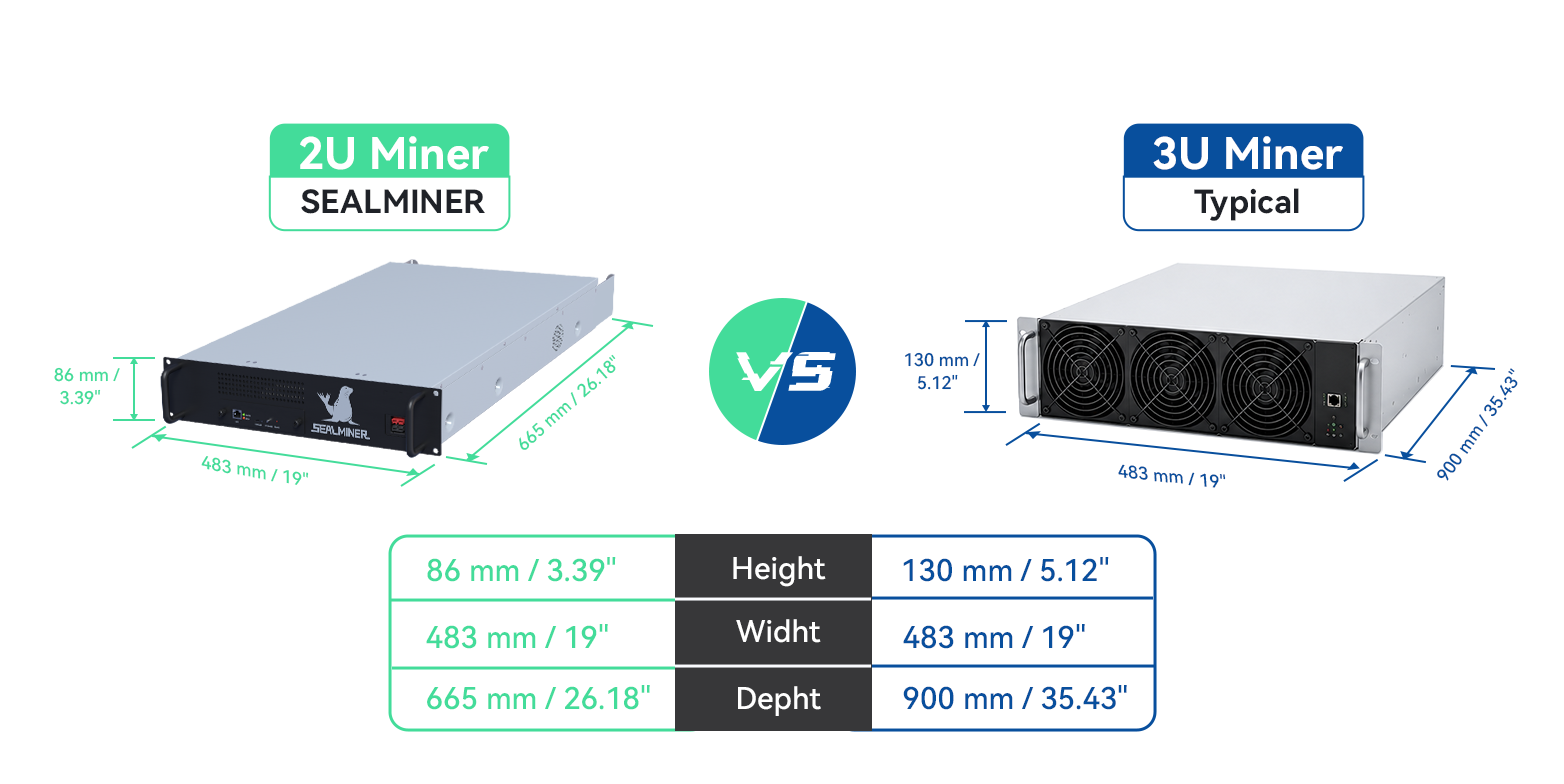
Looking at final customer applications—using a 40U rack as an example—a 2U miner allows for a maximum of 20 units, while a 3U miner can only fit 13. This is a 35% reduction in unit count; consequently, a 3U miner would need to increase its single-unit hashrate by 54% just to match the total rack hashrate of the 2U setup. In reality, the hashrate increase of 3U miners over 2U miners falls far short of 54%, leading to a decrease in overall deployed hashrate and significant spatial waste for the user.
This is why the Sealminer A4 Ultra Hydro is the cost-effective choice for customers. While maintaining a 2U spec and a weight of only 21kg, it also achieves a world-leading energy efficiency ratio of 9.45 J/TH.
Behind this "lightweight" design is a dual breakthrough in materials science and structural engineering. By utilizing light alloys with higher thermal conductivity and more efficient flow channel designs, 2U miners can achieve industry-leading energy conversion efficiency at roughly half the weight of competitors. For mine operators, those "missing" 19 kilograms represent a more scientific industrial design and a precise capture of the balance between performance and maintainability. True technical progress should not be the blind expansion of volume, but the release of greater productivity in a more efficient and lighter physical form.
Thermodynamic Perspective: How Volume Impacts Cooling Efficiency
In traditional industrial perception, people often fall into the intuitive trap that "bigger is better for cooling." However, in the era of liquid cooling represented by the Sealminer A4 Ultra Hydro, the core of cooling performance has shifted from "physical volume" to a balanced art defined by flow rate, flow resistance, and heat exchange efficiency.
From a physics standpoint, the specific heat capacity of liquid is much higher than that of air, allowing hydro-cooling systems to carry higher heat loads in smaller volumes. In heavy 3U structures, redundant internal space often leads to longer fluid paths, which significantly increases power loss due to flow resistance within the system. In contrast, the 2U structure utilizes an extremely streamlined flow channel design to minimize resistance while maintaining high flow rates. This ensures that the coolant can rapidly dissipate heat from the chip core at an optimal temperature differential, achieving higher energy density.
The efficiency of hydro-cooling depends largely on the conduction distance from the heat source to the coolant. Heavy 3U miners, due to their massive metal mass (40kg), possess high thermal inertia—meaning while they offer a slight instantaneous buffer, the massive thermal mass leads to a sluggish cooling response under continuous high-load operation. 2U miners, by using high-conductivity light alloys to reduce weight to 21kg, essentially shorten the heat transfer path and eliminate ineffective heat accumulation.
In the hydro-cooling field, true technical leadership is not merely stacking cooling materials, but a calculation of flow logic that delivers higher heat-transfer quality within a compact 2U space. This sophisticated design allows miners to move away from bloated volumes and return to the essence of efficiency and profit.
Mining Economics: The Compounding Costs of a 19kg Gap
For professional mine operators running thousands or even tens of thousands of miners, a 19kg weight difference per machine is not just a physical value; it generates significant compounding costs across logistics, labor, and infrastructure.
Logistics & Deployment
In international shipping, freight costs are typically calculated based on either actual weight or volumetric weight. A 40kg heavy-duty miner means that for the same shipping container or air cargo space, the total hashrate you can transport is nearly halved compared to lightweight equipment. This creates a significant "upfront premium" on your CAPEX before the machines even go online.
Furthermore, logistics providers like DHL impose strict rules; for instance, exceeding 120 cm on any single side triggers a massive "Oversize Surcharge." While a 115 cm chassis might seem safe, the added dimensions of the pallet and protective packaging frequently push the shipment over the limit, resulting in unexpected penalties.
Comparison Cost
To illustrate this, let’s look at a realistic shipping scenario. For a total hashrate of approximately 11.5k T shipped from Vietnam to a data center in Texas, here is the cost breakdown comparing 13 units of the SEALMINER A4 Ultra Hydro (2U) against 10 units of a standard 3U competitor:
| Comparison Metric | SEALMINER A4 (13 Units) | Other 3U Miners (10 Units) |
| Total Hashrate | ~11,518 T | ~11,600 T |
| Total Chargeable Weight | 305.5 kg | 480.0 kg |
| Est. Rate (USD/kg) | ~$6.80 | ~$6.20 (Bulk discount) |
| Base Freight Estimate | $2,077.40 | $2,976.00 |
| Fuel Surcharge (~25%) | $519.35 | $744.00 |
| Total Estimated Freight (USD) | $2,596.75 | $3,720.00 |
| Freight Cost per Unit | $199.75 / unit | $372.00 / unit |
As shown above, although the SEALMINER requires more units to reach the same total hashrate, its compact 2U design and weight efficiency result in nearly 30% savings in total shipping costs.
The Labor Lever
Beyond shipping, deployment efficiency is an operational detail that beginners often overlook, yet it significantly impacts the bottom line. According to international occupational health and safety standards, a 40kg object typically requires a two-person lift or specialized hydraulic equipment for safe racking and maintenance. In contrast, the 21kg SEALMINER A4 can be easily handled and installed by a single technician.
In an era of rising labor costs across North America and Europe, this "single-operator" capability essentially doubles your team's deployment capacity. By reducing the reliance on heavy machinery and multi-person crews, the lightweight 2U architecture dramatically lowers your OPEX and accelerates your time-to-hashrate.
The Balance Point Between Performance and Maintainability
In mining engineering, high performance should not come at the expense of maintainability. By observing the two mainstream cooling solutions—air and hydro—one can see the unique advantages of lightweight design in total lifecycle management.
In the air-cooled miner market, where 12 J/TH efficiency is common and equipment is becoming increasingly bulky, devices that can keep energy efficiency (PE) under 11 J/TH while maintaining a lightweight architecture (like the A4 Pro Air) demonstrate superior engineering integration. For large-scale mining facilities relying on natural air cooling, the portability of the 2U structure significantly simplifies regular dusting and fan replacement, lowering the long-term technical threshold for maintenance.
While hydro-cooling systems offer a higher cooling ceiling, their maintenance complexity also increases. If a leak or hashboard failure occurs in a heavy 3U hydro-cooled miner, dismantling and repairing it is a time-consuming and labor-intensive task due to its massive weight and complex internal structure. In comparison, a 2U structure (like the A4 Ultra Hydro) tends toward a more modular and compact design, which not only shortens troubleshooting time but also minimizes the risk of damage during return-to-factory (RMA) shipping.
The "Occam’s Razor" of Miner Design
The best designs often follow Occam’s Razor—the principle that "entities should not be multiplied beyond necessity." The evolution of miners from 40kg to 21kg is essentially the result of both semiconductor process progress and industrial design optimization.
For investors seeking long-term stable returns, understanding the technical orientation behind 2U and 3U is vital. Heavy designs are often a form of "stacking compromise" during technical bottlenecks, whereas lightweighting is the "refined restructuring" of technological maturity. Those "missing" 19 kilograms remove redundant logistics costs, inefficient labor expenditures, and heavy infrastructure burdens.
In an era where hashrate is power, lighter, more precise, and more efficient hardware is the productivity tool that truly aligns with long-term value. By choosing equipment that achieves the golden balance between performance and maintainability, miners can maintain the leanest and most resilient profit posture across complex and changing cycles. Visit the Bitdeer Learning Hub for more insider deployment tips you may not know.
*Information provided in this article is for general information and reference only and does not constitute nor is intended to be construed as any advertisement, professional advice, offer, solicitation, or recommendation to deal in any product. No guarantee, representation, warranty or undertaking, express or implied, is made as to the fairness, accuracy, timeliness, completeness or correctness of any information, or the future returns, performance or outcome of any product. Bitdeer expressly excludes any and all liability (to the extent permitted by applicable law) in respect of the information provided in this article, and in no event shall Bitdeer be liable to any person for any losses incurred or damages suffered as a result of any reliance on any information in this article.


