
How to Earn Dogecoin: From Community Tips to Merged Mining
13.07.2026
This blog looks at how each method works and where it may or may not make sense.
When people think about earning Dogecoin (DOGE), the first idea that often comes to mind is simple: buy DOGE on an exchange, wait for the price to rise, and sell it for a profit. This is one of the most common ways to gain exposure to DOGE, but it also puts your capital directly at risk when the market moves against you.
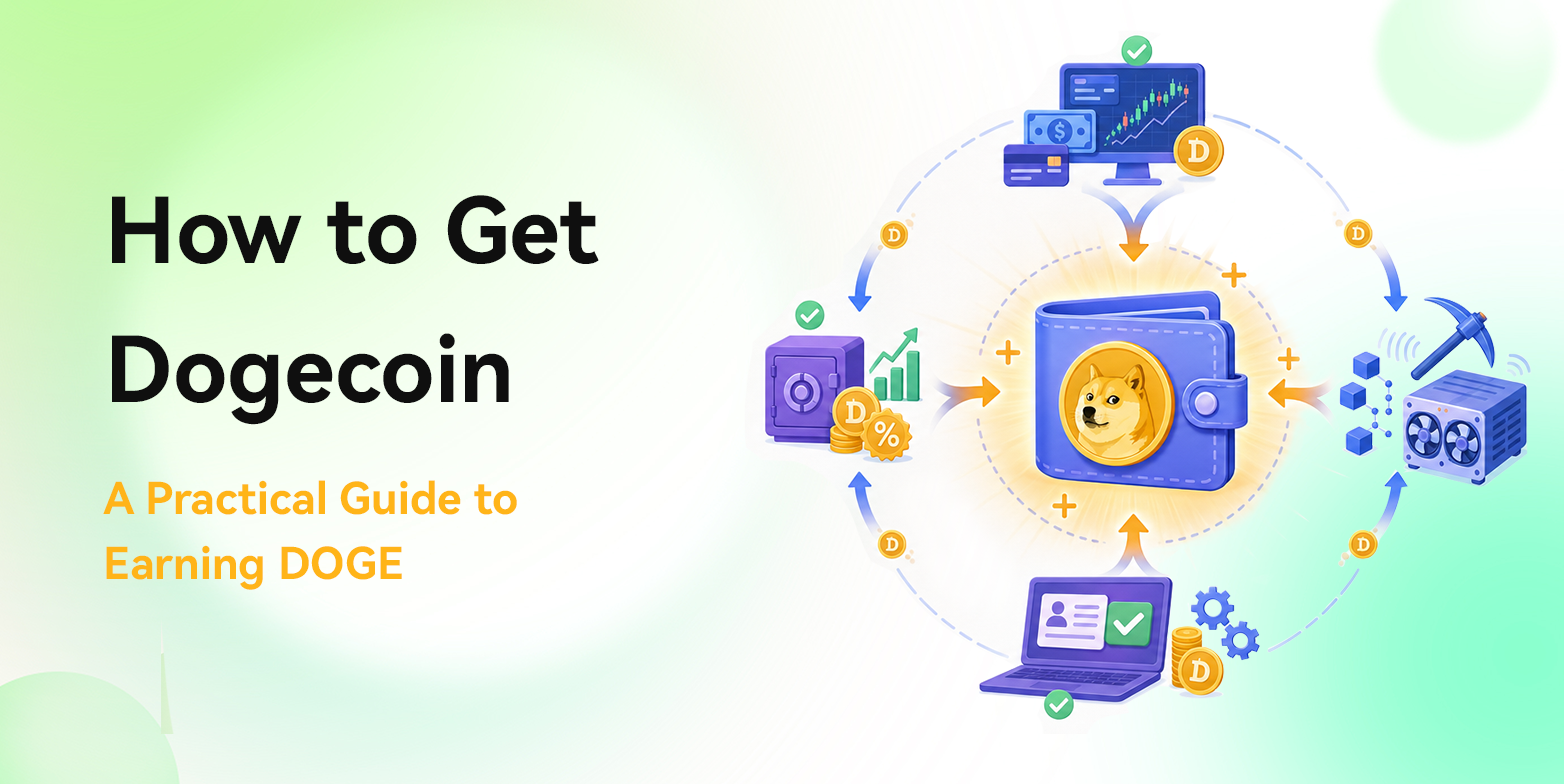
There are other ways to earn DOGE beyond buying and selling it. You can provide freelance services, create useful community content, accept DOGE as payment, complete reward-based tasks, or invest in hardware for merged mining. Each approach comes with a different mix of technical requirements, operating costs, capital needs, and risk. This blog looks at how each method works and where it may or may not make sense.
Buying DOGE: Exposure, Not Income
Buying DOGE through a centralized exchange or a supported fiat payment service is the fastest way to build a position. From a basic financial perspective, however, buying DOGE is simply exchanging one asset for another. The purchase itself does not create new income.
Your return depends mainly on DOGE’s price movement. You make a profit only if you later sell at a higher price after accounting for trading fees and other costs. This approach is better suited to users who understand position sizing and are comfortable with price volatility. Buying heavily after a social-media-driven rally can leave retail users exposed to sharp losses if the market reverses.
Accepting DOGE as Payment
For freelancers, independent designers, software developers, cross-border e-commerce sellers, and remote consultants, accepting DOGE as a payment option can be a practical way to earn crypto through work they already provide.
Crypto payments can also offer an alternative to traditional international settlement methods such as bank wires. This can be useful for smaller or more frequent payments from clients in different countries.
Because DOGE can be volatile, service providers may choose to convert part of each payment into a stablecoin or local currency. For example, a business might convert 70% of incoming DOGE to cover operating expenses while keeping the remaining 30% as a longer-term crypto position. The exact split depends on the business’s cash-flow needs and risk tolerance.
Content Creation and Community Tips
Dogecoin has had a strong tipping culture since its early days. Community members have long used small DOGE payments as a way to reward useful, entertaining, or helpful contributions.
If you create content on social platforms, Web3 blogs, or developer forums, useful technical or practical content may naturally attract tips from the community. Examples include DOGE wallet security and cold-storage guides, beginner-friendly phishing and scam-prevention tutorials, real-world operating logs for Scrypt mining hardware, power-consumption and profitability breakdowns, or balanced updates on blockchain technology and Dogecoin-related developments.
The long-term principle is straightforward: provide useful information first, then make it easy for readers to support your work if they want to. In established crypto communities, content that consistently provides value tends to build more trust than content that simply asks people for tips.
Task Rewards, Events, and Community Incentives
Some decentralized platforms, Web3 applications, and open-source communities use crypto-based bounty programs to attract early users, gather feedback, and encourage community participation.
Users may be able to earn DOGE or other crypto rewards by completing tasks such as product testing, bug reporting, technical-document translation, or educational content creation.
The quality of bounty programs varies widely, so beginners should pay close attention to security. Any task that asks you to send DOGE first in order to “activate” or “unlock” higher rewards should be treated as a serious scam warning sign. You should also avoid connecting a wallet that holds significant funds to an unaudited third-party Web3 site just to claim a reward. A separate wallet with limited funds is generally safer for this type of activity.
Most importantly, you should never share your seed phrase or private keys. Legitimate platforms, customer-support teams, and airdrop forms do not need them.
Mining Dogecoin
Many people still picture Dogecoin mining as something you can do by installing software on a home computer and using a CPU or GPU. In today’s mining environment, that approach is generally no longer economically practical for most users because network competition and hashrate requirements have increased substantially.
ASIC mining is a much more capital-intensive business. Mainstream industrial Scrypt miners often consume several kilowatts of power and use high-speed fans to remove heat. These machines can produce significant noise, which makes many industrial models impractical for homes and regular office environments. Residential electricity rates can also be much higher than industrial power rates, making it harder for older or less efficient machines to cover their daily electricity costs during low-margin periods.
That does not mean individual users are completely excluded from today’s mining ecosystem. Products such as the SEALMINER DL1 Air are designed for quieter Scrypt mining compared with conventional industrial miners, making them more suitable for lower-noise environments where cooling, space, and electricity access are more limited.
Even so, users still need to evaluate their all-in electricity rate, ventilation, heat removal, uptime, and expected payback. A more efficient miner can improve the operating equation, but profitability still depends on market prices, network difficulty, pool performance, and local power costs.
Trading DOGE: Potential Upside, but High Risk
Dogecoin is widely recognized as a meme-based crypto asset, and its price can react quickly to broader market conditions, social-media activity, and large on-chain transactions. That can create sharp short-term price swings.
Strategies such as grid trading or swing trading may allow experienced traders to accumulate more DOGE, but they can also create significant losses. Beginners who do not have a clear risk-management process should be especially cautious.
If you choose to trade, it is generally safer to limit the amount of capital exposed to short-term speculation to an amount you can afford to lose. High leverage adds another layer of risk because sudden price moves can trigger rapid liquidations.
Traders may use tools such as predefined position limits and stop-loss orders to manage downside risk. The important point is to define the risk before entering a trade rather than relying on emotion after the market moves.
DOGE Staking? Know What You’re Actually Buying
As Proof-of-Stake (PoS) assets have become more popular, beginners often see products advertising high yields from “staking DOGE.” This requires an important distinction.
Dogecoin is a Proof-of-Work (PoW) cryptocurrency. The Dogecoin network does not have a native on-chain staking mechanism that pays users simply for locking DOGE on the network.If an exchange or DeFi platform offers yield on DOGE deposits, the return usually comes from a separate financial product rather than from the Dogecoin protocol itself.
One common model is CeFi lending. A platform may lend deposited DOGE to other market participants and share part of the interest income with depositors.Another model uses wrapped DOGE in DeFi liquidity strategies. In this case, a wrapped version of DOGE may be supplied to third-party liquidity pools in exchange for rewards.
These products may be legitimate, but they introduce risks that are separate from the Dogecoin network itself. These can include counterparty risk, smart-contract risk, and liquidity risk during periods of market stress. Third-party financial yields should not be confused with native rewards from the Dogecoin protocol.
Which DOGE Earning Method Fits Different Types of Users?
The table below compares several common approaches based on user profile, key metrics, and risk.
| User Type | Best Fit | Key Metric | Risk | Notes |
| Beginner | Small recurring purchases, community rewards, tipping | Time required vs. potential reward | Low to Moderate | Start with secure wallet practices and low-cost community participation |
| Influencer | Add a DOGE tip address and publish educational content | Audience engagement, repeat support, consistency | Low | Focus on useful and accurate content that builds long-term trust |
| Freelancer | Accept DOGE as a payment option | Settlement speed, conversion percentage | Moderate | Use a suitable crypto payment processor and decide how much DOGE to keep versus convert |
| Miner | Deploy Scrypt ASIC hardware for LTC + DOGE merged mining | J/GH, long-term electricity cost, CAPEX payback | High | Requires reliable infrastructure, low-cost power, and disciplined operating and risk management |
Earning DOGE Starts with Understanding Where the Return Comes From
The best way to evaluate any DOGE earning method is to ask where the return actually comes from.
Buying DOGE exposes you to market price movements, so any potential gain depends on future prices. Accepting DOGE as payment allows you to earn crypto through services you already provide. Community tips reward useful content and audience engagement. Merged mining can generate revenue when mining rewards exceed electricity, hardware, and operating costs.
Legitimate crypto income does not appear out of nowhere. Every method requires something in return, whether that is your time, skills, capital, technical infrastructure, or willingness to take market risk.
Rather than waiting for the next sudden rally, start with what you already control: your skills, capital, electricity cost, technical setup, and risk tolerance. The best DOGE earning method is the one that matches your actual resources, not the one that looks most exciting during a market spike. For deeper crypto insights, visit the Bitdeer Learning Hub.
*Information provided in this article is for general information and reference only and does not constitute nor is intended to be construed as any advertisement, professional advice, offer, solicitation, or recommendation to deal in any product. No guarantee, representation, warranty or undertaking, express or implied, is made as to the fairness, accuracy, timeliness, completeness or correctness of any information, or the future returns, performance or outcome of any product. Bitdeer expressly excludes any and all liability (to the extent permitted by applicable law) in respect of the information provided in this article, and in no event shall Bitdeer be liable to any person for any losses incurred or damages suffered as a result of any reliance on any information in this article.


