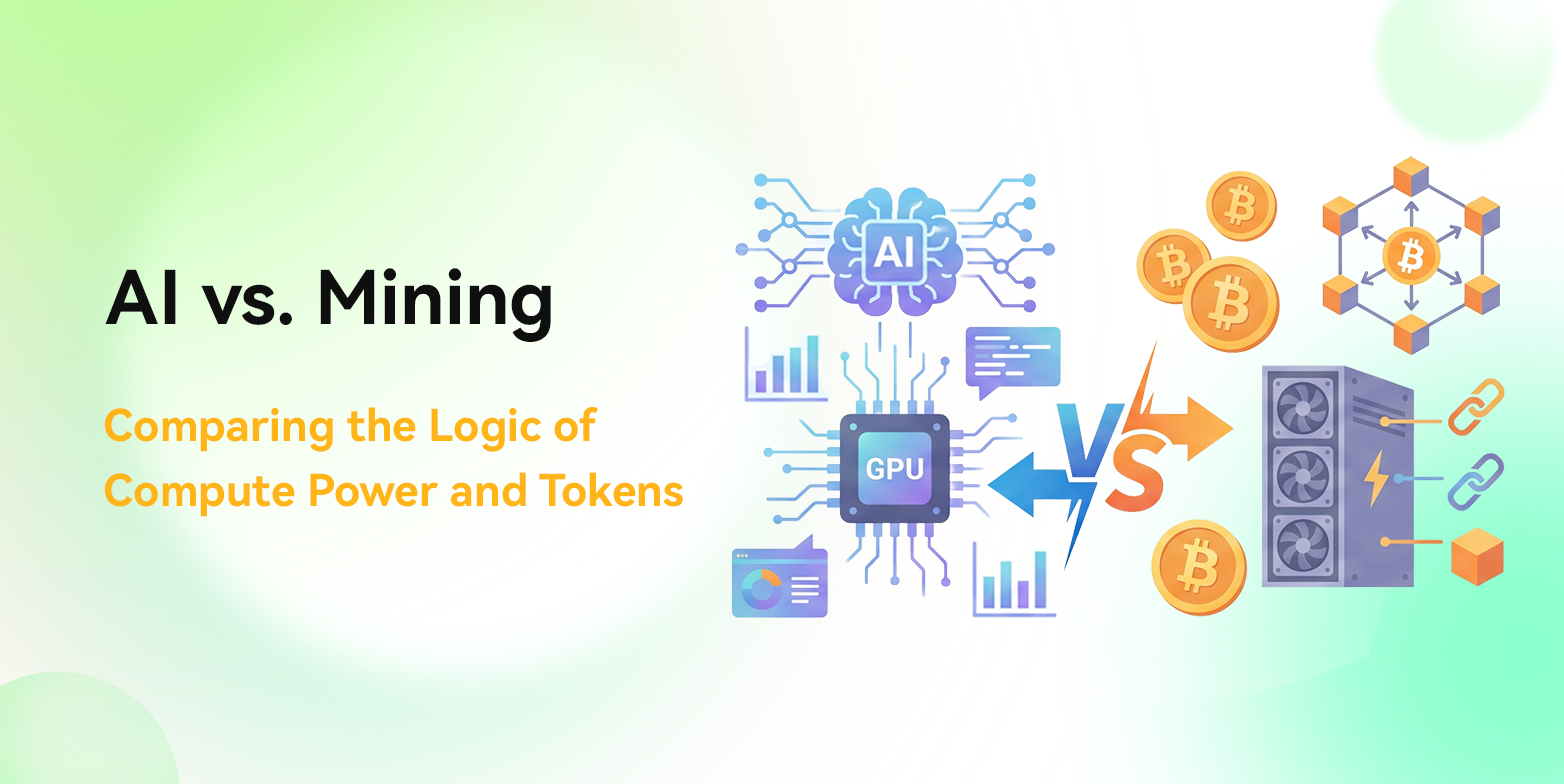
AI vs. Mining: Comparing the Logic of Compute Power and Tokens
2026.05.04
This blog uses simple industry logic to break down the physical limits of these two types of computing power. We look at physical chip limits and the true meaning of scarcity for both tokens. This will help you understand the core math behind both assets.
Companies spend huge amounts of money building facilities and buying chips. But are AI computing centers and crypto mining data centers really the same thing? Why do both industries use the word “Token,” while AI tokens and blockchain tokens follow completely different economic rules?
This blog uses simple industry logic to break down the physical limits of these two types of computing power. We look at physical chip limits and the true meaning of scarcity for both tokens. This will help you understand the core math behind both assets.
Both Use Power and Servers. Why Can't These Data Centers Simply Be Shared?
Many people assume that AI computing centers and Bitcoin mining data centers look almost identical. Both have rows of server racks, dense cables, large transformers, and machines running around the clock. Some people even argue that since both systems consume electricity to generate computing output, operators can simply unplug mining rigs and replace them with GPUs when mining profits decline. However, this idea ignores the strict infrastructure requirements behind different types of computing workloads.
Bitcoin mining data centers are rare "flexible power consumers." If the power grid is overloaded or power prices spike, a mining farm can shut down thousands of machines in seconds. This power cut does not cause data loss or damage hardware. This ability to stop instantly allows mining data centers to get cheap industrial electricity. On the other hand, AI compute centers require a steady power supply. This is especially true for large model training, which requires over 99.99% uptime. If the power drops mid-way, weeks of work can be destroyed. Therefore, AI centers must buy very expensive backup battery systems (UPS) and generators.
Many traditional mining sites use semi-open buildings to save money. They use huge industrial fans to pull in outside air directly. This means the machines must handle dust, humidity, and seasonal temperature changes. Standard AI servers are very sensitive to the environment. High humidity or too much dust can easily cause short circuits in small electronic parts.
Simply put, mining data centers focus heavily on the lowest power cost per watt. They are willing to give up backup systems for this goal. AI data centers focus entirely on system stability. They must spend a lot of capital to remove any risks. These different design choices mean you cannot easily mix them up. Operators cannot swap the hardware directly, and they cannot reuse the setup without changes. However, some mining data centers have excellent power, cooling, and network potential. These sites can pivot to high-performance computing (HPC) or AI hosting after a costly upgrade. Learn more about ‘How Bitcoin Data Centers Power the HPC Era.’
Complex Probability Math vs. Massive Hash Guessing
We must look closely at the chips to understand why the hardware is not interchangeable. Let us see what they are calculating all day.
AI Compute: Massive Matrix Math
The work of AI compute is like running a large language model. We can use a simple example. Imagine thousands of students sitting in one classroom. They are all working together on a very complex, connected math problem about probability.
When you speak to an AI, the system breaks your words into many number patterns called vectors. Then, it runs massive multiplication and addition math across a network of trillions of settings called parameters. Every time it writes a word, it looks at the meaning of the past words. It calculates the highest probability for the next word.
This type of workload has two strict requirements. First, AI requires high precision. The industry now uses lower-precision formats such as INT8 and FP8, but these calculations still involve floating-point values and high-dimensional vectors. Data errors or transfer problems can reduce output quality and sometimes create responses that miss the intended meaning.
Second, AI heavily depends on memory speed. GPU cores run extremely fast, but they constantly need to read and write trillions of parameters from memory. If memory cannot deliver data fast enough, expensive GPU cores sit idle and wait for more information. This limitation is often called the memory wall. This issue explains why leading AI chips in 2026 rely on high-bandwidth memory technologies such as HBM3e and HBM4. In many cases, memory itself costs more than the computing cores.
Mining Compute: Simple and Repeated Hash Guessing
In contrast, mining power like Bitcoin uses a much simpler method. It does not need to think. The process is like buying lottery tickets very fast using pure physical force.
A mining rig does not need to understand any context. It does not make complex probability guesses. It only does one thing. It takes a piece of data called a block header, adds a random number to it, and runs it through a fixed math formula like SHA-256. Then, it checks how many zeros are at the start of the result. If the number of zeros is wrong, it means the rig did not win. It immediately tries the next random number. This continues until one lucky machine in the world guesses the right code.
This workload has very different requirements. A failed attempt has no relationship with the next attempt. This design means the chip does not need large amounts of memory to store temporary data. The chip performs nearly all calculations inside its own logic units and depends very little on external memory bandwidth.
A failed hash also has almost no impact on the overall process. If one calculation fails, the machine simply tries another nonce. A failed attempt does not interrupt future calculations the way AI training tasks can.
A Comparison of Both Computing Powers
To see the technical boundaries clearly, we can compare them using this simple table:
| Feature | AI Compute Centers (Deep Learning/Inference) | Crypto Mining data centers (PoW Consensus) |
| Core Algorithm | GEMM (General Matrix Multiply) | Hash algorithms like SHA-256 / Scrypt |
| Main Chip Type | GPU / TPU / Custom Accelerators | ASIC (Application-Specific Integrated Circuit) |
| Memory Speed Need | Extremely High (Must use HBM to clear data bottlenecks) | Extremely Low (Math happens on the chip; no need for fast external memory) |
| Network Speed Limit | Extremely High (Thousands of cards must sync instantly; slow speeds ruin efficiency) | Extremely Low (The machine only needs a basic internet connection to send small updates) |
| Math Error Tolerance | Lower (Errors in key data can crash the model output) | 100% (Wrong guesses are thrown away instantly without hurting the next guess) |
| Main Metric | FLOPS / Latency | Hashrate / Energy Efficiency (J/TH) |
GPUs vs. ASIC Miners: Why Can Expensive GPUs Do Many Jobs While Miners Only Do One?
Now that we know the differences in math, we can see the business trade-off in hardware. It is a battle between flexibility and specialization.
Why do top Nvidia cards like the H100 or B200 cost tens of thousands of dollars each? Engineers design them to be highly flexible. Inside the chip, engineers include many control circuits and multi-level memory caches alongside the math units. This setup makes the GPU a general doctor. It can run a large language model today, render movie graphics tomorrow, and simulate complex fluids the next day.
To get this flexibility, the chip must give up some space and power efficiency. If you use it for one simple job like calculating hashes, its energy efficiency is much worse than a custom chip.
On the other hand, Bitcoin mining chips are custom circuits called ASICs. When factories make these chips, they permanently burn the SHA-256 math onto the hardware circuits. The design removes all unnecessary control parts, complex caches, and decimal math units. The chip is like a worker who only knows how to turn one specific screw for a lifetime. It uses all its space and power for just one task: hash math.
This extreme focus allows ASIC miners to reach amazing power efficiency. New models use less than 10 J/TH. However, this rigid design has a major downside. If the network changes its math formula or the coin loses its value, you cannot upgrade the software to run AI. Its business value will drop heavily, and the machine becomes almost useless.
Are AI Tokens and Blockchain Tokens the Same Thing?
In modern tech talks, the word "Token" is very common and easily confuses people. Even though people use the same word, the underlying tech runs on opposite logic for money and data.
AI Tokens
In AI systems, a token works more like a counting unit and a processing unit. AI models cannot directly read human words. The system must first break text into smaller pieces. For example, an AI tool cuts the word "mining" into "min" and "ing." Roughly speaking, 100 words equal about 130 AI tokens.
An AI token comes from probability math. It has no physical form and is not scarce. If you pay the electricity bill for the data center, you can ask the AI to write a massive book. It will create millions of tokens out of nothing. It is simply a basic measurement unit for the model to process language.
Crypto Tokens
In contrast, a token on a blockchain like BTC represents a verifiable record of asset ownership. It is not text made by math. It is a record verified by all computers on the network. When you send one token to someone on the chain, the system changes the ownership on the ledger across the whole network.
Some crypto assets like Bitcoin feature true scarcity. For example, the total supply of BTC is hard-capped at 21 million coins. Strict math proofs prevent double-spending, which means spending the same money twice. For other tokens on the chain, the network consensus confirms any change in ownership.
What is the Main Difference?
If we link the technical logic together, we see an interesting contrast. AI computing exists to create tokens. Mining computing exists to protect tokens. GPUs use power to run probability math and create logical text outputs. Miners use power to run hash math constantly. This protects the network consensus and makes it very expensive for anyone to change the ledger.
What Hidden Commonalities Do These Two Computes Share in Costs and Fees?
We spent a lot of time breaking down the differences between AI compute and mining compute. However, if we step back from the tech design and look at digital economics, we find a surprise. These two seemingly different businesses share similar rules for fees and energy.
The Price Tag of Compute Resources
When you give a prompt to a large model and get an answer, the API provider, like OpenAI, charges you based on the number of AI tokens you use. Behind this token cost is the electricity used by the GPU and the wear and tear of the chip.
Similarly, when you make a transfer on a blockchain network like Ethereum or Bitcoin, you must pay gas fees or transaction fees. Behind this fee is the electricity spent by miners running hash math to secure your spot in a block.
From a business perspective, both systems turn deep math and power use into a clear price for users. AI services charge per token, while blockchain transactions use fees to show the use of block space and consensus. They are not the same pricing system, but they prove one thing. The surface price of digital services always depends on the cost of computing power and energy at the bottom.
Machines That Turn Energy into Digital Value
The old industrial economy used power to drive machines that made physical items like cement and steel. These two compute data centers do something different. They elevate energy into the digital world. An AI center sends high-voltage power into GPU clusters. Through parameters, it produces the smart data flows that human society needs. A crypto mining farm sends industrial power into ASIC chips. Through hash math, it builds a solid math wall to produce scarce trust assets. From a broader view, both systems convert real-world power and compute costs into measurable value in the digital world.
How Do We Evaluate These Two Different Compute Assets?
Today, computing power is growing fast, and operations are becoming more precise. The market no longer blindly follows hype. Before spending big capital on a deployment, you must use numbers to manage risks.
AI compute is a flexible asset with high capital costs. Building its data center is very expensive. The network connecting thousands of cards is complex, and owners must constantly spend money to update GPUs. However, the advantage is that the chips are not locked into one single math formula. You can update the software to switch smoothly into different business uses.
Mining compute is a rigid asset focused purely on power efficiency with a very narrow use case. It has low requirements for network speed and stability. It focuses entirely on the best efficiency ratio under one specific algorithm. Although it faces the physical risk of being locked into one algorithm, it is still an excellent tool for power networks. In specific grid setups and energy trading situations, it remains the fastest and most certain tool to convert energy into cash.
When we understand the physical limits of both compute types and the asset properties of their tokens, we can make better business choices across different cycles. We can avoid using loose mining logic to build AI data centers. We can also avoid spending too much on unnecessary backup costs when upgrading a mining farm. You can use the Bitdeer mining calculator to enter your operational data. This will help you verify your facility's payback period and long-term ROI performance with real data.
*Information provided in this article is for general information and reference only and does not constitute nor is intended to be construed as any advertisement, professional advice, offer, solicitation, or recommendation to deal in any product. No guarantee, representation, warranty or undertaking, express or implied, is made as to the fairness, accuracy, timeliness, completeness or correctness of any information, or the future returns, performance or outcome of any product. Bitdeer expressly excludes any and all liability (to the extent permitted by applicable law) in respect of the information provided in this article, and in no event shall Bitdeer be liable to any person for any losses incurred or damages suffered as a result of any reliance on any information in this article.