
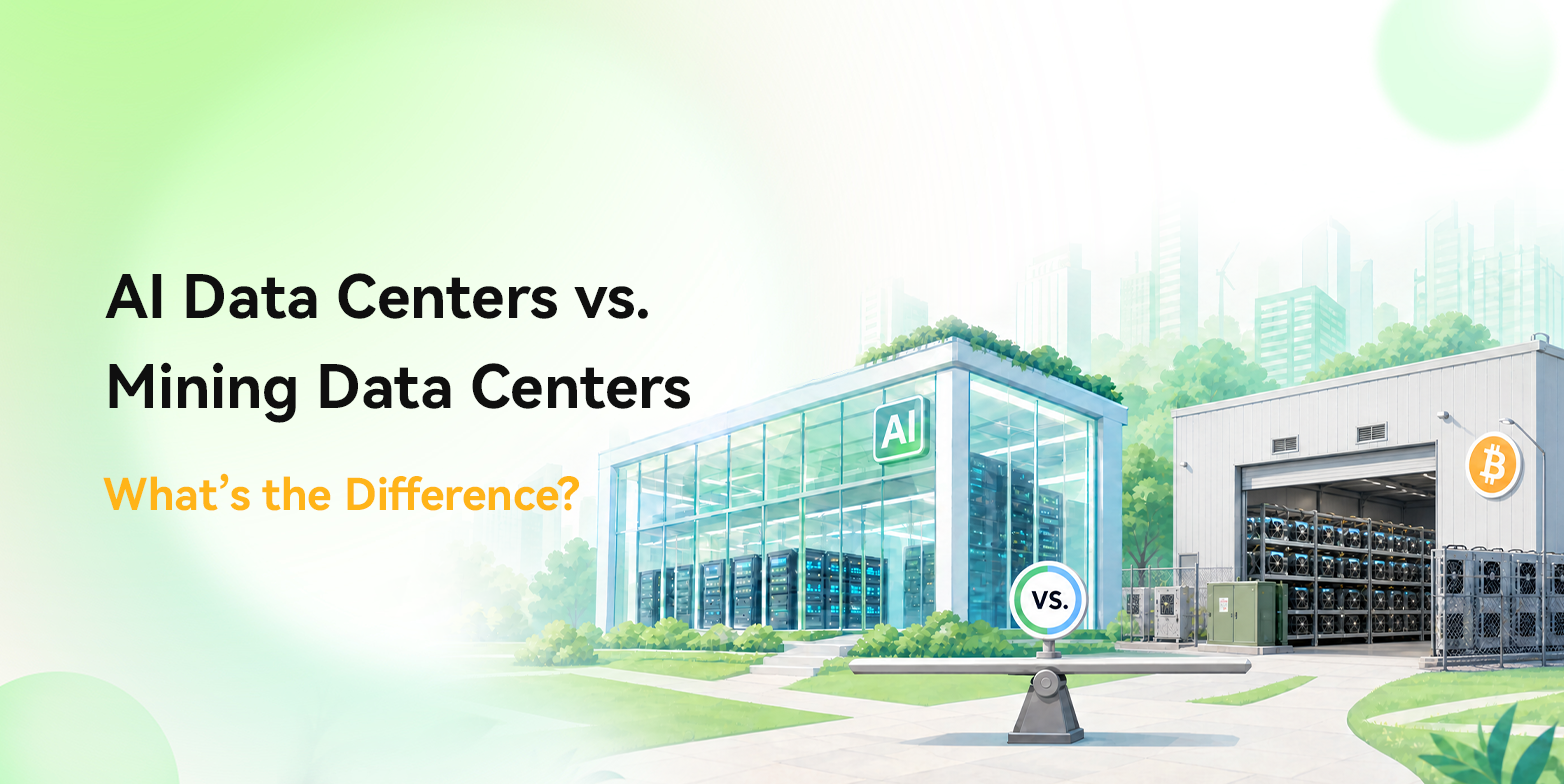
AI Data Centers vs. Bitcoin Mining Facilities: What’s the Difference?
22.10.2026
This blog compares the two types of facilities across five areas: chips, networking, power, cooling, and business model. It answers common questions such as, "Can an ASIC miner become an AI server through a software upgrade?" and examines whether a mine can realistically be converted into an AI data center.
AI data centers and Bitcoin mining facilities both require large-scale computing hardware, substantial power capacity, and advanced cooling infrastructure. But they serve fundamentally different purposes, use different types of chips, and have very different operational requirements.
AI data centers rely mainly on GPUs and other accelerators for large language model (LLM) training, AI inference, and massive data processing. Bitcoin mining facilities run ASIC miners built specifically for the SHA-256 hash algorithm, taking part in block production and securing the ledger on the Bitcoin network.
This blog compares the two types of facilities across five areas: chips, networking, power, cooling, and business model. It answers common questions such as "Can an ASIC miner become an AI server through a software upgrade?" and looks at whether a mine can realistically be converted into an AI data center.
What Do AI Data Centers and Bitcoin Mining Facilities Each Do?
At the most basic level, both consume megawatts (MW) of power to run high-speed computation. But what they compute, the commercial value they produce, and the end users they serve are completely different.
AI Data Centers: Computing Power for Model Training and Inference
AI data centers are built for the lifecycle of artificial intelligence models. They rely mainly on clusters of GPUs (graphics processing units) or dedicated AI accelerator chips to handle high-dimensional matrix multiplication and complex parallel computing. In day-to-day use, an AI data center's compute output generally falls into two stages:
- Model training: Think of it as "teaching a machine to learn by reading." Before launch, a large language model with hundreds of billions of parameters may need hundreds or thousands of GPUs running together for weeks or even months, taking in huge volumes of text to learn grammar, logic, and knowledge. At this stage, lost data or an interruption on any compute node can set training progress back.
- Model inference: Think of it as "a user asking an AI assistant a question." When you type a prompt into a chatbot and get an answer within seconds, or upload a photo to generate an image, the AI is running inference behind the scenes. Inference prioritizes low latency and high concurrency, and it serves businesses and consumers directly.
Bitcoin Mining Facility: Joining Network Consensus Through Hash Computation
A Bitcoin mining facility has thousands of ASIC miners that keep trying different nonces and computing SHA-256 hashes over and over, looking for a result that meets the difficulty target. The Bitcoin network produces a new block roughly every 10 minutes. Whoever finds a valid result earns the right to record the block, along with the block reward and the transaction fees in it. In practice, mining usually join a mining pool, which submits the block and then distributes earnings according to each participant's hashrate contribution.
Bitcoin mining facilities don't process users' text, images, or business data. Its computing power exists only to secure the Bitcoin ledger and make transaction records hard to tamper with.
From the outside, the two types of facilities are easy to confuse. Both have large buildings or modular containers, high-voltage substations and distribution, cooling towers or big fans, and operations teams on duty 24 hours a day. But similar infrastructure on the outside doesn't mean the equipment inside, or the way it runs, is interchangeable. Think of a cargo airport and a high-speed rail station: both cover a lot of land and need high-voltage power and a dispatch center, but the vehicles and what they carry are completely different.
GPU vs. ASIC: How Do the Two Chips Differ?
To understand how AI data centers differ from Bitcoin mining facilities, the key is to understand how GPUs and ASICs differ in hardware architecture.
| Dimension | GPU | ASIC |
| Compute architecture | General-purpose parallel computing: thousands of cores optimized for matrix and floating-point operations | Fixed-function circuits: the computing logic is hardwired during chip manufacturing and supports only SHA-256 |
| VRAM / memory | High-bandwidth memory (HBM3/HBM3e): up to several TB/s per card, enough for large models that read parameters constantly | Only a tiny amount of on-chip cache for temporary hashing data; no separate video memory |
| Software ecosystem | Mature development ecosystem (CUDA, PyTorch, TensorFlow); programmable to run different AI frameworks | Firmware-level control only: adjusting frequency, monitoring temperature, connecting to mining pools |
| Range of use | Broad: LLM training, image rendering, scientific computing, autonomous driving simulation, and more | Single-purpose: SHA-256 mining only (Bitcoin and similar); can't run other algorithms |
GPUs were originally designed for graphics rendering, so they naturally have thousands of cores that can work at the same time. That parallel architecture happens to suit the huge volume of matrix multiplication and addition in deep learning. High-end AI chips like the H100 and B200 also come with expensive high-bandwidth memory (HBM), because large language models often have tens or hundreds of billions of parameters, and the GPU has to shuttle massive amounts of data between memory and compute cores in a very short time. Add the mature CUDA software ecosystem, and developers can change the code so the same group of GPUs trains a language model today and handles image generation or autonomous driving simulation tomorrow.
An ASIC (application-specific integrated circuit) is a chip designed for one particular purpose. Bitcoin miner chips build the SHA-256 computing logic directly into the circuitry. Because they strip out anything unrelated to hashing, such as display output, complex instruction sets, and general-purpose memory controllers, ASICs can devote nearly all of their chip area and power to hash computation. That makes them far more energy-efficient and compute-dense than any CPU or GPU at SHA-256. The tradeoff is that they give up general-purpose use entirely.
Why Can't an ASIC Miner Become an AI Server With a Software Upgrade?
This is a common misconception among beginners, and the answer is clear: no amount of firmware or software upgrades can turn an ASIC miner into an AI server, because the limitation lies in the chip's physical circuitry.
Here's an analogy. Think of a GPU as a versatile computer that can perform different tasks by running different software. An ASIC is more like a specialized machine on a factory assembly line, built to perform one specific operation. Updating its operating instructions won't turn it into a completely different machine.
A miner's control board does run a simplified embedded system, but it only manages the device and connects to the mining pool, and it has very little computing power. The actual computing chips can execute only SHA-256. They have no matrix-operation units for deep learning and no high-bandwidth memory.
How Do Different Workloads Change Networking and Reliability Requirements?
When training a large AI model, a single GPU's memory can't hold the whole model, so the work has to be split across many cards and servers running in parallel. After each step, hundreds or thousands of GPUs must exchange data and synchronize parameters. If just one network link is congested or slows down, the entire cluster has to stop and wait, and compute utilization drops sharply. That's why AI data centers need more than ordinary Ethernet. They use high-speed interconnects such as NVLink, along with high-bandwidth, low-latency RDMA networks such as InfiniBand or RoCE v2.
Bitcoin miners work completely differently. Think of an AI cluster as a team working closely together, while Bitcoin miners work more independently. Tens of thousands of miners in a mine never need to exchange data with each other. Each miner just receives a small work package from the mining pool (usually no more than a few KB), computes locally and independently, and keeps submitting results that meet the pool's difficulty (shares). The data volume is tiny, so a mine doesn't need expensive high-speed internal networking. A stable commercial broadband connection is usually enough.
Why Do AI Data Centers Require Higher Availability?
The nature of the workload also determines how well a facility can tolerate a power interruption:
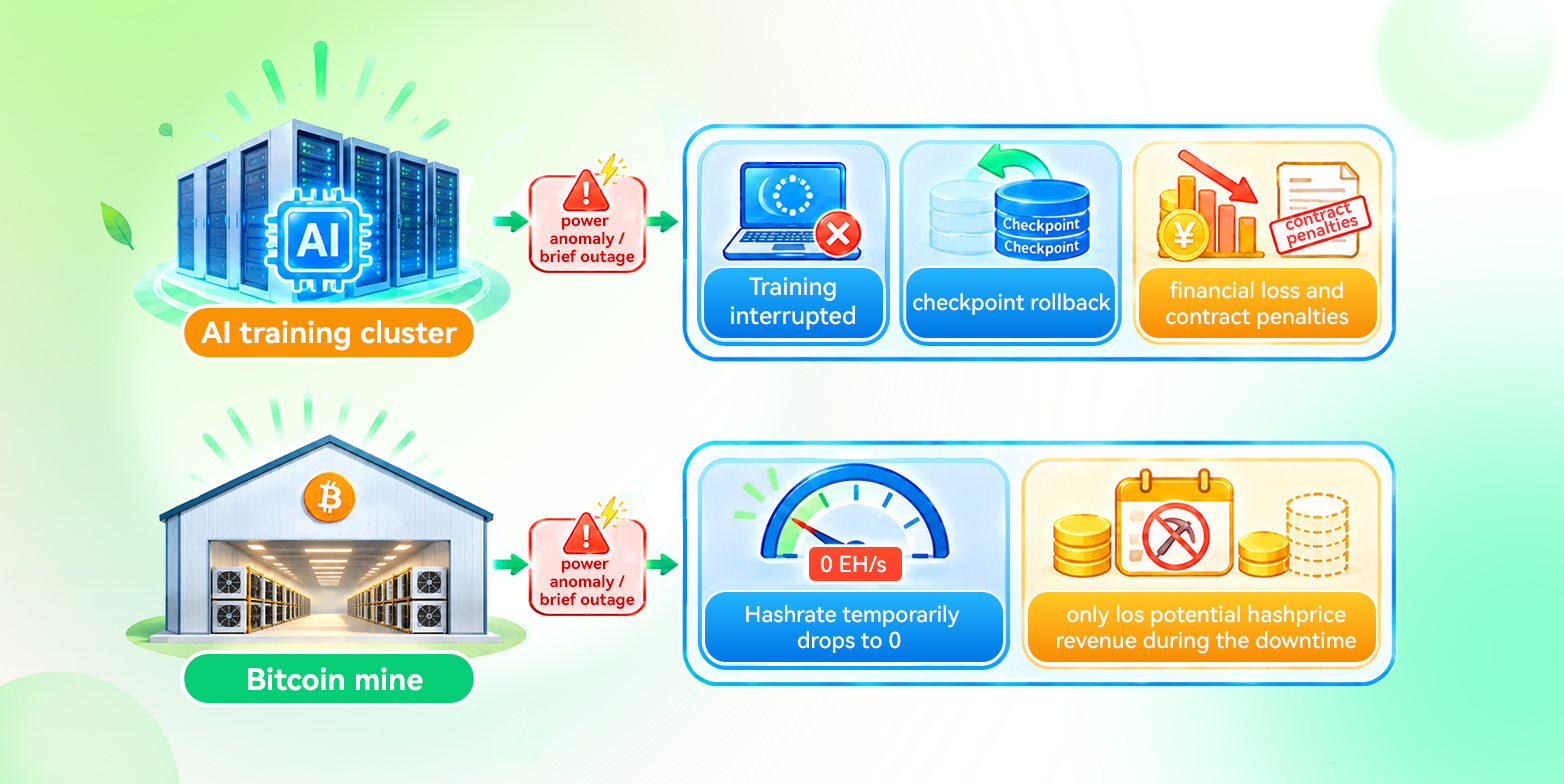
If an enterprise AI inference service goes down, customers' operations can grind to a halt and trigger steep service level agreement (SLA) penalties. And in the training of a model on tens of thousands of cards, a sudden power loss can wipe out computing state in memory that hasn't been saved. That forces a checkpoint rollback and wastes hours or even days of compute. Depending on workload requirements and service-level commitments, AI data centers may use UPS systems, backup generators, and N+1 or 2N power redundancy to maintain availability.
Bitcoin mining makes independent hash attempts every second, so there's no concept of accumulated computing progress. A mine can quickly cut its load or even shut down when power prices spike or the grid is under peak demand, which gives Bitcoin mining facilities a natural advantage in grid flexibility. That said, frequent power cycling does add wear to power supplies and hash boards.
How Do Cooling Methods and Power Density Differ?
Heat removal is one of the biggest physical challenges in data center engineering. Both types of facilities have to handle megawatts of heat. But because rack differences in power density call for different cooling approaches.
Traditional general-purpose IT racks typically run at 5–10 kW of power density. A single flagship AI chip, meanwhile, already draws 700–1,000 W or more, and the latest high-density GPU racks (such as NVIDIA's NVL72 architecture) can exceed 100 kW per rack. At that density, air can't carry heat away from the chip surface fast enough.
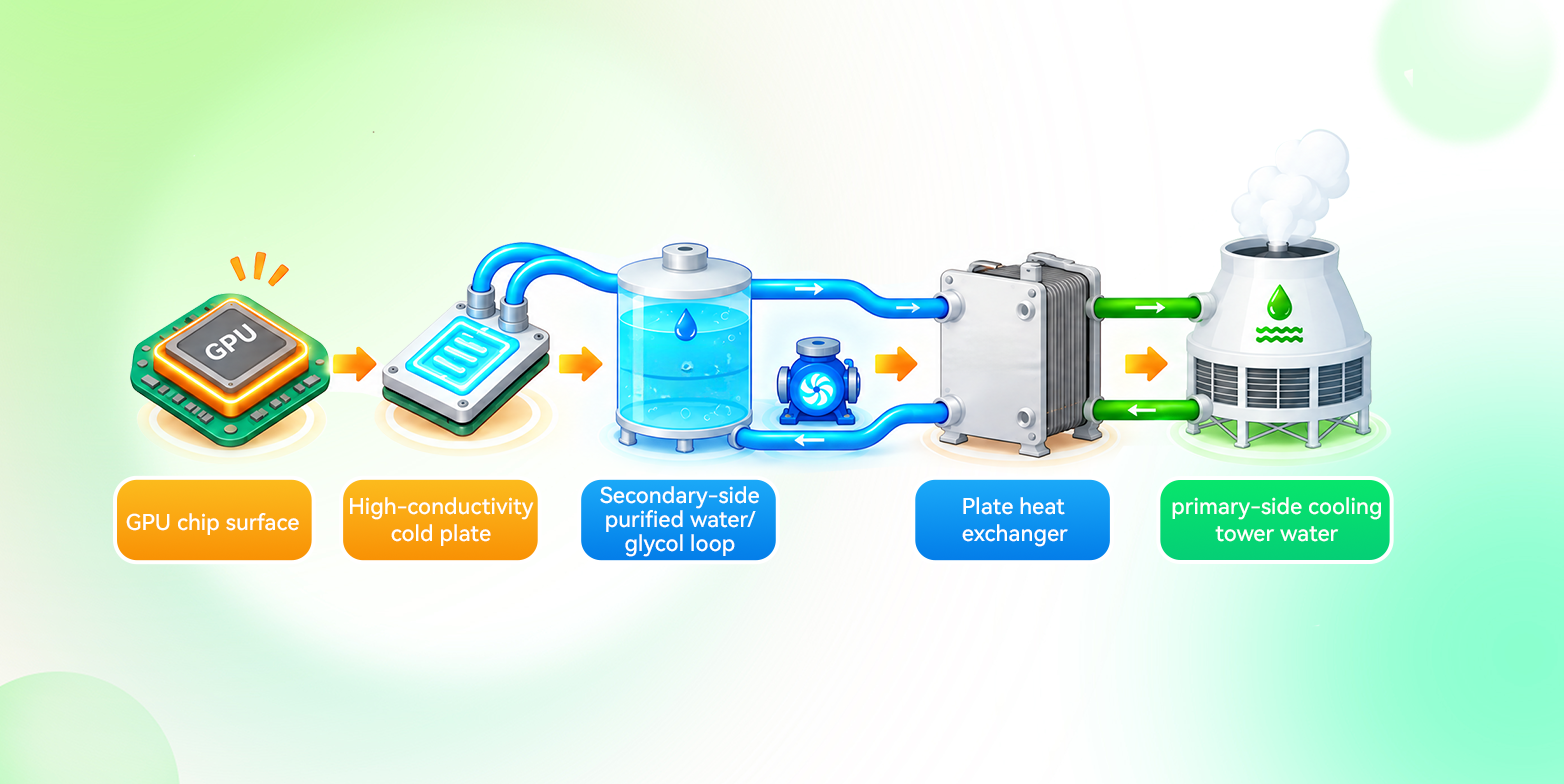
As a result, AI data centers are moving quickly toward direct-to-chip liquid cooling (DLC). High-purity coolant flows through metal cold plates attached directly to the GPU chips, carrying heat to the heat exchanger in a coolant distribution unit (CDU). The heat is then rejected outdoors through the primary-side cooling water system (such as a cooling tower).
What Cooling Methods Do Bitcoin Mining Facilities Typically Use?
Because their equipment is purpose-built and cost-sensitive, Bitcoin mining facilities use a wider range of cooling solutions, depending mainly on local climate, power prices, and cost considerations. Traditional mining commonly use negative-pressure air-cooling buildings with high-volume industrial fans and evaporative cooling pads. The upfront construction cost is very low, but maintenance gets more expensive in hot, humid, or dusty regions.
As high-density miners become more common, such as the hydro-cooling SEALMINER line, solutions that pair closed-circuit cooling towers with hydro-cooling containers are increasingly widespread. Hydro-cooling containers support higher-density deployments, reduce fan noise, and provide efficient cooling in high-temperature environments.
Another approach is to submerge miners entirely in insulating coolant, which carries heat away from the hash boards directly. This is called immersion cooling (or oil cooling). It supports higher overclocking performance and keeps out dust, but the coolant and maintenance costs are higher.
Even with the same 20 MW of power capacity, an AI data center might need a hundred or more high-density liquid-cooling racks with precision temperature control, while a Bitcoin mine might simply deploy a few dozen modular hydro-cooling containers or build one long, negative-pressure air-cooling building. The two differ greatly in building structure, piping layout, and fluid engineering.
How Do Costs and Revenue Models Differ Between AI Data Centers and Bitcoin Mining Facilities?
From a business perspective, AI data centers and Bitcoin mining facilities operate under very different revenue models. Even when they consume the same amount of power, their revenue sources, cost structures, and exposure to market risk are fundamentally different.
How Do AI Data Centers Make Money?
An AI data center's business model is closer to traditional B2B tech infrastructure services. Its revenue is built on customer contracts and service quality (SLAs):
- GPU compute rental: Renting out GPU compute nodes (such as H100/B200 clusters) by the hour, month, or year to AI startups, model developers, and enterprise customers. Customers pay based on compute usage and data transfer.
- Colocation: Customers buy their own GPU servers, and the data center provides only rack space, highly redundant power, high-spec liquid cooling, and network bandwidth. It charges service fees by the megawatt (MW) or by monthly rack rental.
- Industry solutions: Optimized inference or fine-tuning compute platforms for specific industries such as finance, healthcare, and autonomous driving.
How stable this revenue is depends on customer order volume, GPU utilization, and renewal rates. Once a long-term enterprise contract is signed, cash flow is usually steady. But if competition intensifies and GPUs sit idle, the operator still faces significant equipment depreciation and facility operating costs.
How Do Bitcoin Mining Facilities Make Money?
A Bitcoin mine's business model is far more direct. At its core, Bitcoin mining facilities uses electricity and specialized computing hardware to generate mining rewards. The ASIC miners in the mine connect to the Bitcoin network and compete to record blocks by contributing hashrate. When the mining pool successfully finds a block, it receives the block reward and transaction fees, then distributes the earnings according to each mine's effective hashrate contribution under an agreed payout method (such as FPPS or PPLNS). The Bitcoin mined can be sold on the market at any time or held as an asset.
Mining revenue is notably volatile and cyclical. Hashprice is primarily driven by Bitcoin's price, network difficulty, and transaction fees, while local electricity costs determine how much of that revenue remains as operating profit. Unlike an AI data center, a mine doesn't need a sales team to find customers. As long as the miners are on and connected to a pool, the pool settles earnings automatically on its payout cycle.
Can a Mining Data Center Be Converted Into an AI Data Center?
As demand for AI computing continues to grow, many Bitcoin mining operators with access to megawatts of power and substantial land resources are considering whether their sites could be converted into AI data centers. The answer is that the site infrastructure has some reuse value, but conversion is far more than "pull out the ASICs and swap in GPUs."
Bitdeer is also transitioning its Tydal Bitcoin mining site in Norway into AI/HPC data center infrastructure. According to the third-quarter 2026 financial results, released on November 10, 2026, the Tydal project is being developed in phases, with the first phase expected to be ready for service in Q4 2026.
Which Infrastructure Can Be Reused?
In a full-site conversion, the heavy upstream infrastructure usually has high retention and reuse value. Industrial land use rights, high-capacity high-voltage dedicated lines, and substation interconnection allocations are the scarcest resources to obtain when building an AI data center.
Upstream main transformers, some switchgear, and primary-side distribution lines can also stay in use after passing electrical compliance testing. Existing campus assets such as the primary-side cooling water piping network, perimeter security fencing, site roads, and basic civil works can also save part of the upfront construction cost.
Related reading: Can Older AI GPUs Still Make Money? Mining and Second-Life Opportunities for Compute Hardware
Why Can't You Just Swap ASICs for GPUs and Start Operating?
Land and power can stay, but the machine rooms and core IT infrastructure need extensive rebuilding. The table below shows where.
| Conversion Item | Traditional Bitcoin Mine | AI Data Center Requirement |
| Power redundancy | Mostly single-feed power (N architecture); short outages are acceptable | Needs added UPS and diesel generators to reach 2N or N+1 redundancy |
| Networking | A few commercial broadband lines | High-performance switches, low-latency internal interconnects (InfiniBand or RoCE v2), and high-bandwidth fiber access |
| Cooling | High-volume air cooling or hydro-cooling containers | Precision-controlled cold-plate liquid cooling; the secondary-side system must be redesigned |
| Facility environment and compliance | Simple industrial building; basic dust protection is enough | Tight control of dust, temperature, and humidity (anti-static and condensation), physical security, and compliance audits such as SOC 2 |
Power and networking take the largest share of conversion spending. On a per-MW basis, conversion costs are typically far higher than what it originally cost to build the mine.
Related reading: Can AI and Bitcoin Mining Share the Same Data Center?
Is Converting a Mine to an AI Data Center Worth It?
Not every mine is a good candidate. AI training mainly demands low-latency interconnects within the cluster and isn't very sensitive to the distance between the site and users, so remote sites with cheap, abundant power can still win training workloads. Real-time inference, however, needs to sit close to users and major network nodes, and sites far from cities have no advantage there. A site also needs high-bandwidth fiber access to meet data transfer needs. For sites with limited network connectivity but very competitive power prices, it often makes more sense to keep focusing on Bitcoin mining, or to run a hybrid site that shares power upstream and runs separate zones downstream, than to take on high conversion costs.
Related reading: How are Bitcoin data centers moving into the HPC era?
Four Common Misconceptions About AI Data Centers and Bitcoin Mining Facilities
Myth 1: ASIC Miners Can Run AI Models After a Software Upgrade
As explained above, an ASIC's computing logic is fixed into a SHA-256 circuit at the chip manufacturing (tape-out) stage. It lacks the matrix-operation units and high-bandwidth memory that deep learning requires.
Myth 2: AI Data Centers Always Use More Power Than Bitcoin Mining Facilities
A facility's total power consumption depends on equipment scale and power density, not on the type of business. A large mine with 100,000 miners can draw more than 300 MW in total, while a mid-sized AI inference data center might draw only around 20 MW.
Myth 3: A Liquid-Cooling Mine Can Simply Become a Liquid-Cooling AI Data Center
Both use liquid for cooling, but the cooling architectures are very different. Hydro-cooling miners can usually run at higher inlet water temperatures, and their redundancy and temperature-control precision requirements are relatively low. GPU liquid cooling has much stricter requirements for coolant purity, flow stability, filtration, and temperature-control precision, and it also needs dedicated coolant distribution units (CDUs). So a hydro-cooling mine's cooling towers and primary-side piping can be partly reused, but the secondary-side system usually has to be redesigned.
Myth 4: AI Revenue Is Always More Stable Than Bitcoin Mining Revenue
The two have different risk profiles. AI data centers can sign long-term contracts, but they also face customer concentration, fast GPU turnover that depreciates equipment, and heavy depreciation costs when there are no orders. Mining revenue fluctuates daily with Bitcoin's price and difficulty, and miners are forced to shut down when hashprice falls below the cost of power. Unlike AI compute services, mined Bitcoin can generally be sold on liquid exchanges without securing an individual enterprise customer.
What's the Fundamental Difference Between AI Data Centers and Bitcoin Mining Facilities?
In a nutshell: an AI data center is a precision facility built for complex computing services, prioritizing versatility, low latency, high power redundancy, and enterprise-grade service quality. A Bitcoin mine is an industrial facility that efficiently converts electricity into Bitcoin, and it pursues low power prices, high energy efficiency, and flexible load control. Understanding these differences helps infrastructure developers and investors make better decisions when planning new projects, converting old sites, or investing in computing infrastructure. To learn more about compute infrastructure and AI cloud services, visit the Bitdeer Learning Hub or explore Bitdeer AI Cloud.
*Dieser Artikel wurde ursprünglich in englischer Sprache verfasst und ausschließlich zur besseren Verständlichkeit maschinell übersetzt. Bei Abweichungen zwischen der englischen Fassung und einer Übersetzung ist die englische Fassung maßgeblich. Bitdeer übernimmt keine Gewähr für die Richtigkeit der Übersetzungen und haftet nicht für darin enthaltene Fehler oder Auslassungen. Wenn Sie Fragen haben, klicken Sie bitte hier, um uns Ihr Feedback zu übermitteln.
*Die in diesem Artikel bereitgestellten Informationen dienen ausschließlich allgemeinen Informations- und Referenzzwecken. Sie stellen weder Werbung, professionelle Beratung, ein Angebot, eine Aufforderung noch eine Empfehlung zum Handel mit Produkten oder zum Abschluss einer Vereinbarung mit Bitdeer dar und sind auch nicht als solche auszulegen. Hinsichtlich der Angemessenheit, Genauigkeit, Aktualität, Vollständigkeit oder Richtigkeit der Informationen sowie der zukünftigen Renditen, Wertentwicklung oder Ergebnisse eines Produkts werden weder ausdrücklich noch stillschweigend Garantien, Zusicherungen, Gewährleistungen oder Verpflichtungen jeglicher Art übernommen. Bitdeer schließt im gesetzlich zulässigen Umfang ausdrücklich jegliche Haftung im Zusammenhang mit den in diesem Artikel bereitgestellten Informationen aus. Bitdeer haftet unter keinen Umständen gegenüber Person für Verluste oder Schäden, die dadurch entstehen, dass diese Person auf die in diesem Artikel enthaltenen Informationen vertraut oder sich darauf verlässt.


