
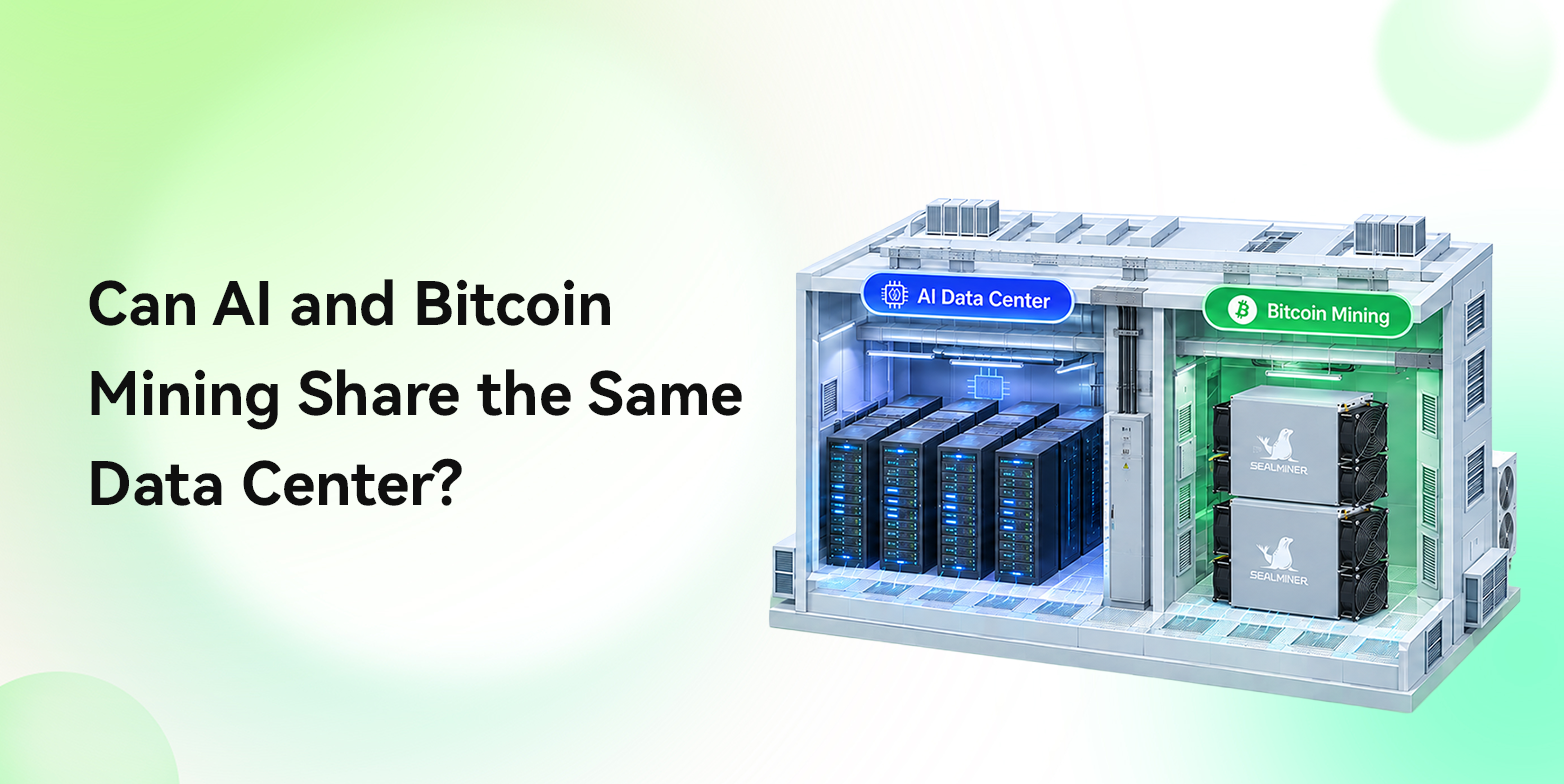
Can AI and Bitcoin Mining Share the Same Data Center?
Sep 4th, 2026
The real value of a hybrid data center is not simply putting GPUs and ASIC miners under the same roof. It comes from using Bitcoin mining as a flexible, interruptible load alongside the higher-reliability, less flexible power requirements of AI computing.
As demand for artificial intelligence (AI) computing continues to surge and the Bitcoin network's hashrate keeps growing, digital infrastructure developers are facing increasing constraints around power and land. AI data centers and Bitcoin mining facilities are competing for many of the same resources, including large-scale grid interconnections, substation capacity, and cooling water.
These constraints have raised an important engineering question for data center developers and infrastructure investors: Can AI computing and Bitcoin mining operate within the same data center campus?
The answer is yes—but primarily at the site level, not by mixing both workloads within the same data hall.
The real value of a hybrid data center is not simply putting GPUs and ASIC miners under the same roof. It comes from using Bitcoin mining as a flexible, interruptible load alongside the higher-reliability, less flexible power requirements of AI computing.
AI Data Centers vs. Bitcoin Mining Facilities: Key Infrastructure Requirements
Although both AI and Bitcoin mining require megawatts of power, their requirements differ significantly when it comes to power quality, cooling architecture, network infrastructure, and operational reliability.
| Category | AI Data Center | Mining Facility |
| Load Profile | Relatively inflexible load. Real-time inference and high-priority training typically require high availability, although some offline batch workloads offer limited scheduling flexibility. | Flexible load. Mining workloads have little task dependency and can be interrupted or adjusted relatively quickly. |
| Power Quality & Redundancy | High-redundancy architecture, such as N+1 or 2N, often supported by UPS systems, backup generators, and redundant power paths. | Basic redundancy, typically N or N+1, with a stronger focus on cost efficiency and electrical protection and switching for short-term outages. |
| Cooling Architecture | Precision cooling, including direct-to-chip liquid cooling and cold plates, with tight control over secondary-loop water temperatures and temperature differentials. | High-airflow air cooling, immersion cooling, or relatively simple hydro-cooling systems, with greater tolerance for environmental temperature and humidity changes. |
| Network Architecture | Very high bandwidth and ultra-low latency, often relying on InfiniBand or high-performance RoCE interconnects. | Low bandwidth requirements with basic redundancy; generally requires only a stable commercial network connection to mining pools. |
| SLA & Commercial Requirements | Enterprise-grade SLAs, often with defined uptime commitments and significant penalties for service failures. | Self-mining operations generally do not require AI-level enterprise SLAs. Hosting operations carry uptime and service obligations based on the hosting contract. |
These differences in load behavior, power reliability, cooling, networking, and contractual SLAs have important implications for how a hybrid AI and mining campus should be designed and operated.
Because Bitcoin mining is a highly flexible load, miners can quickly reduce power consumption or shut down during extreme heat, grid congestion, or spikes in spot electricity prices. In this way, mining can act as a flexible power buffer for the broader campus, potentially helping manage overall electricity costs while also participating in grid demand-response programs.
AI data centers, by contrast, generally require higher power quality and stronger uptime protection through systems such as UPS and backup generators. Their power-distribution systems and high-cost networking infrastructure—including ultra-high-bandwidth, low-latency RoCE or InfiniBand interconnects—also make AI infrastructure significantly more expensive to build on a per-megawatt basis than a relatively simple mining facility that requires only standard commercial connectivity.
Cooling requirements are also different. AI GPUs may rely on precision-controlled direct-to-chip liquid cooling, with strict requirements for secondary-loop water temperatures and temperature differentials. ASIC miners commonly use high-airflow air cooling or simpler hydro-cooling systems. The two cooling loops should therefore be separated at both the physical and control levels so that higher-temperature return water from the mining system does not affect GPU cooling stability.
Commercial obligations differ as well. AI customers may require enterprise SLAs with clearly defined uptime commitments and significant penalties for service failures. Self-mining operations generally focus on hashrate production, while hosted mining operations follow the uptime and service requirements defined in their contracts. These differences make separate operational and accountability structures important.
What Can Be Shared, and What Must Remain Separate?
If AI computing and crypto mining are deployed on the same campus, the infrastructure that can realistically be shared is primarily the heavy upstream infrastructure.
Both workloads can use the same industrial site, high-voltage substation, transmission connection, and long-term power purchase agreement (PPA). They may also share perimeter security and access control, primary-side cooling-water resources, and an energy management system (EMS) that monitors power and water use across the campus.
Sharing these upstream resources can reduce duplicated infrastructure investment and potentially shorten the process of securing and building additional substation capacity.
Once power reaches the downstream distribution system and individual data halls, however, AI and mining should be clearly separated across power distribution, cooling, and networking.
First, the electrical systems should be isolated.
AI servers have higher power-quality requirements. Enterprise AI environments may require power conditioning, UPS systems, backup power, and other protections depending on SLA requirements. ASIC miners, meanwhile, may shut down or restart in large groups in response to grid conditions. These rapid load changes can create step changes in power demand and voltage fluctuations. Without proper low-voltage distribution isolation, those disturbances could affect the stability of the AI environment.
Second, cooling loops and networks should also remain separate.
The campus may share a large cooling tower, but once cooling enters the data halls, plate heat exchangers (HEX) can be used to separate the water loops. The AI area requires its own stable secondary cooling loop and should not share the same internal cooling circuit with the mining area.
At the network level, AI clusters may handle sensitive enterprise data and face compliance requirements such as SOC 2. The AI management network should therefore be separated from the mining network through appropriate network segmentation and firewall controls.
How Does the Business Model Work, and When Should the Mining Load Shut Down?
One of the biggest economic benefits of a hybrid data center is the ability to reduce mining loads during high-price periods, helping lower overall power costs for AI operations. But there is a common misconception that miners should shut down whenever electricity prices rise. In reality, the decision is more complicated.
Whether the mining load should shut down is ultimately an economic calculation: curtailment only makes sense when the electricity savings plus demand-response payments exceed the net mining revenue lost during the shutdown.
A simple formula can help illustrate the trade-off:
Net Benefit From Curtailment ≈ Demand-Response Payment + Avoided Peak Electricity Cost − Lost Net Mining Revenue During Curtailment − Equipment Start-Stop Costs
Suppose the grid experiences an extreme demand peak for one hour. If the mining load shuts down in response to a grid request, it may receive $1,000 in demand-response compensation while avoiding another $500 in peak electricity costs. If the miners would otherwise have generated $1,200 in net mining revenue during that hour—depending on the prevailing hashprice, or the mining revenue generated by a unit of hashrate over a given period—and frequent shutdowns and restarts create an estimated $100 in equipment-related costs, the net benefit from shutting down would be:
$1,000 + $500 − $1,200 − $100 = $200
In this case, reducing the mining load to support the grid or protect the AI area would generate an additional $200 in value. But if Bitcoin prices rise sharply and hashprice becomes high enough that continued mining would generate $1,600 during that same period, the net benefit from shutting down would fall to −$200. In that situation, forcing the miners offline would actually reduce the project's economic return.
This is why a hybrid data center needs more intelligent automated dispatch software. The system should monitor grid spot prices, Bitcoin hashprice, and real-time power demand from the AI area, then rapidly adjust mining loads based on electrical protection requirements, electricity price signals, and overall load-management needs.
Three Common Misconceptions to Avoid
1. “You Can Buy an Old Mining Site and Run AI Immediately”
An existing mining facility may already solve two difficult problems: land and access to grid capacity. But AI infrastructure requires much more.
High-redundancy power systems, UPS capacity, high-density liquid cooling, ultra-low-latency networking, and enterprise-grade security may all require substantial additional investment. Depending on the condition and design of the existing site, the cost of conversion can be significant and may approach the cost of building new infrastructure.
2. “Mining Can Always Subsidize AI Power Costs”
The economics depend on both the power market and the crypto market.
When Bitcoin mining economics are strong and hashprice is high, shutting down miners comes with a higher opportunity cost. The financial value of curtailment and demand response becomes more attractive when mining economics are weaker while grid spot prices are high.
Mining flexibility therefore has value, but that value is conditional rather than guaranteed.
3. “AI and Mining Can Switch Back and Forth Seamlessly”
ASIC miners are relatively flexible loads, but frequent rapid load reductions, shutdowns, and restarts may increase stress on power supplies and electrical distribution equipment.
Some offline AI batch workloads also offer a degree of scheduling flexibility, but managing those workloads is generally more complex than simply reducing or shutting down ASIC mining load.
AI and Mining Can Share a Campus—but They Need Separate Zones
AI data centers and Bitcoin mining facilities can operate within the same data center campus.
The more practical engineering approach is not to force both workloads into the same data hall. Instead, a hybrid campus can share upstream high-voltage infrastructure, separate downstream systems by workload, and coordinate both through a centralized automated control system.
The key to a successful hybrid campus is not simply “putting AI and mining together.” It is establishing clear boundaries across power, cooling, networking, and financial operations so that two fundamentally different load profiles can complement each other.
When evaluating mining cash flow and the value of interruptible load within a hybrid campus, a clear model of hashrate and electricity costs is essential.
You can use the Bitdeer Mining Calculator to enter specific ASIC specifications, electricity rates, and expected mining difficulty to estimate the standalone revenue and cash flow of the Bitcoin mining load. This can provide a baseline for evaluating the broader economics of a hybrid campus.
A complete AI + mining financial model, however, should also account for GPU revenue, cooling-system investment, power-distribution upgrades, demand-response rules, and compliance requirements.
*Information provided in this article is for general information and reference only and does not constitute nor is intended to be construed as any advertisement, professional advice, offer, solicitation, or recommendation to deal in any product. No guarantee, representation, warranty or undertaking, express or implied, is made as to the fairness, accuracy, timeliness, completeness or correctness of any information, or the future returns, performance or outcome of any product. Bitdeer expressly excludes any and all liability (to the extent permitted by applicable law) in respect of the information provided in this article, and in no event shall Bitdeer be liable to any person for any losses incurred or damages suffered as a result of any reliance on any information in this article.


