
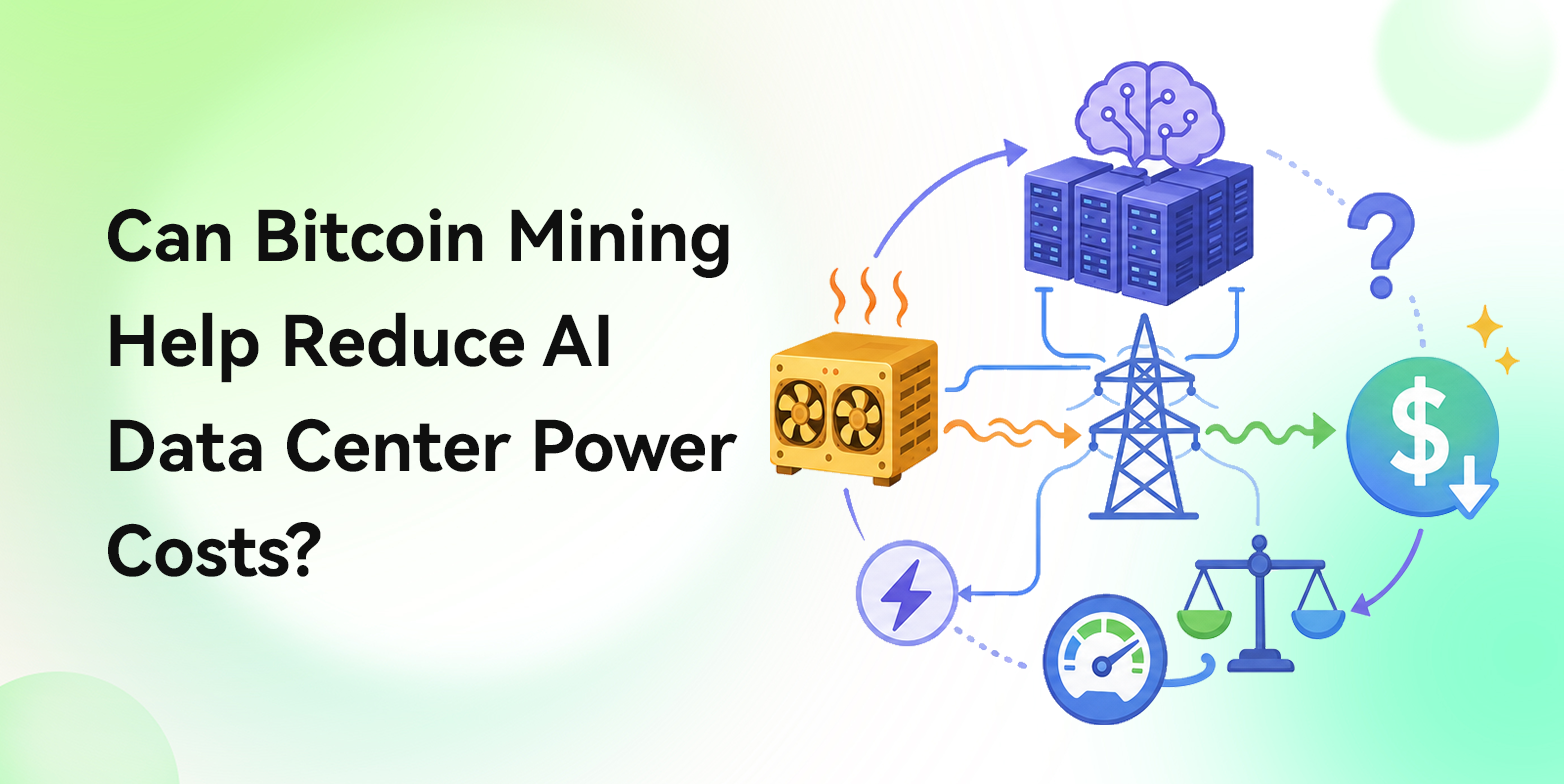
Can Bitcoin Mining Help Reduce AI Data Center Power Costs?
May 14th, 2026
This blog examines whether this hybrid model can truly lower overall power costs by looking at load characteristics, demand response programs, internal economics, and real-world constraints.
Can Bitcoin Mining Help Reduce AI Data Center Power Costs?
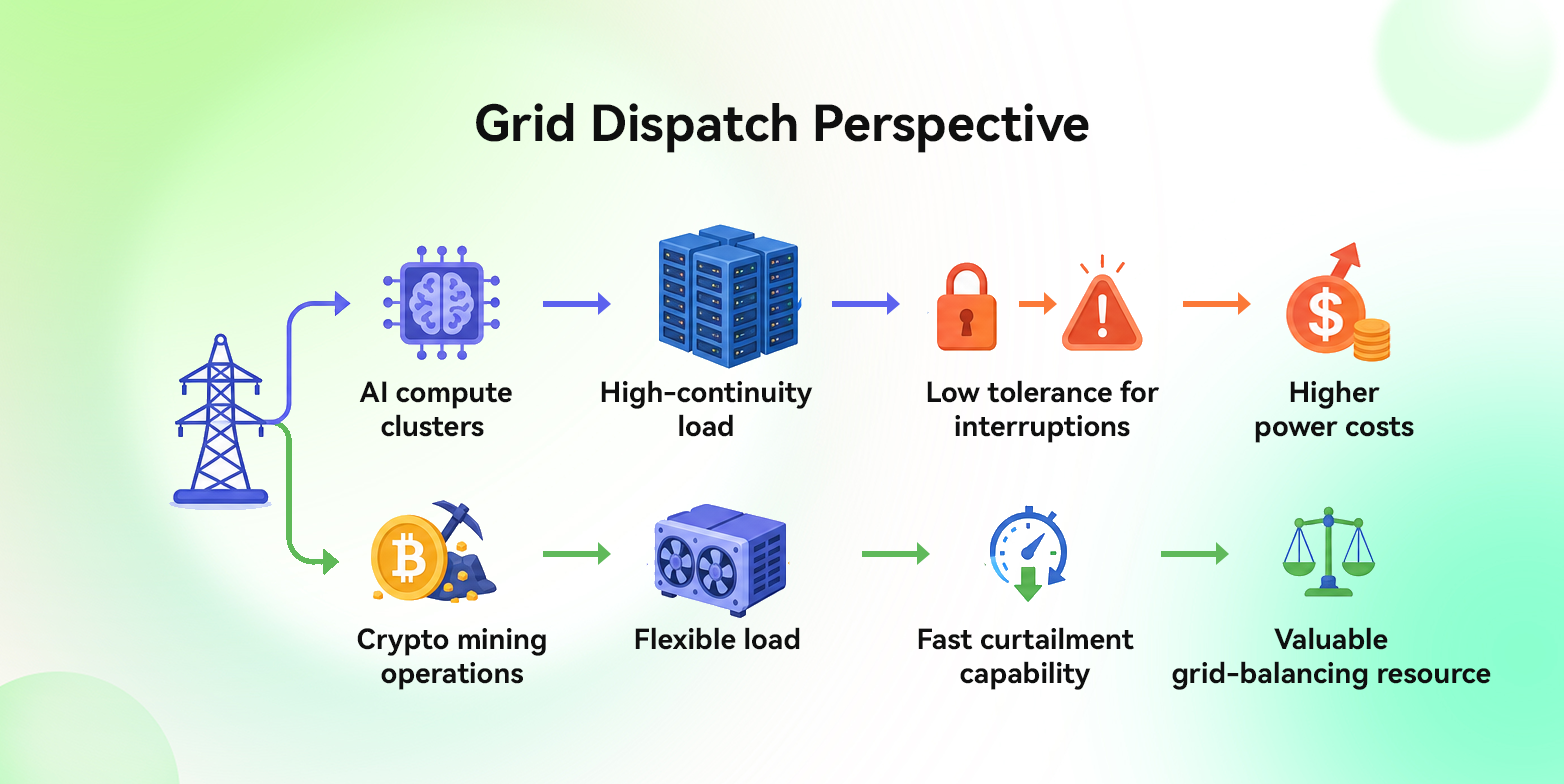
As large-scale AI training and blockchain networks continue to expand, both AI data centers and crypto mining operations are driving up electricity demand for large computing infrastructure. While both are energy-intensive businesses, the grid does not view them the same way. AI training and real-time inference are considered rigid loads that require highly reliable, continuous power. Crypto mining, on the other hand, behaves like a flexible load that can be adjusted within seconds and can tolerate interruptions with minimal impact.
As infrastructure operators focus more on efficiency and cost control, hybrid compute centers that combine these two workloads under the same facility are moving from theory to reality. The core business model is simple: mining's interruptible nature can serve as a power-management resource. Operators can use mining loads to participate in demand response programs and avoid expensive peak-power periods, helping offset the high operating costs of AI workloads. This blog examines whether this hybrid model can truly lower overall power costs by looking at load characteristics, demand response programs, internal economics, and real-world constraints.
Why Do AI and Mining Look Completely Different to the Power Grid?
From the perspective of a grid operator, the value of a large power consumer has little to do with whether it produces AI-generated content or cryptographic assets. What matters is its load profile and the impact it may have on grid stability. Viewed through that lens, AI clusters and crypto mining facilities have almost opposite physical characteristics.
AI Training and Real-Time Inference Depend on Continuous Power and Redundancy
AI data centers, especially those training large models with hundreds of billions of parameters, are classic examples of rigid loads.
Large-scale training relies on thousands, or even tens of thousands, of GPUs connected through ultra-high-bandwidth networks such as InfiniBand and NVLink. These systems continuously exchange gradients and write intermediate data to memory throughout the training process. An unexpected power interruption can halt training jobs, erase unsaved progress, trigger node restarts, and create SLA risks. Even when checkpoint recovery is available, operators still face lost time, higher operational costs, and wasted resources.
To ensure power quality, enterprise-grade AI facilities typically require higher levels of redundancy, including UPS systems, backup generators, redundant transformers, and advanced power-quality controls. Many projects are designed around standards similar to Tier III or Tier IV data centers. As a result, AI compute facilities often pay a premium for power reliability and power quality.
Mining Can Tolerate Short Interruptions and Reduce Load Quickly
Crypto mining operations, particularly those securing proof-of-work networks such as Bitcoin, have very different physical characteristics. They function as highly flexible loads.
ASIC miners perform hash calculations that are independent from one another. Each attempt is essentially a standalone computation. The machines do not need to maintain complex intermediate states. In facilities with automated controls, mining loads can often be reduced within seconds or minutes, and some sites can meet the response requirements of grid demand-response programs.
When mining is interrupted, the primary loss is forgone revenue during the downtime. Operators do not lose partially completed computational work. However, frequent shutdowns still require careful management of electrical systems, cooling infrastructure, and hardware longevity.
The Core Difference: A Production Line vs. A Dispatchable Load
In simple terms, an AI cluster behaves like a highly automated production line that depends on stable power and continuous operation. A mining facility behaves more like a large industrial load that can quickly ramp power consumption up or down when economic conditions justify it.
This fundamental difference creates the technical foundation for hybrid deployments. One workload demands reliability, while the other provides flexibility. Together, they can complement each other in ways that neither could achieve alone.
What Is Demand Response, and Why Are Utilities Willing to Pay Flexible Loads?
To understand how hybrid compute centers can actually make money through power management, we first need to understand a core challenge in electricity markets: maintaining real-time balance between supply and demand.
Peak Load and Grid-Balance Challenges
Electricity is one of the most difficult commodities to store at large scale at a low cost. Power generation and power consumption must remain balanced every second of every day.
When extreme summer heat drives a surge in air-conditioning demand, or when winter storms limit generation capacity, the grid can enter a high-risk condition known as peak load.
Traditionally, utilities have relied on two ways to deal with these situations. The first option is to bring high-cost peaker plants online, such as natural-gas generation units. However, doing so can cause wholesale electricity prices to spike dramatically. In markets such as the Texas ERCOT system, real-time prices can jump from tens of dollars per MWh to thousands of dollars per MWh during periods of extreme weather or tight supply.
The second option is rolling blackouts. While effective in preventing a total grid failure, blackouts create significant economic and social costs.
How Interruptible Loads Help Relieve Grid Stress
To avoid these outcomes, modern power markets have increasingly adopted demand response programs.
Grid operators have discovered that paying certain customers to reduce power consumption during peak periods can often cost less than building additional generation capacity or risking widespread outages. This concept is sometimes described as a Negawatt—a unit of electricity that is never consumed because demand was reduced.
Under these programs, large industrial users that can adjust their power consumption agree to participate as interruptible loads. When grid frequency becomes unstable or demand rises too high, the utility sends a curtailment request. Participating customers then reduce a specified amount of load within a defined time window and receive compensation based on their contribution.
Why Mining Is a Natural Fit for Demand Response
Many traditional industrial facilities consume enormous amounts of electricity, but they are often poor candidates for demand response.
Aluminum smelters, paper mills, and other heavy industries usually face long restart times, expensive production interruptions, and labor costs whenever equipment shuts down. These constraints make frequent participation difficult.
Crypto mining facilities are different. Mining farms offer a unique combination of rapid response and significant load flexibility. In facilities equipped with automated controls, operators can reduce power consumption within seconds or minutes while still maintaining overall operational readiness. In some cases, mining sites can satisfy the response requirements for grid-support services and demand response programs.
As a result, mining operations are increasingly viewed as highly responsive interruptible resources that can help stabilize the grid during periods of stress.
The Four Revenue Streams Behind Hybrid Compute Centers
By allowing flexible mining loads to participate in grid programs, hybrid compute centers can potentially create value from several different sources.
| Revenue Source | Mechanism | Description |
| Demand Response Payments | Provide standby capacity or demand-response services | Operators receive compensation for maintaining curtailment capability and responding when called upon |
| Peak Price Avoidance | Shut down during high-price periods | Mining loads can be curtailed when electricity prices exceed mining profitability |
| Demand Charge Reduction | Lower recorded peak demand | Strategic curtailment during critical peak windows can reduce future transmission and distribution charges |
| Power-Supply Negotiation Leverage | Increase facility flexibility | Flexible loads may help operators negotiate more favorable power arrangements in certain markets |
How Hybrid Compute Centers Use Mining Flexibility to Offset AI Power Costs
Once we understand the physical differences between these workloads and the incentives behind demand response programs, we can look at the internal economics of a hybrid compute center.
The central idea is simple: operators use the flexibility of mining to create a financial hedge against the high operating costs of AI infrastructure.
The Power-Cost Challenge of a Pure AI Data Center
Imagine an operator building a standalone 20 MW AI compute facility.
Because the GPU cluster requires continuous operation and high-quality power, the operator often has limited negotiating leverage when purchasing electricity from utilities or energy providers.
Base electricity premiums: Utilities must dedicate stable generation and transmission resources to support the load. As a result, long-term power purchase agreements (PPAs) for AI facilities often include a reliability premium.
Exposure to peak-market prices: In partially hedged power markets, extreme weather or supply shortages can cause spot prices to surge. During these periods, high-priority inference workloads and active training jobs cannot simply shut down to avoid expensive electricity. While some lower-priority AI tasks can be rescheduled, doing so introduces additional operational costs and service risks.
Managing a Mixed Portfolio of AI and Mining Loads
A hybrid compute center takes a different approach. Instead of operating only AI workloads, the facility places both asset types behind the same substation and primary transformer. Imagine a site with 50 MW of total power capacity: 20 MW dedicated to AI computing (rigid load) and 30 MW dedicated to crypto mining (flexible load).
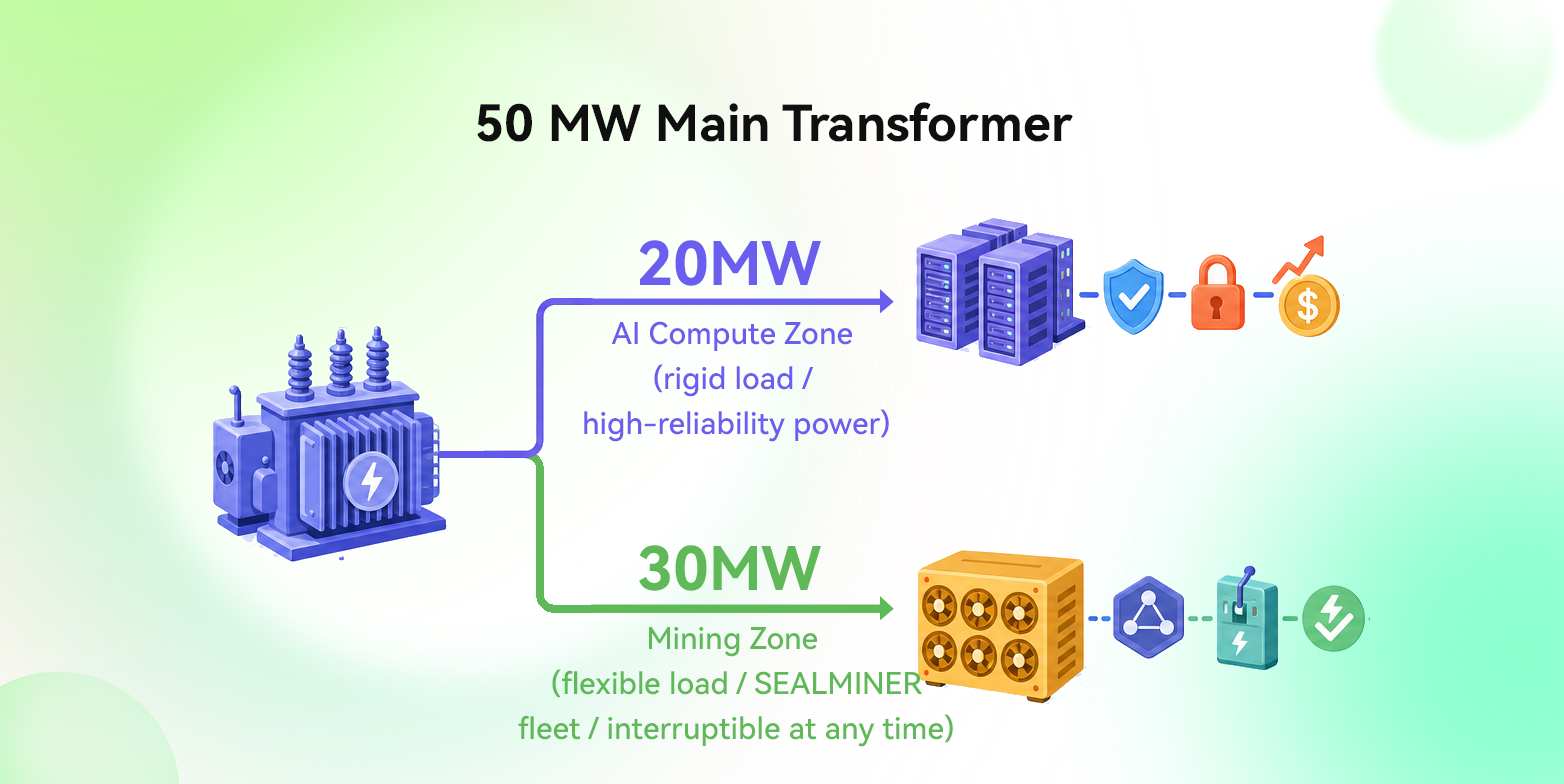
This structure changes how the facility appears to the grid. Because 30 MW of load can be curtailed when needed, the operator may be able to negotiate more flexible power arrangements and potentially secure more competitive electricity pricing for the site as a whole. It is important to note that this example is intended only to illustrate how flexible loads can help offset peak electricity costs. Actual market outcomes depend on local regulations, contract structures, curtailment costs, and eligibility requirements for grid-service programs.
How Curtailment Revenue Offsets Peak Power Costs
The financial impact becomes clearer during a real-world peak-price event.
Assume a hybrid facility has secured a wholesale power price of $45/MWh. On a particular day, between 2:00 PM and 4:00 PM, grid congestion causes the local marginal price (LMP) to surge to $3,000/MWh. At the same time, the utility launches an emergency demand-response event and offers compensation of $2,500/MWh for load reductions.
Scenario 1: A traditional AI-only facility
The 20 MW AI cluster must continue operating. Assuming the facility remains exposed to spot-market pricing, the two-hour electricity cost becomes:
Peak-period AI power cost = 20 MW × 2 hours × $3,000/MWh = $120,000
Scenario 2: A hybrid compute center
The AI cluster continues running, but the mining operation curtails 30 MW of load after receiving the utility signal. The mining zone earns demand-response compensation:
Mining curtailment compensation = 30 MW × 2 hours × $2,500/MWh = $150,000
Simplified net impact = $150,000 − $120,000 = $30,000
This example is intentionally simplified. It does not include lost mining revenue during curtailment, settlement differences, contractual restrictions, or other operating costs.
Even though the AI facility still consumed $120,000 worth of high-priced electricity during those two hours, the neighboring mining operation generated $150,000 in compensation by giving up its power consumption rights. Under this simplified model, mining curtailment can significantly offset AI power costs and may even create additional profit. The actual outcome, however, depends on local market rules, contract terms, mining opportunity costs, and settlement mechanisms.
The Core Trade-Off: Exchanging Mining Revenue for Power Flexibility
It is important to view this model realistically.
The system does not create free money. Instead, it converts one economic opportunity into another.
When miners participate in demand response events, they stop generating hashrate revenue. During that period, mining income effectively falls to zero.
For the strategy to make sense, the value of demand-response payments and peak-price avoidance must be significantly higher than the mining profits the facility would have earned by staying online. In practice, operators compare curtailment compensation against the net mining value during the same period, often measured as hashprice minus electricity costs.
This requirement means operators must constantly evaluate both markets in real time. Success depends on accurately measuring the economic value of electricity flexibility versus the economic value of mining production.
When Does This Model Work—and When Does It Not?
Putting rigid AI workloads and flexible mining loads inside the same hybrid compute center may sound like a natural fit. On paper, the model looks like a straightforward way to reduce power costs. In practice, however, simply combining AI and mining does not automatically create economic benefits.
The success of this model depends on several factors, including local power-market rules, mining opportunity costs, power-distribution design, automation capabilities, and the quality of the AI business itself. Only when these conditions align can mining flexibility become a meaningful advantage for AI operations.
The Local Power Market Must Reward Flexibility
The first question is whether the local power market actually places value on flexible loads.
If the region supports real-time electricity pricing, demand response programs, interruptible-load contracts, or ancillary-service markets, then a mining operation's ability to rapidly reduce power consumption may have measurable value. Operators can lower overall electricity costs through demand-response payments, peak-price avoidance, capacity revenues, or demand-charge optimization.
However, if the local market relies on fixed industrial electricity rates and lacks dynamic pricing or mature demand-response programs, mining flexibility becomes much harder to monetize. In that case, combining AI and mining may simply create a diversified business mix rather than a meaningful power-cost hedge.
For this reason, hybrid compute centers are generally better suited to regions with competitive electricity markets and established demand-response programs. Operators in less developed power markets should evaluate the model carefully rather than assuming results similar to ERCOT or other mature markets.
Curtailment Payments Must Exceed Mining Opportunity Costs
Mining can be interrupted, but interruption is never free.
When miners shut down to support the grid, they give up the hashrate revenue they would otherwise generate. During periods of strong Bitcoin prices, elevated transaction fees, or favorable hashprice conditions, mining itself may already produce attractive profits.
As a result, operators should never evaluate demand-response opportunities based solely on the size of the utility payment. They must compare two separate revenue streams.
On one side are the benefits of curtailment, including demand-response compensation, avoided peak electricity costs, and potential demand-charge reductions.
On the other side are the revenues lost during downtime, along with the operational costs associated with frequent shutdowns and restarts.
Curtailment only makes economic sense when the value of grid participation clearly exceeds the value of continued mining operations.
This is why sophisticated hybrid operators continuously monitor hashprice, electricity prices, mining efficiency, and demand-response incentives. Successful participation requires dynamic decision-making rather than automatically shutting down whenever the grid requests support.
The Power Distribution System Must Separate AI and Mining Loads
One of the biggest engineering challenges of a hybrid facility is not simply placing AI servers and mining machines on the same property.
AI systems require highly stable voltage, consistent power quality, and uninterrupted service. Mining loads, by contrast, may ramp down and return to full power frequently. In some situations, large portions of mining capacity may be switched on or off within a short period of time.
Without proper separation, these power fluctuations can introduce voltage swings, harmonics, or transient disturbances that affect nearby AI infrastructure.
For this reason, hybrid facilities should use segmented power-distribution designs. Operators often separate AI and mining zones through dedicated busways, independent distribution systems, filtering equipment, and automated protection systems. These measures help ensure that rapid mining-load adjustments do not affect AI operations.
Simply put, mining can be flexible, but that flexibility should not be transferred to the AI environment. Otherwise, a design intended to reduce power costs may end up increasing operational risk.
Cooling Systems Must Also Support Independent Control
Power infrastructure is only part of the equation. Cooling systems require the same level of attention. In some hybrid facilities, AI clusters and mining fleets share portions of the cooling infrastructure, such as cooling towers, primary water loops, or centralized thermal-management systems. When mining loads are reduced quickly, the associated heat load changes just as quickly.
If the cooling system cannot adapt independently, local temperature, flow rates, or pressure conditions may become unstable.For AI servers, thermal stability is critical. GPU clusters need more than sufficient cooling capacity. They require a predictable and consistent operating environment over long periods of time.
As a result, hybrid facilities should ensure that AI zones maintain dedicated and stable cooling resources. Rapid mining curtailment should not create noticeable disruptions to AI thermal management. This is why shared infrastructure does not mean every system should be fully integrated. Successful hybrid deployments often share major infrastructure while preserving independent control over critical subsystems.
Automation Systems Must Be Mature Enough
Demand response is not something operators can manage manually. When a utility issues a curtailment request, the facility must reduce load within a specified timeframe. The process must also be safe, measurable, and fully documented. This requires a sophisticated automation framework.
At a minimum, the system should monitor several variables simultaneously:
- Real-time electricity prices
- Demand-response signals
- Mining-fleet status
- AI power conditions
- Cooling-system loads
- Mining profitability
- Equipment safety thresholds
When the system determines that curtailment creates more value than continued mining, it should reduce mining loads in stages while ensuring that AI power delivery and cooling performance remain unaffected.
Achieving this level of coordination often requires integration among SCADA platforms, mining-fleet management software, energy-management systems, and utility communication interfaces. For many operators, the real challenge is not acquiring hardware. The challenge is integrating these systems into a reliable operating platform.
The AI Business Must Have Sustainable Revenue
The goal of hybrid deployment is to improve the long-term economics of AI infrastructure through mining flexibility. The goal is not to use mining revenue to support an AI facility that lacks real customer demand.
AI data centers require substantial capital investment. GPU depreciation can be rapid. Customer contracts, service-level agreements, and utilization rates all play a critical role in financial performance.
If the AI side of the business lacks stable customers, long-term hosting agreements, or consistent inference demand, mining flexibility alone cannot transform the economics of the project. In other words, mining flexibility can improve the power-cost structure, but it cannot replace market demand for AI services.
Only when the AI business already generates healthy and sustainable revenue can demand-response payments, peak-price avoidance, and enhanced negotiating leverage become meaningful profit enhancers.
The Future Competition Is About Managing Power Portfolios
As we move through 2026, competition among compute infrastructure operators is no longer defined solely by installed capacity or chip performance. Leading operators are increasingly approaching their facilities as power portfolios that require active management.
In some electricity markets, hybrid compute centers with fast-response load capabilities may even begin to perform functions similar to those of a virtual power plant (VPP).
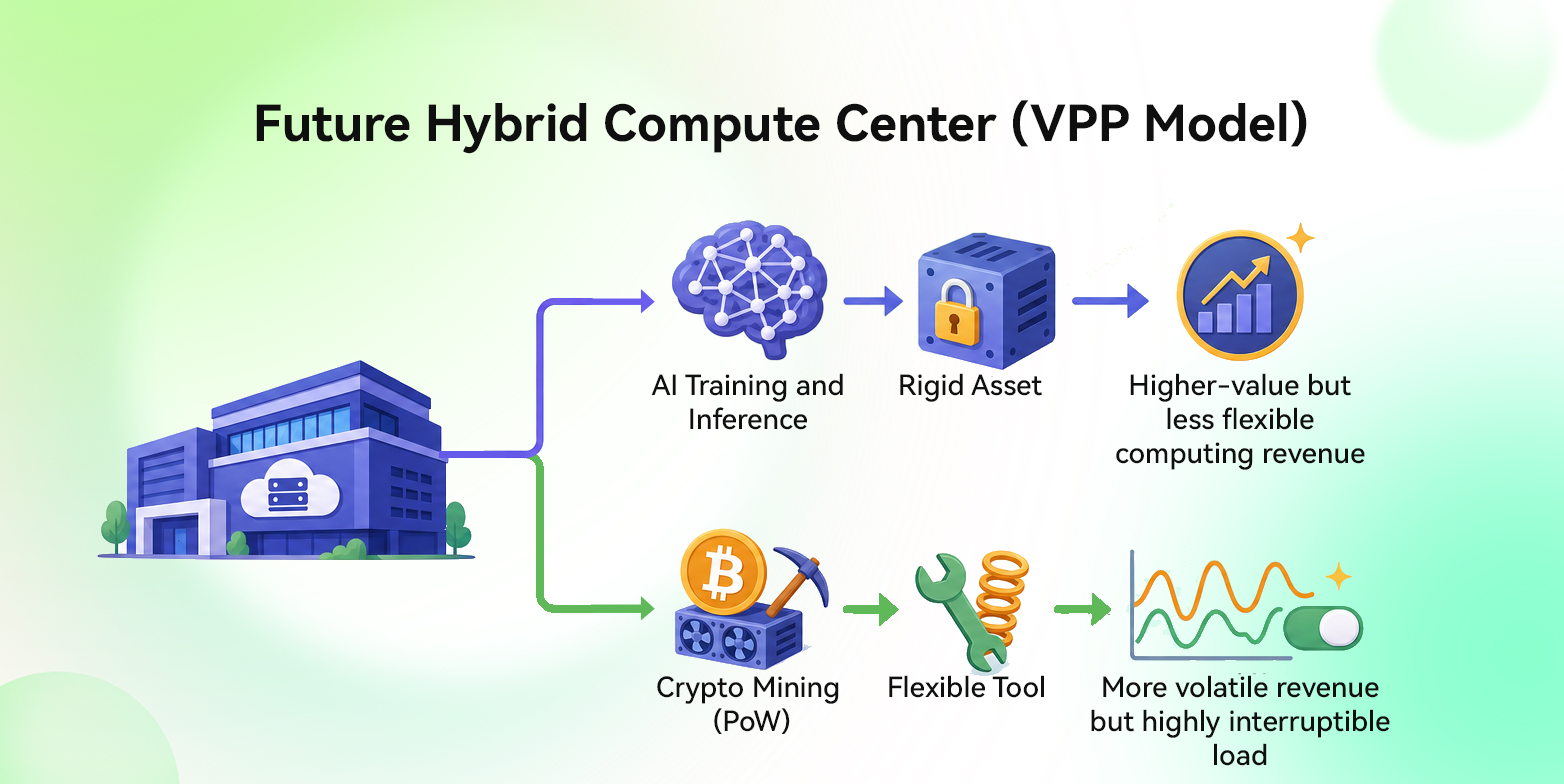
AI workloads generate relatively high-value computing revenue, but they also require stable operating conditions. Mining workloads generate more variable revenue, yet they provide the flexibility that utilities increasingly value.
The real value of a hybrid facility does not come from one business subsidizing the other. It comes from dynamically adjusting the workload mix based on electricity prices, grid conditions, and market opportunities. The key performance metric is no longer the peak profitability of a single business line. It is the overall yield per megawatt generated by the entire facility.
When electricity is abundant and market prices remain stable, operators can run both AI and mining workloads at full capacity to maximize infrastructure utilization. When extreme weather, grid congestion, or price spikes occur, software systems can automatically curtail mining operations and convert that flexibility into demand-response revenues or avoided energy costs.
As a result, the competitiveness of a hybrid compute center does not depend on simply placing AI and mining together. It depends on whether operators can continuously optimize the workload mix based on electricity prices, demand-response signals, hashprice conditions, and customer demand.
From Simple Monetization to Precision Management of Physical and Financial Assets
The old approach of simply aggregating hashrate or adding more machines is becoming less effective in the increasingly competitive infrastructure landscape of 2026. Rising AI infrastructure costs and shrinking mining margins are forcing operators to rethink the relationship between electricity, compute resources, and data-center assets.
Combining rigid AI workloads with flexible mining loads is not a simple arbitrage strategy. It is a form of precision management that balances different workloads, different power-price cycles, and different load characteristics. Whether the model succeeds depends on an operator's ability to manage power-distribution isolation, automation systems, electricity-price volatility, and business cash flow as part of a single strategy. Visit the Bitdeer Learning Hub to explore more insights on AI infrastructure, Bitcoin mining, and the future of large-scale compute operations.
*Information provided in this article is for general information and reference only and does not constitute nor is intended to be construed as any advertisement, professional advice, offer, solicitation, or recommendation to deal in any product. No guarantee, representation, warranty or undertaking, express or implied, is made as to the fairness, accuracy, timeliness, completeness or correctness of any information, or the future returns, performance or outcome of any product. Bitdeer expressly excludes any and all liability (to the extent permitted by applicable law) in respect of the information provided in this article, and in no event shall Bitdeer be liable to any person for any losses incurred or damages suffered as a result of any reliance on any information in this article.


