
What Makes a Site Suitable for Co-Mining? 5 Key Factors to Evaluate
Sep 17th, 2026
This guide walks you through five key factors and tells you which site is best suited for co-mining, as well as what to prepare before reaching out to a co-mining partner.
Owning land and having access to power doesn't automatically make a site a good fit for co-mining. Whether the power capacity is sufficient, whether the electricity price is competitive, whether existing infrastructure can support miner deployment, and whether local regulations and power contracts allow long-term operation all affect project viability.
This guide walks through five key factors, drawing on site scenarios, to help landowners, power providers, and data center operators answer a core question: is my site actually suited for co-mining, and what should I prepare before reaching out to a co-mining partner?
What Does Co-Mining Require From a Site?
In a typical co-mining arrangement, the client (the resource owner) provides the site, power allocation, grid connection, and supporting infrastructure. The mining partner provides a fleet of high-performance miners, deployment expertise, and 24/7 operations and maintenance support. Both sides share the project's net profit as set out in the contract. So evaluating a site isn't really about how much land you have. It's about whether miners can run reliably and for the long term, at a reasonable cost, while staying compliant.
How Do Site Requirements Differ Between Co-Mining and Traditional Hosting?
With hosting, a professional mining operator provides a deployment environment with power distribution, cooling, and networking. The client buys the miners and pays an agreed hosting fee. Co-mining focuses on a different question: what site, power, and infrastructure can the resource owner bring to the table, and how do both sides share investment and operating responsibilities?
A project can start from undeveloped land or build on an existing industrial facility or mining site. How far construction has progressed, how much upfront investment is needed, and who bears which responsibilities all shape the final terms and the profit split. Learn more in Hosting vs. Co-Mining: Which Model Fits Your Resources?.
What Kinds of Sites Are Worth Evaluating?
You don't need a fully developed mining facility to qualify for evaluation. Several types of sites make good candidates: industrial park land with a compliant grid connection; idle plants or oil and gas flare-gas sites with low-cost power; former mining sites that need a restart after equipment became obsolete or operations stalled; and data centers with spare power allocation and room to expand.
In terms of project size, Bitdeer's co-mining business generally recommends prioritizing air-cooling projects of 15 MW or more and hydro-cooling projects of 5 MW or more. Actual feasibility still depends on the site's power stability, supply contract, and terrain.
Factor 1: Is the Power Capacity Sufficient and Stable?
Reliable power is the foundation of any mining operation. But having a high-voltage transmission line nearby doesn't mean the site has access to usable power capacity. When evaluating electricity, it helps to separate three different figures: planned capacity, approved interconnection capacity, and actual available capacity.
How Much Power Is Actually Available?
Start by confirming how much power, in MW, is actually available at the site and whether the utility has signed an interconnection agreement.
For example, say a site is billed as a 20 MW project, but only 5 MW of high-voltage transformer capacity is currently in place. The other 15 MW is still going through approvals or distribution buildout. In that case, the initial financial model should be based on the 5 MW currently available. Treating unapproved planned capacity as existing power is a common mistake in early-stage evaluations.
For sites that aren't energized yet, confirm the expected energization date with the utility. Even after interconnection approval, a site can't go live if transformer procurement, transmission line construction, or grid upgrades are unfinished. The expected energization timeline is a key indicator of whether the project can actually get off the ground.
Can Power Be Supplied Reliably Over the Long Term?
A mine's uptime directly determines how long its miners actually run. But higher uptime doesn't always mean higher profit. A mine also has to weigh power prices, mining revenue, and equipment efficiency to decide whether running continuously makes economic sense. So site evaluation should look at supply stability and also at whether the site can flexibly adjust its load during high-price periods.
Even at a site with low power prices, frequent unplanned outages or voltage sags can cause repeated shutdowns, which means lost output and higher maintenance costs that eat into the price advantage.
Is There Room to Expand Later?
If a project plans to grow from 10 MW to 30 MW within two to three years, find out early how long expansion approvals and construction will take. Expansion potential can make partners more willing to commit miners to your site. Even so, future capacity should never be the basis for your initial hashrate deployment.
Factor 2: Is the Power Price Competitive Over the Long Term?
Low power costs help a mine ride out market volatility. But when evaluating prices, don't rely on the "energy charge" quoted by the utility or generator alone. What really determines whether a project makes money is the all-in power cost delivered to the site.
How Do You Calculate a Site's Real All-In Power Cost?
The all-in cost needs to include every additional charge, spread across actual consumption. You can use this formula:
All-in Power Cost ($/kWh) = (Energy Charges + Transmission and Distribution Charges + Demand Charges + Taxes and Other Fees) ÷ Total Electricity Consumption (kWh)
Here's a simple example:
Site A: The quoted energy charge is $0.04/kWh. But the site is remote and carries extra transmission and distribution fees plus a share of line losses, bringing the all-in cost to $0.058/kWh.
Site B: The utility quotes a bundled all-in price of $0.050/kWh, covering all taxes and transmission and distribution costs.
When compared on the same basis, Site B actually offers a lower all-in electricity cost.
Fixed vs. Variable Electricity Rates: Which Works Better?
A fixed rate locks in the price per kWh for the contract term. It gives you predictable cash flow, which suits projects that need to repay hardware or construction CAPEX on schedule. A floating rate, as the name suggests, moves with the spot power market. It can improve mining margins when prices are low, but it can spike during summer demand peaks. Projects on floating rates usually need an automated dispatch system so they can curtail load or shut down when prices climb too high.
Does Cheaper Power Always Mean Higher Profit?
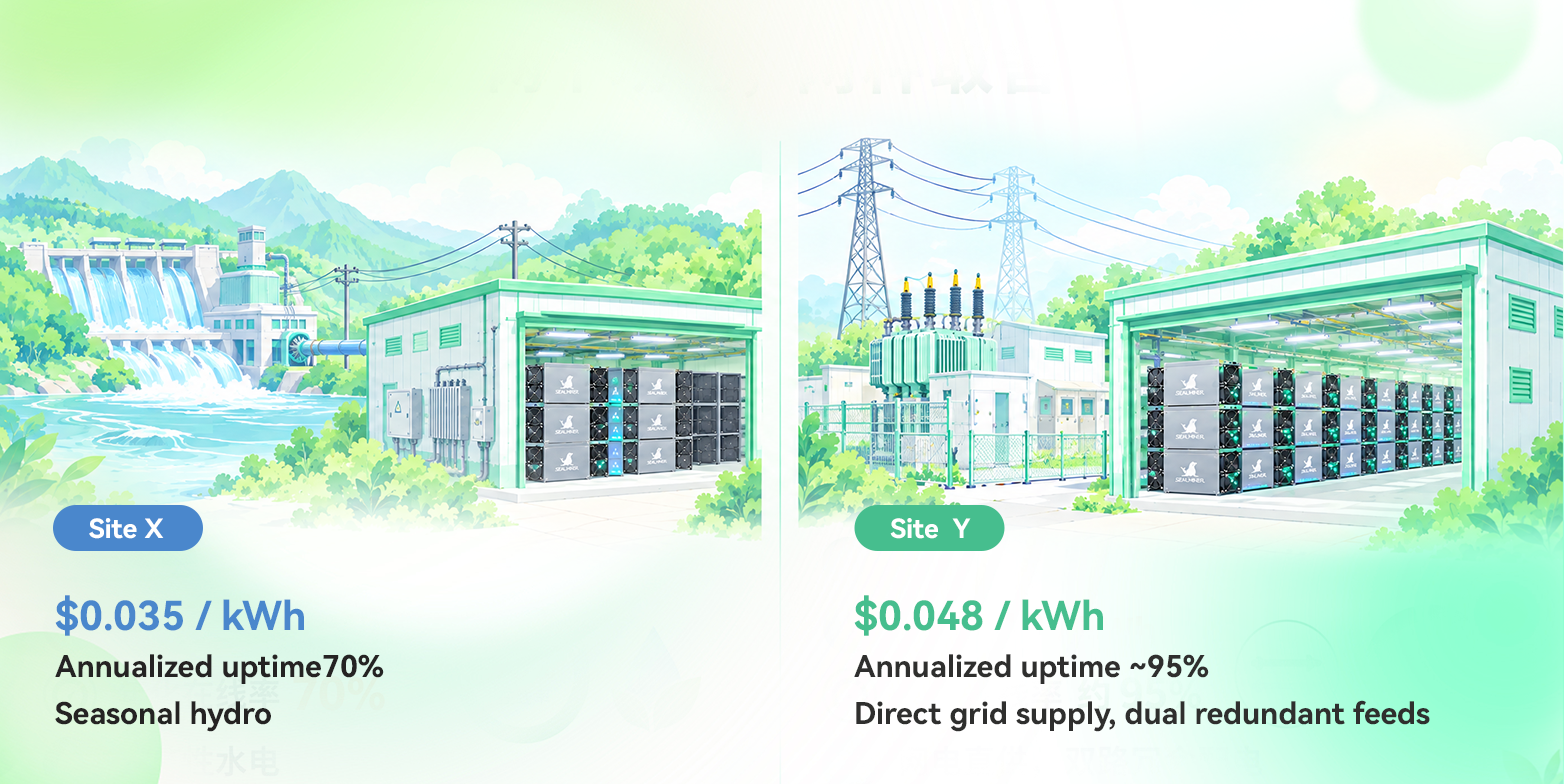
Consider two 10 MW sites:
Site X: All-in cost of just $0.035/kWh. The power is seasonal hydro, with severe curtailment during a four-month dry season and frequent grid faults. Annualized uptime is 70%.
Site Y: All-in cost of $0.048/kWh. The site is on direct grid supply with dual redundant power feeds. Annualized uptime is about 95%.
Neither site is clearly better. When mining revenue is high, Site Y can earn more by running longer. When revenue falls, Site X's lower power cost may matter more. So resource owners should model each site's annual net profit under different bitcoin prices, network difficulty levels, and equipment efficiencies, rather than deciding on power price or uptime alone.
Factor 3: Can the Site's Infrastructure Support Miner Deployment?
Once the power checks out, the next question is whether the site can hold the mining fleet, transformer and distribution equipment, and cooling systems. Existing infrastructure can reduce upfront construction costs, as long as the existing equipment is technically compatible with the hardware you plan to deploy.
Is There Enough Land and Building Space?
Don't judge by total land area alone. Resource owners first need to confirm how much of the land can actually be used for equipment. High-voltage line corridors, building setbacks, and uneven terrain can all reduce usable space. Transformers, switchgear, and Hydro- Cooling containers may also need dedicated foundations and load-bearing design. And the site needs safe spacing between equipment, fire access lanes, and room for delivery vehicles and lifting equipment.
What Do Air-Cooling and Hydro-Cooling Mines Need?
Each cooling approach places different demands on infrastructure. Air cooling relies on strong airflow. When evaluating a site, look at the number of extreme-heat days, humidity, dust, and sandstorm frequency. Large air-cooling buildings also need negative-pressure fan design, and the cost of maintaining dust filters on the air inlets and outlets should be factored in.
Hydro-cooling removes heat from miners through liquid circulation and suits mines that need high-density deployment. Compared with air cooling, it cuts fan noise at the miner level and provides more stable cooling. However, hydro-cooling systems usually also require piping, pumps, and heat exchange equipment. It's best to compare the total cost of both approaches based on local climate, water resources, and construction budget, rather than looking only at cooling efficiency.
The table below gives a rough comparison of infrastructure requirements at the same hashrate scale:
| Factor | Air-Cooling | Hydro- Cooling |
| Space | Depends on building and equipment layout | Modular designs can support high-density deployment |
| Environment | Sensitive to temperature, air quality, and ventilation | Requires water circulation, heat exchange, and water quality management systems |
| Construction Cost | Depends on building, ventilation, and power distribution design | Includes cooling equipment, piping, and installation costs |
| Operating Cost | Mainly fans, filtration, and equipment maintenance | Mainly pumps, heat exchange, and water treatment |
Can an Existing Plant or Mine Be Used As-Is?
Reusing existing facilities can often shorten construction time, but older facilities may still require upgrades. Check the rated capacity and age of the existing high- and low-voltage transformers, circuit breakers, and switchgear to see whether they can handle the power draw of the latest miners. Many traditional industrial buildings have air-exchange and heat-removal designs that fall well short of what modern high-density hardware needs. Going live without addressing this can create local hot spots and cause frequent overheating shutdowns.
Factor 4: Do Local Policy, Land Use, and Power Contracts Allow Mining?
A site can be technically and financially viable and still not be legal to operate in the long run. Compliance and policy risk are major factors in long-term operations.
Do Land Use and Local Regulations Permit Mining?
Resource owners should first confirm that the site's zoning allows the construction and operation of mining equipment. Requirements for industrial, commercial, and special-use permits vary by region. Some areas also set extra limits on mine noise, power consumption, and operating hours. Before committing construction funds, check the requirements with the local planning department.
You'll also need to find out whether electrical work permits, building modification permits, and compliance reviews are required. And look into how state, provincial, and local governments treat digital asset mining, including any special tax rates or restrictive legislation aimed at the crypto industry.
Does the Power Contract Allow Crypto Mining?
Some resource owners already have a power purchase agreement (PPA) or other supply contract, but still need to confirm that it allows the power to be used for crypto mining. Some agreements restrict who may consume the power, whether it can be resold, how large the load can be, or what it can be used for. If the project adds a large new load, check with the utility early on whether the existing agreement must be renewed or amended.
Do Noise, Heat, and Environmental Requirements Affect Site Selection?
Air-cooling miners produce constant noise, especially in large, concentrated deployments, so mines need to consider their impact on the surrounding area. Noise levels vary by miner model and cooling method. Resource owners should use test data for specific equipment, along with local noise standards, to decide whether soundproofing is needed or the layout should change. Hydro-cooling generally reduces fan noise at the miner level, but pumps and cooling equipment can still generate operating noise. You'll also need to check local water authority requirements for industrial water withdrawal permits and environmental assessments of waste heat discharge. These requirements should therefore be considered early in the site selection process.
Factor 5: Can Project Costs and Partnership Terms Support Long-Term Profitability?
Even if a site has the power, land, and permits, you still need to work out the payback period before a project can move forward. A greenfield project offers more design flexibility because power distribution, buildings, and cooling systems can be planned around the mining hardware you intend to deploy. But it usually means higher upfront construction costs and a longer timeline. A brownfield project benefits from existing assets such as transformers, buildings, and lines, which can shorten time to launch. But it is also constrained by existing structures and may involve costly demolition of old equipment and rewiring.
How Is Net Profit Calculated in a Co-Mining Project?
In a co-mining model, both sides share net profit after actual operating costs are deducted:
Net project profit ≈ total mining revenue − actual delivered power cost − on-site operations and maintenance costs − pool fees − hardware repairs and reserves
After those agreed costs are deducted, profit is split according to the contract's ratio (for example, 30/70 or 60/40). So before negotiating, resource owners should be clear on which costs can be deducted before profit is distributed.
The ratios above are hypothetical examples to illustrate how profit is shared. They do not represent Bitdeer's standard terms. Actual ratios, deductible costs, and settlement cycles are governed by the contract signed by both parties.
Co-mining profitability is affected by changes in Bitcoin's price, network hashrate, and mining difficulty. So both sides should agree in advance on how to adjust operations when revenue doesn't cover operating costs, and which fixed costs still need to be paid while mining is suspended. Settle these points in the partnership agreement up front, not after the market turns down.
Why Do Construction Timelines and Contract Length Matter?
Delays in substation procurement, high-voltage line construction, or approvals can push back your go-live date. In a fast-moving crypto market, starting three months late could mean missing a period of high hashprice.
The length of a co-mining partnership should reflect equipment lifecycles, upfront construction investment, and the expected payback period. For projects that require heavy investment in power and cooling infrastructure, a longer term can help spread construction costs. But both sides should also consider market shifts, equipment upgrades, and early termination conditions, so that a long contract doesn't limit future operating decisions.
Case Studies: Which of Three Common Site Types Fits Co-Mining Best?
The three simplified cases below show how the five factors play out in practice. They are illustrative models only, not commitments of real project returns.
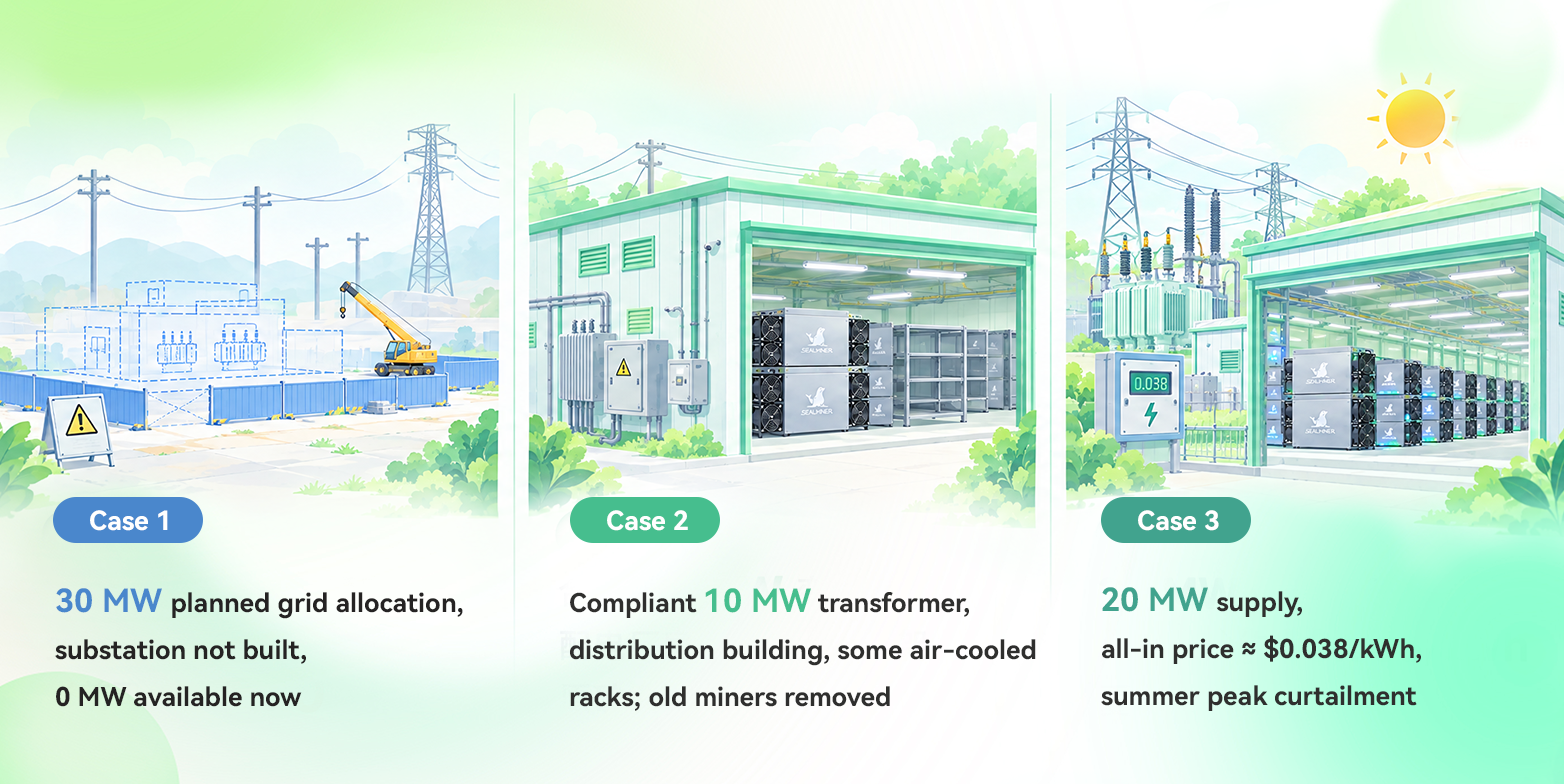
Case 1: Undeveloped Site with Planned Power Capacity
The site has ample land and a 30 MW planned grid allocation, but the high-voltage substation hasn't been built, so actual available power is currently zero. The site has strong long-term expansion potential, but uncertainty around energization timing and substation costs means miners can't be deployed right away.
Partnership strategy: A phased development agreement is a good fit. Prioritize power distribution buildout and approvals for Phase 1 (for example, 10 MW), and deploy hardware once the site is physically energized.
Case 2: Existing Mining Site Ready for Upgrades
The site has a compliant 10 MW transformer, a power distribution building, and some air-cooling racks, but the original miners have been retired and removed. The site already has part of the infrastructure and may get online faster than a new build. Still, you'll need to confirm that the power distribution equipment, cooling conditions, and permits meet the requirements for deploying new miners.
Partnership strategy: First check whether the existing power distribution equipment and air-cooling system can stay in service. If retrofit costs are high, consider a modular hydro-cooling option and weigh it against equipment needs and the overall budget.
Case 3: Low-Cost Power with Seasonal Curtailment
The site has 20 MW of supply capacity and an all-in power price of about $0.038/kWh. But because local summer demand is high, the mine may need to cut consumption during some peak periods each year. The number and length of curtailments depend on the utility's dispatch requirements. The all-in price is relatively low, but supply is subject to seasonal limits.
Partnership strategy: The financial model needs to account for lost output during curtailment periods. If the local power market offers demand response or ancillary services programs, the resource owner can look into whether the mine qualifies. Eligible projects may earn compensation for proactively reducing load, but actual returns depend on local market rules, contract arrangements, and how the site actually responds.
What Should You Prepare Before Contacting a Co-Mining Partner?
Before starting an initial evaluation with a professional co-mining partner such as Bitdeer, site owners can speed up early assessment and due diligence by preparing a brief site information package covering the following:
- Location and land details: Precise site location (GPS coordinates), land area, proof of ownership or lease agreement, and zoning classification.
- Power and grid details: Interconnection agreement signed by the utility, rated capacity of existing transformers (kVA/MVA), actual available power at the site (MW), interconnection voltage level (kV), all-in rate bills, and supply stability and historical curtailment records.
- Current infrastructure: Site photos and floor plans, an inventory of existing substation and distribution equipment, building specifications, water source availability, and dedicated network connectivity.
- Business and partnership goals: Expected investment budget, desired partnership term, and initial expectations for profit settlement cycles.
What Does a Site Need to Be a Good Fit for Co-Mining?
Deciding whether a site suits co-mining takes more than asking how large the site is or whether power is a few cents cheaper. Power capacity sets the ceiling for deployment. Power price and uptime determine profit potential. Infrastructure determines upfront construction costs. And policy and power contracts determine whether the project can run steadily over the long term. A gap in any one of these can turn into sunk cost once operations begin.
If you own land with power access, an idle mine, or another industrial facility, start with a preliminary assessment against the five factors above. Bitdeer's co-mining business works with partners who own sites and power resources. We provide miners, deployment, and operations support, and share project net profit as set out in the contract. Not sure if your site is suitable for co-mining? Submit your interest to discuss your site's potential with our technical team.
*Information provided in this article is for general information and reference only and does not constitute nor is intended to be construed as any advertisement, professional advice, offer, solicitation, or recommendation to deal in any product. No guarantee, representation, warranty or undertaking, express or implied, is made as to the fairness, accuracy, timeliness, completeness or correctness of any information, or the future returns, performance or outcome of any product. Bitdeer expressly excludes any and all liability (to the extent permitted by applicable law) in respect of the information provided in this article, and in no event shall Bitdeer be liable to any person for any losses incurred or damages suffered as a result of any reliance on any information in this article.


