

2026 Litecoin Miner Setup Guide: Deployment, Testing, and ROI Planning
Jul 6th, 2026
Learn how to deploy a Litecoin miner in 2026, validate power and cooling, run commissioning tests, calculate ROI, and decide when to scale.
Whether a Litecoin miner can generate steady returns largely depends on how well the hardware fits the site. The all-in electricity rate, circuit capacity, cooling capability, and mining pool payout rules define the what the miner can realistically sustain. If any of these factors is underestimated, downtime, rejected shares, or retrofit costs can erode the value of the miner's rated hashrate.
A sound deployment should follow a three-stage sequence: site validation, equipment commissioning, and ROI model calibration. First confirm that the infrastructure can support the continuous load, then complete a 24-hour stability test, and finally update the ROI model with data from a full payout cycle. This creates a more realistic operating baseline and a stronger basis for deciding whether to expand.
Confirm Algorithm Compatibility and Payout Structure
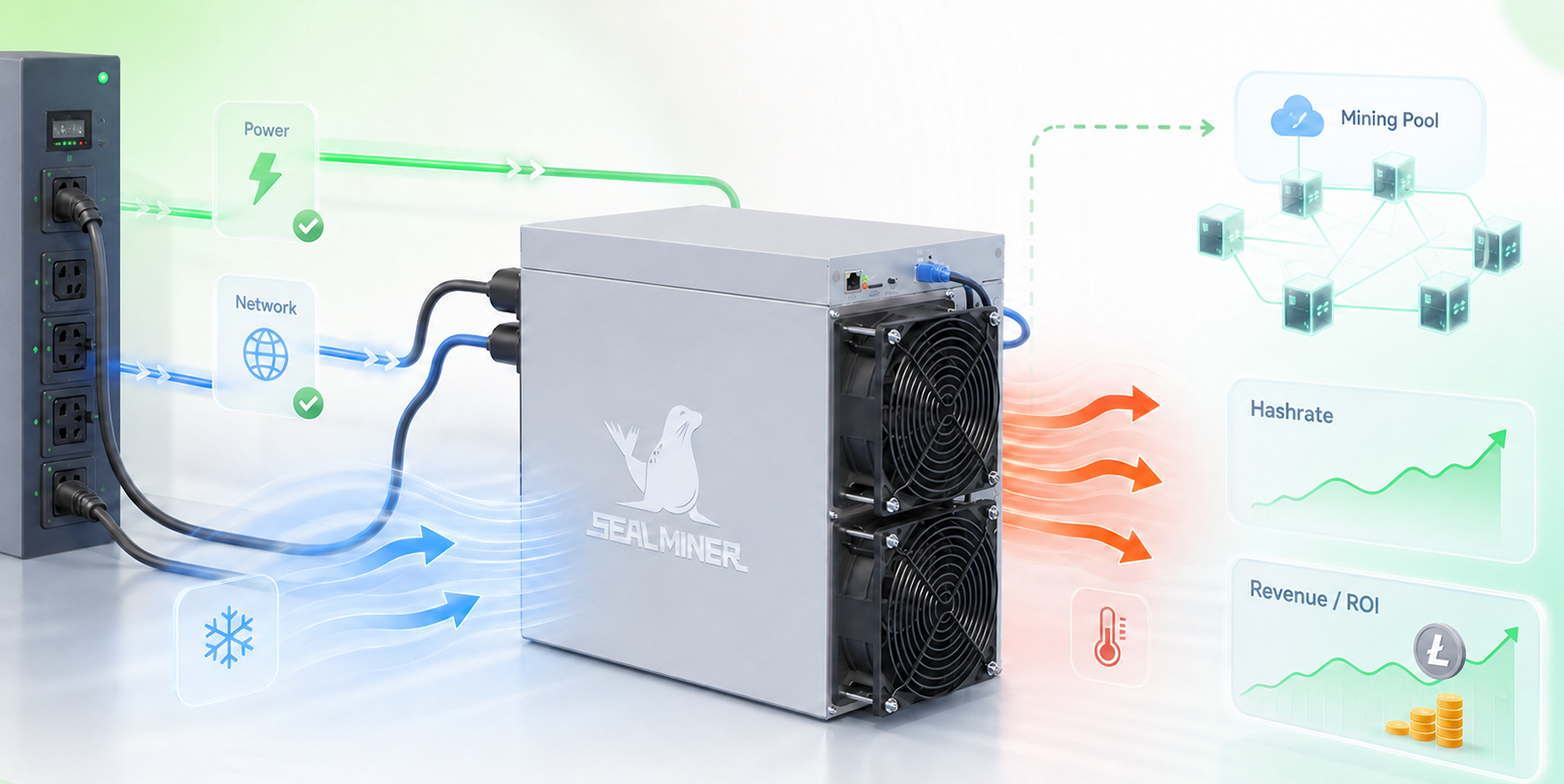
Litecoin (LTC) and Dogecoin (DOGE) both use the Scrypt algorithm and can participate in merged mining, allowing the same Scrypt proof of work to contribute to reward distribution on both networks. ASIC miners built for Bitcoin (BTC) are typically optimized for SHA-256 and cannot be used directly for LTC or DOGE mining. The two hardware classes differ in chip architecture, hashrate units, and target networks. Before purchasing equipment, compare the differences between Scrypt and SHA-256 instead of treating a larger hashrate number as evidence of better cross-algorithm performance.
Actual Scrypt mining cash flow also depends on how the pool settles LTC and DOGE rewards. Even when one proof of work contributes to both networks, realized payouts still depend on pool fees, payout intervals, minimum thresholds, settlement methods, and wallet rules. Before commissioning the miner, verify how each asset is paid and test pool latency and connection stability from the deployment location.
Turn Miner Specs into Power and Cooling Requirements
When reviewing miner specifications, hashrate, power efficiency, and total power draw should be evaluated within the same operating model. Hashrate sets the theoretical output, efficiency defines the energy required per unit of compute, and total power draw directly affects wiring, cooling, and daily cash outflow. Comparing GH/s alone can hide whether the facility can sustain rated performance over time.
Using the SEALMINER DL1 Air as an example, Normal Mode is rated at 25 GH/s with 149 J/GH power efficiency and a typical power draw of 3,725 W. Continuous operation uses approximately 89.4 kWh per day. Low Power Mode reduces electrical and thermal load, while High Hashrate Mode increases output at the cost of higher energy use and cooling demand. The value of each mode depends on the site's electricity rate, seasonal temperature, and available circuit headroom.
| Mode | Hashrate | Efficiency | Power Draw | Daily Energy | Cost at $0.06/kWh |
| Low Power Mode | 20.5 GH/s | 136 J/GH | 2.79 kW | 67.0 kWh | $4.02 |
| Normal Mode | 25 GH/s | 149 J/GH | 3.725 kW | 89.4 kWh | $5.36 |
| High Hashrate Mode | 26.5 GH/s | 160 J/GH | 4.24 kW | 101.8 kWh | $6.11 |
At the reference electricity rate shown above, Normal Mode costs about $5.36 per day to operate. High Hashrate Mode raises rated hashrate by roughly 6% versus Normal Mode, while estimated power draw and daily electricity cost rise by about 14%. Before switching modes, confirm that the additional LTC and DOGE payouts can cover the extra electricity, cooling burden, and hardware stress. The power figures in the table are estimated as hashrate multiplied by power efficiency; final planning should rely on meter readings and delivered-unit data.
Finish Power and Cooling Preparations Before the Miner Arrives
A 3.725 kW miner is a continuous industrial load. The circuit must remain stable during sustained operation, not merely pass a brief power-on test. Input voltage, conductor sizing, circuit breakers, receptacles or PDUs, grounding, and safety headroom should all be verified by a qualified electrician. Relying on extension cords, temporary adapters, or circuits operating close to their rated limit can turn a low electricity rate into downtime and electrical risk.
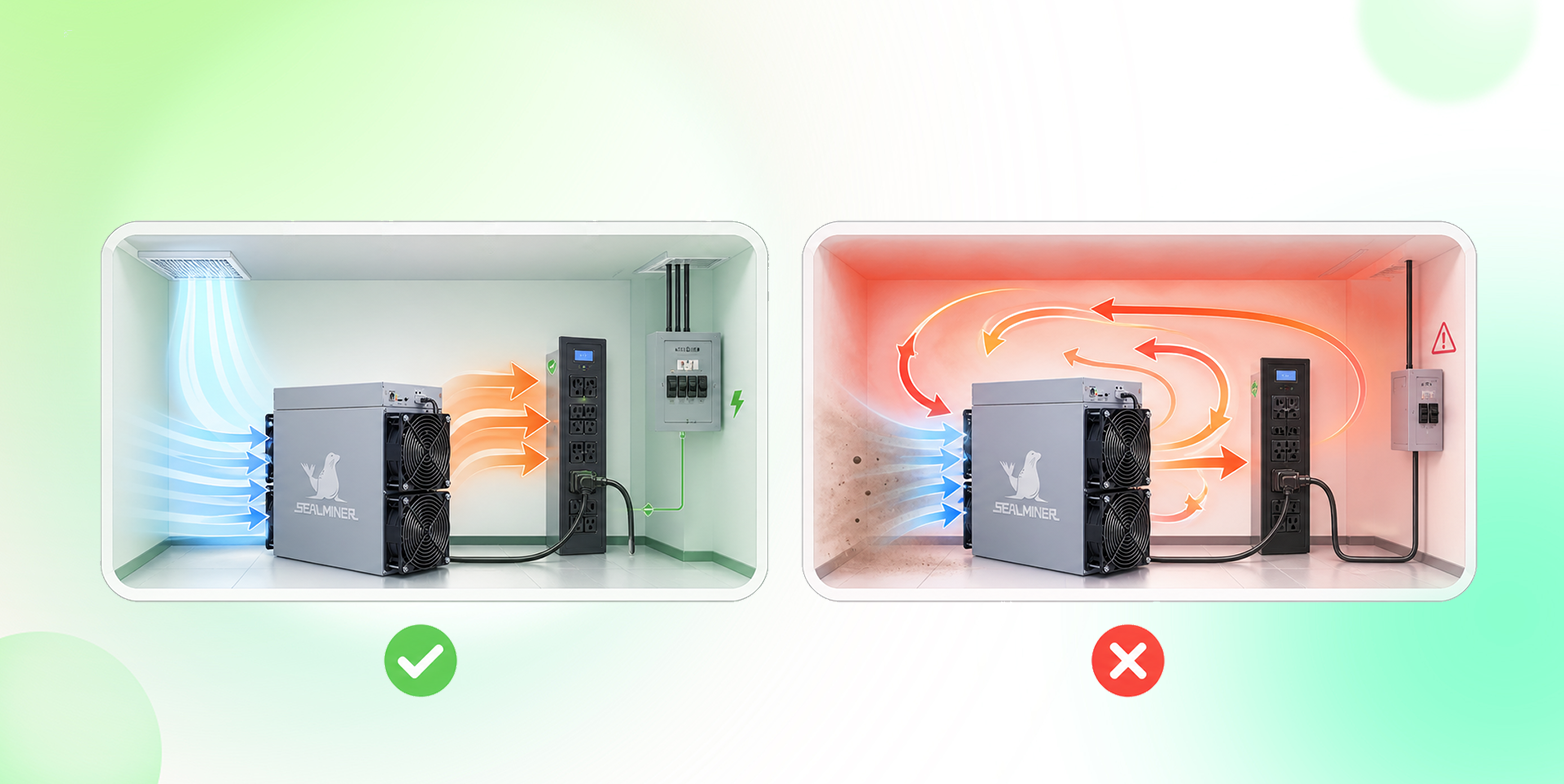
Heat rejection is just as important. A 3.725 kW input load releases approximately 12,710 BTU/h into the surrounding space. Effective airflow should deliver cool air to the miner, move hot exhaust out of the room through a short path, and prevent recirculation back to the intake side. When make-up air is insufficient, adding exhaust fans alone may fail to lower temperatures and can instead create negative pressure, draw in dust, and reduce actual airflow. At smaller sites, electricity cost, noise, and ROI should be evaluated as one deployment decision.
| Airflow Stage | Healthy Condition | Warning Signs |
| Intake Air | Stable inlet temperature, unobstructed miner fronts, and clean filters | Rising intake temperature, declining airflow, or rapid filter loading |
| Exhaust | Hot air follows a short path out and stays isolated from the intake zone | Exhaust recirculates to the intake side, and miner temperature rises with runtime |
| Make-Up Air and Pressure Balance | Make-up airflow matches exhaust volume, and room pressure differential remains controlled | Strong inward airflow at door gaps, dust infiltration, or higher temperatures after exhaust capacity is increased |
Use a 24-Hour Commissioning Test, Not Just a Power-On Check
A successful boot only confirms initial power and network connectivity. A valid commissioning test should capture day-night temperature changes, network variability, and variations in pool reporting. Keep the first run close to factory settings so Normal Mode becomes a repeatable baseline.
During the first 24 hours, compare local hashrate with pool-reported hashrate, watch the rejected-share rate, and track how temperature and fan speed respond to the environment. Also record disconnects, error codes, and automatic restarts. If pool-side hashrate remains materially below the local reading, the likely causes are network latency, pool connectivity, or invalid and stale shares rather than the ASIC chips themselves.
After the initial 24-hour test, continue monitoring for a full week. Meter readings, pool payouts, cleaning frequency, and environmental changes will gradually reveal costs that the initial model may have missed. Only when daily energy use, uptime, and actual payouts remain close to expectations should the unit move into a 30-day profitability assessment.
| Observation Window | Key Metrics | Criteria to Proceed |
| First 24 Hours | Local and pool-reported hashrate, reject rate, temperature, fan behavior, error codes, and restarts | Hashrate variance stays within the expected range, with no persistent errors, disconnects, or automatic restarts |
| Continuous 7 Days | Metered energy use, uptime, pool payouts, ambient temperature, and cleaning frequency | Energy use and payouts track the model, with no structural deterioration in operating conditions |
| Rolling 30 Days | Average net cash flow, downtime, maintenance expense, and stress scenarios | The downside case remains manageable before expansion is considered |
Build ROI from Rolling Operating Data, Not One-Day Revenue
Net cash flow from Litecoin mining can be summarized as the realized value of LTC and DOGE payouts, plus any transaction-fee revenue, less electricity, pool fees, maintenance expense, and downtime losses. The payback period is total capital outlay divided by average daily net cash flow. The formulas are straightforward; the harder part is making sure every input comes from the actual operating site.
| ROI Core Calculations Daily net cash flow = realized value of LTC and DOGE payouts + transaction-fee revenue - electricity - pool fees - maintenance expense - downtime losses Payback period (days) = total capital outlay / average daily net cash flow If average daily net cash flow is zero or negative, payback is undefined. Adjust the electricity rate, operating mode, or hardware configuration first. |
Total capital outlay includes more than the miner purchase price. Freight, tariffs, electrical work, PDUs, racks, ventilation upgrades, cleaning supplies, and repair logistics should all be included in the model. Electricity should be calculated using the all-in rate on the utility bill, including time-of-use pricing, demand charges, and fixed service fees where applicable. On the revenue side, build at least three scenarios: a base case, a downside case with lower coin prices or higher network difficulty, and a case that includes periodic downtime. If the deployment is profitable only under optimistic assumptions, expansion can quickly amplify cash-flow pressure.
Mining and Buying Coins Create Different Cash-Flow Profiles
Buying Litecoin directly provides immediate market exposure and relatively high liquidity. Operating a miner accumulates LTC and DOGE over time, while exposing the operator to recurring electricity costs, hardware depreciation, and execution risk. Direct ownership is exposed mainly to price volatility; mining also requires management of energy, equipment, uptime, and on-site operations.
To compare mining with buying, use the same time horizon and cash-flow basis. A low all-in site electricity rate, reliable infrastructure, and continuous monitoring strengthen the mining case. Where power is expensive, space is constrained, or maintenance capability is limited, direct asset ownership is usually simpler. Neither path is inherently superior; the better choice is the one whose risk profile fits the capital plan.
Let Operating Data Trigger Expansion
Before adding more units, confirm that the existing miners have established a repeatable operating baseline: the electrical system still has safety headroom, hot air leaves the space effectively, pool-accepted hashrate remains close to target, payouts reach the correct wallet, and the rolling 30-day net cash flow stays positive under a conservative scenario. If any of these checks fails, additional miners will scale the existing problem along with the hashrate.
Experienced operators do not rely on fixed return forecasts. They continuously record metered energy use, actual pool payouts, and uptime, then adjust operating modes, maintenance intervals, and expansion timing. For Scrypt mining in 2026, repeatable operating performance is more useful than a single day of unusually high revenue.
Note: Coin prices, network difficulty, pool performance, electricity rates, and operating conditions change over time. The figures in this article are intended for planning and comparison only and do not guarantee returns.
If you are evaluating a Scrypt mining setup, start with the SEALMINER DL1 Air’s hashrate, efficiency, and operating modes. Then use your own all-in electricity rate, cooling conditions, pool performance, and measured operating data to estimate site-level costs and payback expectations. The final decision should still be based on your all-in electricity rate, mining pool performance, and measured operating data.
*Information provided in this article is for general information and reference only and does not constitute nor is intended to be construed as any advertisement, professional advice, offer, solicitation, or recommendation to deal in any product. No guarantee, representation, warranty or undertaking, express or implied, is made as to the fairness, accuracy, timeliness, completeness or correctness of any information, or the future returns, performance or outcome of any product. Bitdeer expressly excludes any and all liability (to the extent permitted by applicable law) in respect of the information provided in this article, and in no event shall Bitdeer be liable to any person for any losses incurred or damages suffered as a result of any reliance on any information in this article.


